Espinach Francesc X, Espinosa Eduardo, Reixach Rafel, Rodríguez Alejandro, Mutjé Pere, Tarrés Quim
Design, Development and Product Innovation, Dept. of Organization, Business, University of Girona, 17003 Girona, Spain.
Chemical Engineering Department, Bioagres Group, Faculty of Science, Universidad de Córdoba, Campus of Rabanales, 14014 Córdoba, Spain.
Polymers (Basel). 2020 Sep 25;12(10):2206. doi: 10.3390/polym12102206.
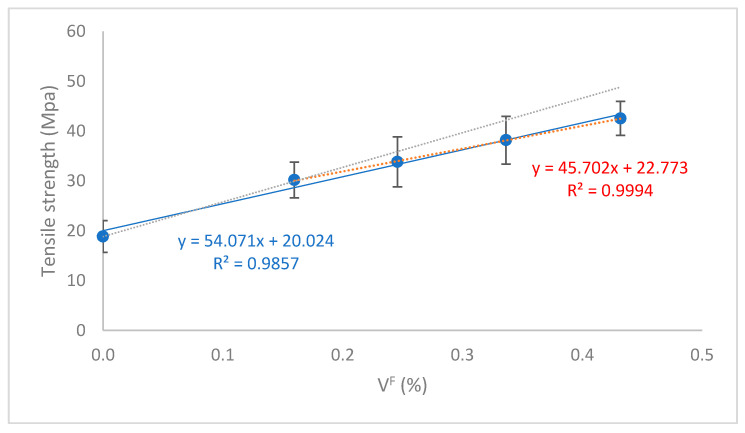
Agroforestry creates value but also a huge amount of waste outside its value chain. Tree pruning is an example of such a low value waste, that is typically discarded or incinerated in the fields or used to recover energy. Nonetheless, tree prunings are rich in wood fibers that can be used as polymer reinforcement. Although there are some bio-based polymers, the majority of industries use oil-based ones. The election of the materials is usually based on a ratio between properties and cost. Bio-based polymers are more expensive than oil-based ones. This work shows how a bio-polyethylene matrix can be reinforced with fibers from orange tree prunings to obtain materials with notable tensile properties. These bio-based materials can show a balanced cost due to the use of a cheap reinforcement with an expensive matrix. The matrix used showed a tensile strength of 18.65 MPa, which reached 42.54 MPa after the addition of 50 wt.% of reinforcement. The obtained values allow the use of the studied composite to replace polypropylene and some of its composites under tensile loads.
农林业创造了价值,但在其价值链之外也产生了大量废物。树木修剪就是这种低价值废物的一个例子,通常被丢弃或在田间焚烧,或用于回收能源。尽管如此,树木修剪物富含可作为聚合物增强材料的木纤维。虽然有一些生物基聚合物,但大多数行业使用的是石油基聚合物。材料的选择通常基于性能与成本的比率。生物基聚合物比石油基聚合物更昂贵。这项工作展示了如何用橙子树修剪物中的纤维增强生物聚乙烯基体,以获得具有显著拉伸性能的材料。由于使用了廉价的增强材料和昂贵的基体,这些生物基材料可以显示出平衡的成本。所使用的基体的拉伸强度为18.65兆帕,在添加50重量%的增强材料后达到42.54兆帕。所获得的值使得所研究的复合材料能够在拉伸载荷下替代聚丙烯及其一些复合材料。