Department of Anesthesiology and Critical Care, Perelman School of Medicine, University of Pennsylvania, 305 John Morgan Building, 3610 Hamilton Walk, Philadelphia, PA, 19104, USA.
Department of Anesthesiology, West China Hospital of Sichuan University, Chengdu, Sichuan, China.
BMC Anesthesiol. 2020 Sep 29;20(1):253. doi: 10.1186/s12871-020-01139-y.
Some retrospective and in vitro studies suggest that general anesthetics influence breast cancer recurrence and metastasis. We compared the effects of general anesthetics sevoflurane versus propofol on breast cancer cell survival, proliferation and invasion in vitro. The investigation focused on effects in intracellular Ca homeostasis as a mechanism for general anesthetic-mediated effects on breast cancer cell survival and metastasis.
Estrogen receptor-positive (MCF7) and estrogen receptor-negative (MDA-MB-436) human breast cancer cell lines along with normal breast tissue (MCF10A) were used. Cells were exposed to sevoflurane or propofol at clinically relevant and extreme doses and durations for dose- and time-dependence studies. Cell survival, proliferation and migration following anesthetic exposure were assessed. Intracellular and extracellular Ca concentrations were modulated using Ca chelation and a TRPV1 Ca channel antagonist to examine the role of Ca in mediating anesthetic effects.
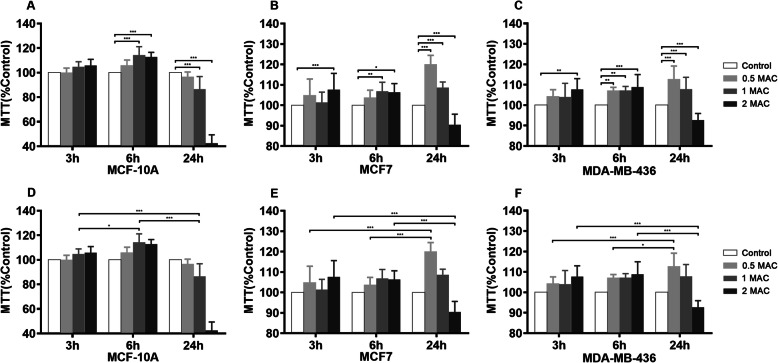
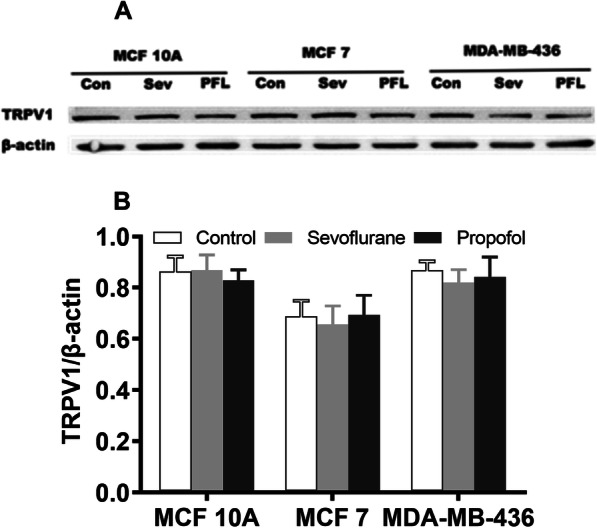
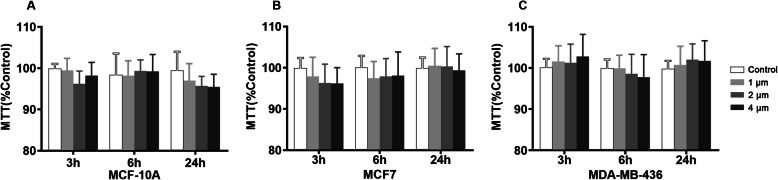
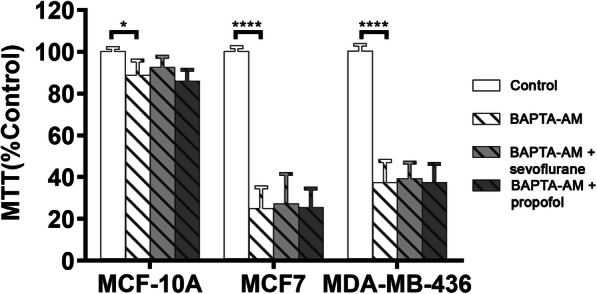
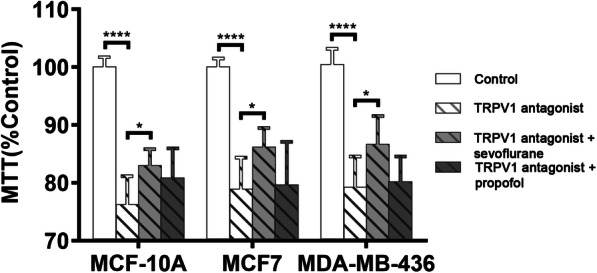
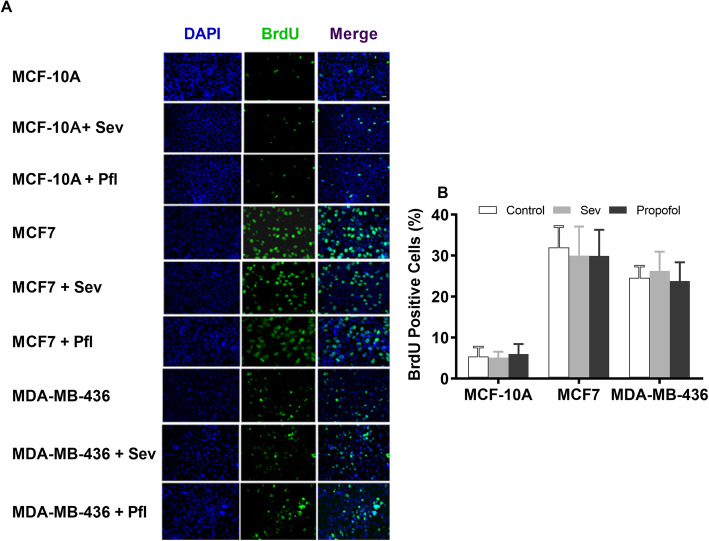
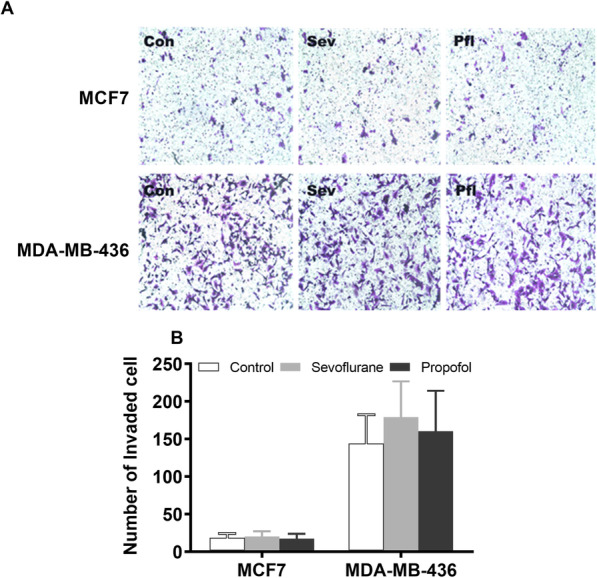
Sevoflurane affected breast cancer cell survival in dose-, time- and cell type-dependent manners. Sevoflurane, but not propofol, at equipotent and clinically relevant doses (2% vs. 2 μM) for 6 h significantly promoted breast cell survival in all three types of cells. Paradoxically, extreme exposure to sevoflurane (4%, 24 h) decreased survival in all three cell lines. Chelation of cytosolic Ca dramatically decreased cell survival in both breast cancer lines but not control cells. Inhibition of TRPV1 receptors significantly reduced cell survival in all cell types, an effect that was partially reversed by equipotent sevoflurane but not propofol. Six-hour exposure to sevoflurane or propofol did not affect cell proliferation, metastasis or TRPV1 protein expression in any type of cell.
Sevoflurane, but not propofol, at clinically relevant concentrations and durations, increased survival of breast cancer cells in vitro but had no effect on cell proliferation, migration or TRPV1 expression. Breast cancer cells require higher cytoplasmic Ca levels for survival than normal breast tissue. Sevoflurane affects breast cancer cell survival via modulation of intracellular Ca homeostasis.
一些回顾性和体外研究表明全身麻醉会影响乳腺癌的复发和转移。我们比较了全身麻醉药七氟醚和丙泊酚对体外乳腺癌细胞存活、增殖和侵袭的影响。研究重点是细胞内钙稳态作为全身麻醉对乳腺癌细胞存活和转移影响的机制。
使用雌激素受体阳性(MCF7)和雌激素受体阴性(MDA-MB-436)人乳腺癌细胞系以及正常乳腺组织(MCF10A)。细胞用七氟醚或丙泊酚以临床相关的和极端的剂量和时间进行暴露,并进行剂量和时间依赖性研究。评估麻醉暴露后细胞的存活、增殖和迁移。使用钙螯合剂和 TRPV1 钙通道拮抗剂调节细胞内和细胞外钙浓度,以研究钙在介导麻醉作用中的作用。
七氟醚以剂量、时间和细胞类型依赖的方式影响乳腺癌细胞的存活。七氟醚而非丙泊酚以等效和临床相关的剂量(2%对 2μM)作用 6 小时,显著促进了所有三种细胞类型的乳腺癌细胞存活。矛盾的是,极端暴露于七氟醚(4%,24 小时)降低了所有三种细胞系的存活率。细胞浆钙螯合显著降低了两种乳腺癌细胞系的细胞存活率,但对对照细胞没有影响。TRPV1 受体抑制剂显著降低了所有细胞类型的细胞存活率,这种作用部分被等效的七氟醚而非丙泊酚逆转。6 小时暴露于七氟醚或丙泊酚对任何类型的细胞均未影响细胞增殖、转移或 TRPV1 蛋白表达。
七氟醚而非丙泊酚在临床相关浓度和时间下增加了体外乳腺癌细胞的存活率,但对细胞增殖、迁移或 TRPV1 表达没有影响。乳腺癌细胞比正常乳腺组织需要更高的细胞质钙水平才能存活。七氟醚通过调节细胞内钙稳态影响乳腺癌细胞的存活。