ToNIC, Toulouse NeuroImaging Center, Université de Toulouse, Inserm, UPS, Toulouse, France.
Department of Physical and Rehabilitation Medicine, University Hospital of Toulouse, Toulouse, France.
J Neuroeng Rehabil. 2020 Sep 29;17(1):130. doi: 10.1186/s12984-020-00759-2.
After stroke, kinematic measures obtained with non-robotic and robotic devices are highly recommended to precisely quantify the sensorimotor impairments of the upper-extremity and select the most relevant therapeutic strategies. Although the ArmeoSpring exoskeleton has demonstrated its effectiveness in stroke motor rehabilitation, its interest as an assessment tool has not been sufficiently documented. The aim of this study was to investigate the psychometric properties of selected kinematic parameters obtained with the ArmeoSpring in post-stroke patients.
This study involved 30 post-stroke patients (mean age = 54.5 ± 16.4 years; time post-stroke = 14.7 ± 26.7 weeks; Upper-Extremity Fugl-Meyer Score (UE-FMS) = 40.7 ± 14.5/66) who participated in 3 assessment sessions, each consisting of 10 repetitions of the 'horizontal catch' exercise. Five kinematic parameters (task and movement time, hand path ratio, peak velocity, number of peak velocity) and a global Score were computed from raw ArmeoSpring' data. Learning effect and retention were analyzed using a 2-way repeated-measures ANOVA, and reliability was investigated using the intra-class correlation coefficient (ICC) and minimal detectable change (MDC).
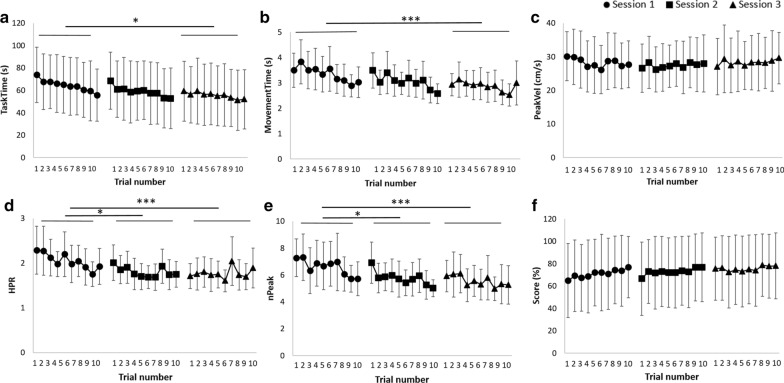
We observed significant inter- and intra-session learning effects for most parameters except peak velocity. The measures performed in sessions 2 and 3 were significantly different from those of session 1. No additional significant difference was observed after the first 6 trials of each session and successful retention was also highlighted for all the parameters. Relative reliability was moderate to excellent for all the parameters, and MDC values expressed in percentage ranged from 42.6 to 102.8%.
After a familiarization session, the ArmeoSpring can be used to reliably and sensitively assess motor impairment and intervention effects on motor learning processes after a stroke. Trial registration The study was approved by the local hospital ethics committee in September 2016 and was registered under number 05-0916.
在中风后,使用非机器人和机器人设备获得的运动学测量值可高度精确地量化上肢的感觉运动障碍,并选择最相关的治疗策略。尽管 ArmeoSpring 外骨骼已证明其在中风运动康复中的有效性,但作为评估工具的兴趣尚未得到充分证明。本研究的目的是调查中风患者使用 ArmeoSpring 获得的选定运动学参数的心理测量特性。
这项研究涉及 30 名中风后患者(平均年龄= 54.5 ± 16.4 岁;中风后时间= 14.7 ± 26.7 周;上肢 Fugl-Meyer 评分(UE-FMS)= 40.7 ± 14.5/66),他们参加了 3 次评估会议,每次会议包括 10 次“水平捕获”运动。从原始 ArmeoSpring'数据中计算了 5 个运动学参数(任务和运动时间、手路径比、峰值速度、峰值速度数)和一个整体分数。使用 2 因素重复测量方差分析分析学习效果和保留,使用组内相关系数(ICC)和最小可检测变化(MDC)研究可靠性。
除了峰值速度外,我们观察到大多数参数的组间和组内学习效果显著。第 2 次和第 3 次会议的测量值与第 1 次会议的测量值显著不同。在每个会议的前 6 次试验后,没有观察到其他显著差异,并且所有参数的保留也很成功。所有参数的相对可靠性为中等至优秀,以百分比表示的 MDC 值范围为 42.6%至 102.8%。
在熟悉阶段之后,ArmeoSpring 可用于可靠且敏感地评估中风后运动障碍和对运动学习过程的干预效果。
该研究于 2016 年 9 月获得当地医院伦理委员会的批准,并以编号 05-0916 进行了注册。