Department of gastroenterology, Shengjing Hospital of China Medical University, No. 36, Sanhao Street, Shenyang, 110004, China.
Endoscopy Unit, Paoli Calmettes Institute, 232 bd Ste Marguerite, 13009, Marseille, France.
Trials. 2020 Sep 29;21(1):817. doi: 10.1186/s13063-020-04758-5.
Endoscopic ultrasound-guided biliary drainage (EUS-BD) is used after failed endoscopic retrograde cholangiopancreatography. Based on existing studies, intrahepatic (IH) approaches are preferred in patients with dilated IH bile ducts. Both ultrasound-guided hepaticogastrostomy (EUS-HGS) and ultrasound-guided antegrade treatment (EUS-AG) are appropriate for patients with unreachable papillae. Nevertheless, there have been no direct comparisons between these two approaches. Therefore, we aim to evaluate and compare the safety and efficiency of EUS-HGS and EUS-AG in patients with an unreachable papilla.
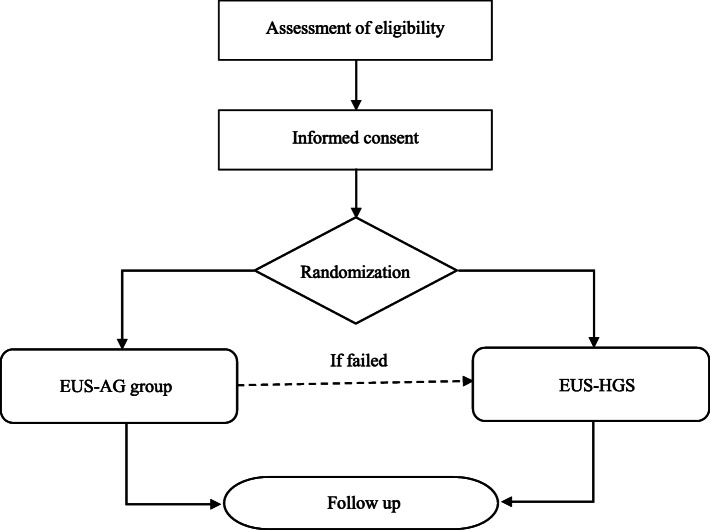
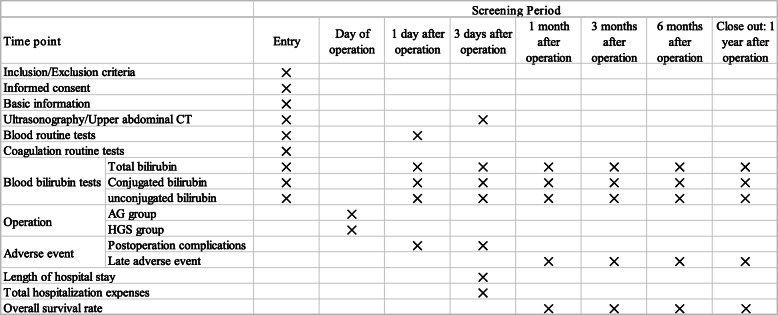
This is a prospective, randomised, controlled, multicentre study with two parallel groups without masking. One hundred forty-eight patients from three hospitals who met the inclusion criteria will be randomly assigned (1:1) to undergo either EUS-HGS or EUS-AG for relief of malignant biliary obstruction. The final study follow-up is scheduled at 1 year postoperatively. The primary endpoint is efficiency, described by technical and clinical success rates of EUS-HGS and EUS-AG in patients with unreachable papillae. The secondary endpoints include stent patency, overall survival rates, complication rates, length of hospital stays, and hospitalisation expenses. The chi-square test, Kaplan-Meier methods, log-rank test, and Cox regression analysis will be used to analyse the data.
To our knowledge, this is the first study to compare these two EUS-BD approaches directly using a multicentre, randomised, controlled trial design. The clinical economic indexes will also be compared, as they may also affect the patient's choice. The result may contribute to establishing a strategic guideline for choosing IH EUS-BD approaches.
Chinese Clinical Trial Registry (ChiCTR) ChiCTR1900020737 . Registered on 15 January 2019.
内镜超声引导下胆道引流术(EUS-BD)用于内镜逆行胰胆管造影术(ERCP)失败后。基于现有研究,对于肝内(IH)胆管扩张的患者,首选 IH 入路。超声引导下经肝胃吻合术(EUS-HGS)和超声引导下顺行治疗(EUS-AG)均适用于无法触及乳头的患者。然而,这两种方法之间尚未进行直接比较。因此,我们旨在评估和比较无法触及乳头的患者中 EUS-HGS 和 EUS-AG 的安全性和有效性。
这是一项前瞻性、随机、对照、多中心研究,分为两个平行组,无设盲。将来自三家医院的符合纳入标准的 148 例患者(1:1)随机分配接受 EUS-HGS 或 EUS-AG 治疗恶性胆道梗阻。最终研究随访计划在术后 1 年进行。主要终点是效率,描述无法触及乳头的患者中 EUS-HGS 和 EUS-AG 的技术和临床成功率。次要终点包括支架通畅率、总生存率、并发症发生率、住院时间和住院费用。将使用卡方检验、Kaplan-Meier 方法、对数秩检验和 Cox 回归分析来分析数据。
据我们所知,这是第一项使用多中心、随机、对照试验设计直接比较这两种 EUS-BD 方法的研究。还将比较临床经济学指标,因为它们也可能影响患者的选择。结果可能有助于制定选择 IH EUS-BD 方法的战略指南。
中国临床试验注册中心(ChiCTR) ChiCTR1900020737 。注册于 2019 年 1 月 15 日。