LaHaise Kristen, Mandell Daniel, Golenbock Samuel, Hopkins Kassandra, Mattingly David
Department of Research, New England Baptist Hospital, Boston, MA, USA.
Department of Orthopedic Surgery, New England Baptist Hospital, Boston, MA, USA.
Arthroplast Today. 2020 May 29;6(3):596-600.e1. doi: 10.1016/j.artd.2020.02.010. eCollection 2020 Sep.
It is unclear whether a connection exists between femoral head size, offset, neck length, and cup abduction angles, and rate of revision in metal-on-metal (MoM) total hip arthroplasty (THA) implant systems.
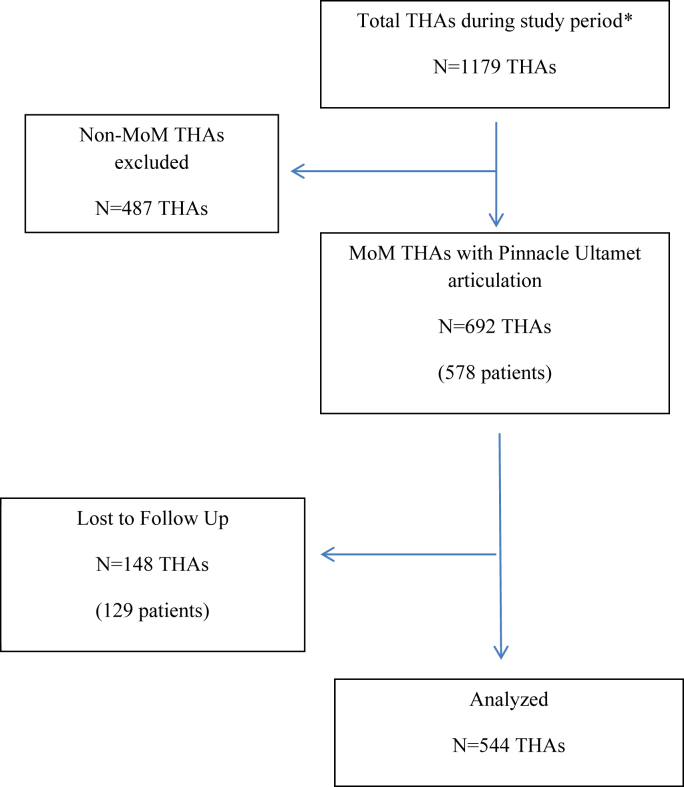
A retrospective review of MoM THA completed by a single surgeon with a single implant between 2003 and 2008 was conducted. Patient demographics, implant data, radiographs, and revision details were collected at follow-up. Incidence rates for revision and osteolysis were calculated in regard to the femoral head size, stem offset, neck length, and cup abduction angles.
Six hundred and ninety two THAs were identified, with 79% of patients returning for a median follow-up of 10.3 years (interquartile range = 6.0-12.3). The median time to revision was 7.5 years (interquartile range = 5.3-9.9) among 27 total revision surgeries. The overall incidence rate of revision was 5.4 revisions per 1000 person-years, 3.0 revisions per 1000 person-years for adverse local tissue reaction. Hips with a cup abduction angle of ≤40° had revisions at nearly twice the rate of those with an angle of 41°-50° (incidence rate ratio = 1.98, 95% confidence interval: 0.92, 4.29). Hips with a 9 mm neck length had an increased rate of revision (incidence rate ratio = 5.94, 95% confidence interval: 1.33, 26.55) relative to those with a neck length of 0 mm. Rates of osteolysis were similar between implants of different head sizes, neck lengths and cup abduction angles.
MoM implant systems with longer necks and smaller cup abduction angles may lead to increased need for revision. Results from this study suggest a need for closer long-term follow-up of MoM THA systems.
在金属对金属(MoM)全髋关节置换术(THA)植入系统中,股骨头大小、偏心距、颈长和髋臼外展角与翻修率之间是否存在关联尚不清楚。
对2003年至2008年间由一名外科医生使用单一植入物完成的MoM THA进行回顾性研究。在随访时收集患者人口统计学资料、植入物数据、X光片和翻修细节。计算了关于股骨头大小、柄偏心距、颈长和髋臼外展角的翻修率和骨溶解发生率。
共识别出692例THA,79%的患者返回进行了中位随访10.3年(四分位间距=6.0-12.3)。在27例全翻修手术中,翻修的中位时间为7.5年(四分位间距=5.3-9.9)。翻修的总体发生率为每1000人年5.4次翻修,不良局部组织反应的发生率为每1000人年3.0次翻修。髋臼外展角≤40°的髋关节翻修率几乎是外展角为41°-50°的髋关节的两倍(发生率比值=1.98,95%置信区间:0.92,4.29)。相对于颈长为0 mm的髋关节,颈长为9 mm的髋关节翻修率增加(发生率比值=5.94,95%置信区间:1.33,26.55)。不同股骨头大小、颈长和髋臼外展角的植入物之间骨溶解率相似。
颈长较长且髋臼外展角较小的MoM植入系统可能导致翻修需求增加。本研究结果表明需要对MoM THA系统进行更密切的长期随访。