Department of Radiology, University Hospital Basel, Petersgraben 4, 4031, Basel, Switzerland.
Eur Radiol. 2021 Apr;31(4):2115-2125. doi: 10.1007/s00330-020-07306-6. Epub 2020 Sep 30.
To investigate the most common errors in residents' preliminary reports, if structured reporting impacts error types and frequencies, and to identify possible implications for resident education and patient safety.
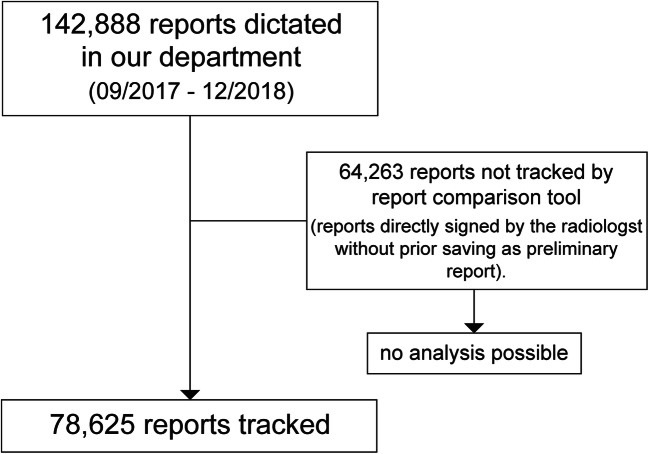
Changes in report content were tracked by a report comparison tool on a word level and extracted for 78,625 radiology reports dictated from September 2017 to December 2018 in our department. Following data aggregation according to word stems and stratification by subspecialty (e.g., neuroradiology) and imaging modality, frequencies of additions/deletions were analyzed for findings and impression report section separately and compared between subgroups.
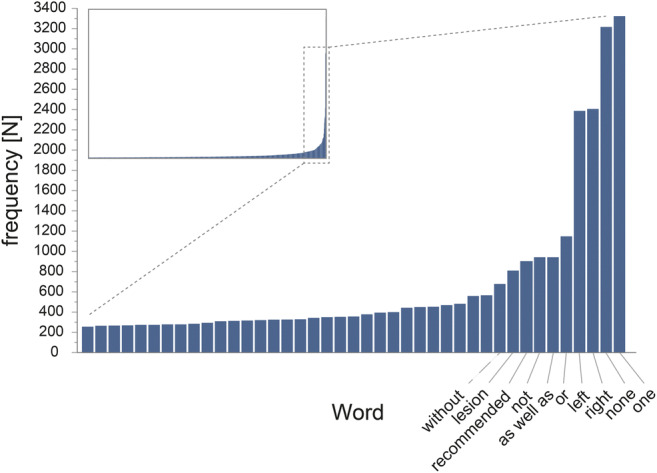
Overall modifications per report averaged 4.1 words, with demonstrably higher amounts of changes for cross-sectional imaging (CT: 6.4; MRI: 6.7) than non-cross-sectional imaging (radiographs: 0.2; ultrasound: 2.8). The four most frequently changed words (right, left, one, and none) remained almost similar among all subgroups (range: 0.072-0.117 per report; once every 9-14 reports). Albeit representing only 0.02% of analyzed words, they accounted for up to 9.7% of all observed changes. Subspecialties solely using structured reporting had substantially lower change ratios in the findings report section (mean: 0.2 per report) compared with prose-style reporting subspecialties (mean: 2.0). Relative frequencies of the most changed words remained unchanged.
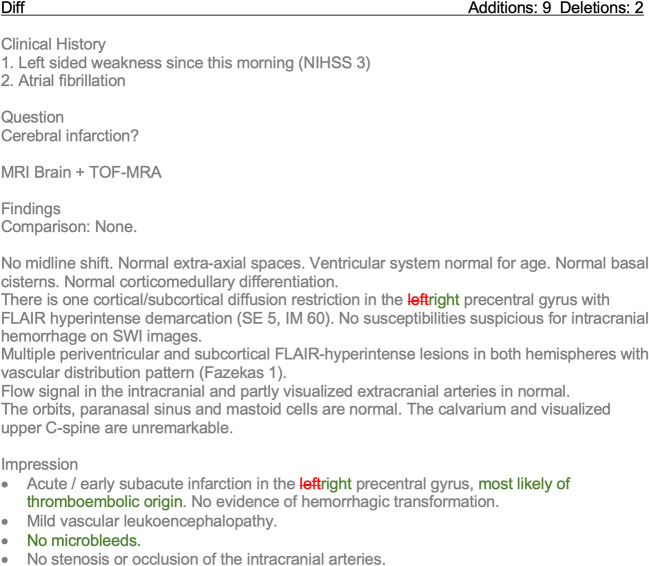
Residents' most common reporting errors in all subspecialties and modalities are laterality discriminator confusions (left/right) and unnoticed descriptor misregistration by speech recognition (one/none). Structured reporting reduces overall error rates, but does not affect occurrence of the most common errors. Increased error awareness and measures improving report correctness and ensuring patient safety are required.
• The two most common reporting errors in residents' preliminary reports are laterality discriminator confusions (left/right) and unnoticed descriptor misregistration by speech recognition (one/none). • Structured reporting reduces the overall the error frequency in the findings report section by a factor of 10 (structured reporting: mean 0.2 per report; prose-style reporting: 2.0) but does not affect the occurrence of the two major errors. • Staff radiologist review behavior noticeably differs between radiology subspecialties.
研究住院医师初步报告中最常见的错误,如果采用结构化报告是否会影响错误类型和频率,并确定对住院医师教育和患者安全的可能影响。
使用报告比较工具在单词级别上跟踪报告内容的变化,并提取我们科室 2017 年 9 月至 2018 年 12 月期间记录的 78625 份放射学报告。根据词干和亚专业(如神经放射学)和成像方式进行数据汇总后,分别分析发现和印象报告部分的添加/删除频率,并在亚组之间进行比较。
每份报告的平均修改量为 4.1 个单词,横断面成像(CT:6.4;MRI:6.7)的修改量明显高于非横断面成像(X 线片:0.2;超声:2.8)。四个最常更改的单词(右、左、一和无)在所有亚组中几乎相似(报告中每报告 0.072-0.117 次;每 9-14 次报告一次)。尽管它们仅占分析词汇的 0.02%,但它们占所有观察到的变化的 9.7%。仅使用结构化报告的专业在发现报告部分的更改比例明显较低(平均:0.2 次报告),而使用散文式报告专业的更改比例较高(平均:2.0)。最常更改的单词的相对频率保持不变。
所有专业和模式下住院医师最常见的报告错误是左右侧分辨器混淆(左/右)和语音识别未注意到描述符错位(一/无)。结构化报告降低了总体错误率,但不会影响最常见错误的发生。需要提高错误意识,并采取措施提高报告正确性并确保患者安全。
住院医师初步报告中最常见的两个报告错误是左右侧分辨器混淆(左/右)和语音识别未注意到描述符错位(一/无)。
结构化报告将发现报告部分的整体错误频率降低了 10 倍(结构化报告:平均 0.2 次报告;散文式报告:2.0),但不会影响两个主要错误的发生。
放射科专业人员的审查行为明显不同。