Sahr T, Kiltz U, Weseloh C, Kallinich T, Braun J
Rheumazentrum Ruhrgebiet, Herne, Ruhr-Universität Bochum, Claudiusstr. 45, 44649, Herne, Deutschland.
Deutsche Gesellschaft für Rheumatologie, Berlin, Deutschland.
Z Rheumatol. 2020 Nov;79(9):943-951. doi: 10.1007/s00393-020-00886-0. Epub 2020 Sep 30.
Familial Mediterranean fever (FMF) is a genetic disease of childhood and adulthood which is relatively rare in Germany. It is characterized by recurrent febrile attacks, peritonitis, pleuritis and arthritis. The established treatment with colchicine is effective and well-tolerated by most patients; however, some patients do not adequately respond or do not tolerate this treatment. Biologics can be considered for some of these patients. The Society for Pediatric and Adolescent Rheumatology (GKJR) and the German Society for Rheumatology (DGRh) have agreed to develop joint recommendations for this specific clinical situation.
Implementation of a systematic literature search (SLR) on the basis of the EULAR recommendations published in 2016 as the foundation for the development of evidence-based treatment recommendations for FMF patients with insufficient response or intolerance to colchicine.
The SLR was performed using references from various databases as an update of the SLR carried out by EULAR up to 2014, whereby all articles must have been published between 1 January 2015 and 31 December 2017. The Rayyan abstract tool for the preselection and the classification of the Oxford Centre for Evidence Based Medicine 2009 were used for the preparation of the evidence tables.
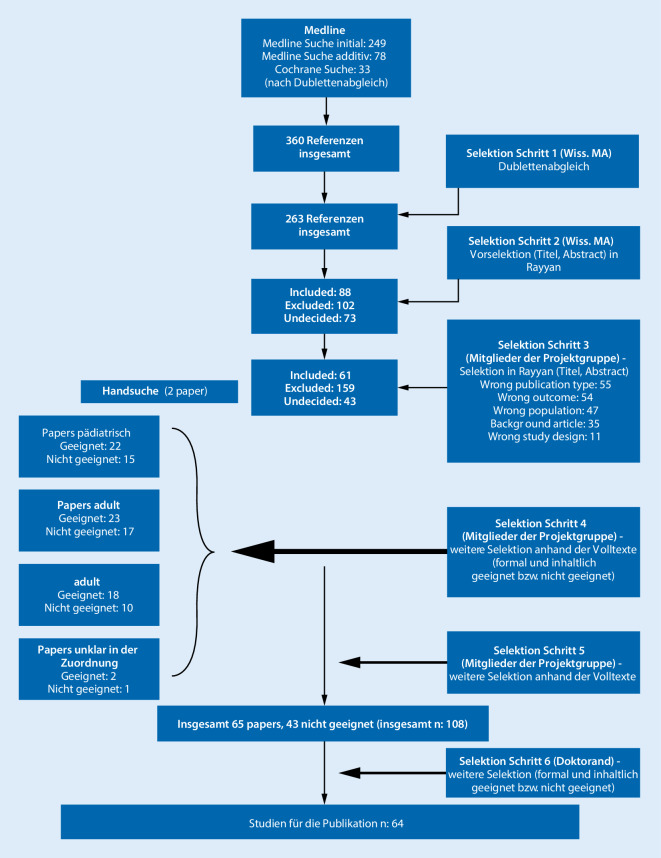
The search yielded 360 hits and after duplicate matching 263. A total of 88 publications were included (34%) and 102 excluded (39%), a review of the full publication was necessary for a further 73 (28%) and 43 were discussed more intensively. Finally, 64 publications (24%) remained. A total of 4 case-control studies, 31 cohort studies, 8 case series, 7 controlled studies (including 5 abstracts), 10 reviews, 4 meta-analyses and systematic reviews were accepted.
The SLR was carried out in a scientifically accurate and transparent manner according to international standards. The SLR proved to be a good basis for a consensus on the 5 overarching principles and the 10 recommendations, so that the joint activity of the GKJR and DGRh was successfully and even promptly concluded. The recommendations are a solid basis for treating patients of all ages with FMF. The explanations on the problem of colchicine resistance play an important role here.
家族性地中海热(FMF)是一种儿童和成人期的遗传性疾病,在德国相对罕见。其特征为反复发热发作、腹膜炎、胸膜炎和关节炎。秋水仙碱的既定治疗方法有效且大多数患者耐受性良好;然而,一些患者对此治疗反应不佳或不耐受。对于其中一些患者可考虑使用生物制剂。儿童和青少年风湿病学会(GKJR)和德国风湿病学会(DGRh)已同意针对这一特定临床情况制定联合建议。
基于2016年发表的欧洲抗风湿病联盟(EULAR)建议进行系统文献检索(SLR),作为为对秋水仙碱反应不足或不耐受的FMF患者制定循证治疗建议的基础。
SLR使用来自各种数据库的参考文献,作为EULAR截至2014年进行的SLR的更新,所有文章必须发表于2015年1月1日至2017年12月31日之间。使用Rayyan摘要工具进行预选,并采用牛津循证医学中心2009年的分类方法来编制证据表。
检索共获得360条结果,重复匹配后为263条。共纳入88篇出版物(34%),排除102篇(39%),另外73篇(28%)需要对全文进行审查,43篇进行了更深入的讨论。最后,剩下64篇出版物(24%)。共接受4项病例对照研究、31项队列研究、8个病例系列、7项对照研究(包括5篇摘要)、10篇综述、4项荟萃分析和系统评价。
SLR按照国际标准以科学准确和透明的方式进行。SLR被证明是就5项总体原则和10项建议达成共识的良好基础,因此GKJR和DGRh的联合活动得以成功甚至迅速完成。这些建议是治疗各年龄段FMF患者的坚实基础。关于秋水仙碱耐药问题的解释在此起着重要作用。