Jensen Christina, Sinkeviciute Dovile, Madsen Daniel Hargbøl, Önnerfjord Patrik, Hansen Morten, Schmidt Henrik, Karsdal Morten Asser, Svane Inge Marie, Willumsen Nicholas
Biomarkers & Research, Nordic Bioscience, 2730 Herlev, Denmark.
Biotech Research & Innovation Centre (BRIC), University of Copenhagen, 2200 Copenhagen, Denmark.
Cancers (Basel). 2020 Sep 28;12(10):2786. doi: 10.3390/cancers12102786.
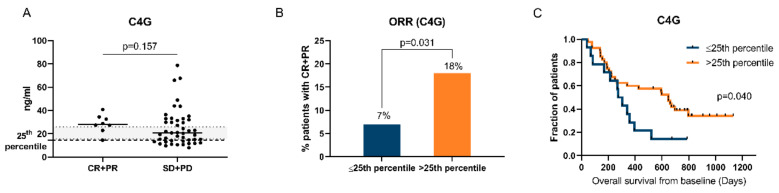
A T-cell permissive tumor microenvironment, characterized by the presence of activated T cells and low fibrotic activity is crucial for response to immune checkpoint inhibitors (ICIs). Granzyme B has been shown to promote T-cell migration through the basement membrane by the degradation of type IV collagen. In this study, we evaluated the biomarker potential of measuring granzyme B-mediated degradation of type IV collagen (C4G) in combination with a fibroblast activation biomarker (PRO-C3) non-invasively for identifying metastatic melanoma patients responding to the ICI ipilimumab. A monoclonal antibody was generated against C4G and used to develop a competitive electro-chemiluminescence immunoassay. C4G and PRO-C3 were measured in pretreatment serum from metastatic melanoma patients ( = 54). The C4G assay was found specific for a granzyme B-generated neo-epitope on type IV collagen. The objective response rate (ORR) was 2.6-fold higher (18% vs. 7%) in patients with high C4G levels (>25th percentile) vs. low levels (≤25th percentile). Likewise, high C4G levels at baseline were associated with longer overall survival (OS) (log-rank, = 0.040, and hazard ratio (HR) = 0.48, 95%CI: 0.24-0.98, = 0.045). Combining high C4G with low PRO-C3 correlated with improved OS with a median OS of 796 days vs. 273 days ( = 0.0003) and an HR of 0.30 (95%CI: 0.15-0.60, = 0.0006). In conclusion, these results suggest that high granzyme B degraded type IV collagen (C4G) combined with low PRO-C3 quantified non-invasively has the potential to identify the responders to ICI therapy.
以活化T细胞的存在和低纤维化活性为特征的T细胞允许性肿瘤微环境对于免疫检查点抑制剂(ICI)的反应至关重要。颗粒酶B已被证明可通过降解IV型胶原促进T细胞穿过基底膜迁移。在本研究中,我们评估了联合测量颗粒酶B介导的IV型胶原降解(C4G)和一种成纤维细胞活化生物标志物(PRO-C3)用于无创识别转移性黑色素瘤患者对ICI伊匹单抗反应的生物标志物潜力。制备了一种针对C4G的单克隆抗体,并用于开发竞争性电化学发光免疫测定法。在转移性黑色素瘤患者(n = 54)的治疗前血清中测量C4G和PRO-C3。发现C4G测定法对颗粒酶B在IV型胶原上产生的新表位具有特异性。C4G水平高(>第25百分位数)的患者与水平低(≤第25百分位数)的患者相比,客观缓解率(ORR)高2.6倍(18%对7%)。同样,基线时高C4G水平与更长的总生存期(OS)相关(对数秩检验,P = 0.040,危险比(HR)= 0.48,95%CI:0.24 - 0.98,P = 0.045)。高C4G与低PRO-C3相结合与改善的OS相关,中位OS为796天对273天(P = 0.0003),HR为0.30(95%CI:0.15 - 0.60,P = 0.0006)。总之,这些结果表明,联合无创定量的高颗粒酶B降解IV型胶原(C4G)和低PRO-C3有可能识别ICI治疗的反应者。