Biomarkers and Research, Nordic Bioscience A/S, Herlev Hovedgade 205-207, 2730, Herlev, Denmark.
Biotech Research & Innovation Centre (BRIC), University of Copenhagen, Ole Maaløes vej 5, 2200, Copenhagen N, Denmark.
J Exp Clin Cancer Res. 2019 Mar 6;38(1):115. doi: 10.1186/s13046-019-1110-6.
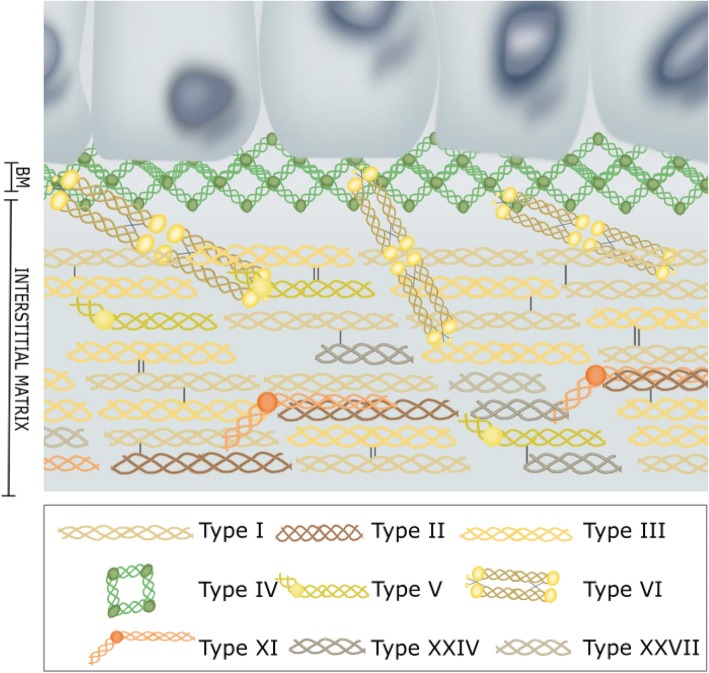
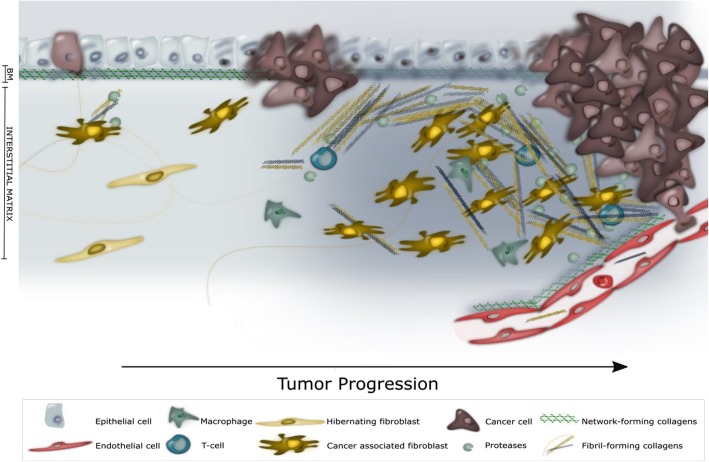
The extracellular matrix (ECM) plays an important role in cancer progression. It can be divided into the basement membrane (BM) that supports epithelial/endothelial cell behavior and the interstitial matrix (IM) that supports the underlying stromal compartment. The major components of the ECM are the collagens. While breaching of the BM and turnover of e.g. type IV collagen, is a well described part of tumorigenesis, less is known regarding the impact on tumorigenesis from the collagens residing in the stroma. Here we give an introduction and overview to the link between tumorigenesis and stromal collagens, with focus on the fibrillar collagens type I, II, III, V, XI, XXIV and XXVII as well as type VI collagen. Moreover, we discuss the impact of the cells responsible for this altered stromal collagen remodeling, the cancer associated fibroblasts (CAFs), and how these cells are key players in orchestrating the tumor microenvironment composition and tissue microarchitecture, hence also driving tumorigenesis and affecting response to treatment. Lastly, we discuss how specific collagen-derived biomarkers reflecting the turnover of stromal collagens and CAF activity may be used as tools to non-invasively interrogate stromal reactivity in the tumor microenvironment and predict response to treatment.
细胞外基质 (ECM) 在癌症进展中起着重要作用。它可以分为基底膜 (BM),支持上皮/内皮细胞行为,和间质基质 (IM),支持下面的基质区室。ECM 的主要成分是胶原。虽然 BM 的破裂和例如 IV 型胶原的转化是肿瘤发生的一个很好描述的部分,但对于基质中存在的胶原对肿瘤发生的影响知之甚少。在这里,我们介绍并概述了肿瘤发生与基质胶原之间的联系,重点介绍了纤维胶原 I、II、III、V、XI、XXIV 和 XXVII 以及 VI 型胶原。此外,我们还讨论了负责这种改变的基质胶原重塑的细胞,即癌症相关成纤维细胞 (CAF),以及这些细胞如何成为协调肿瘤微环境组成和组织微结构的关键参与者,从而也推动肿瘤发生和影响治疗反应。最后,我们讨论了如何使用特定的胶原衍生生物标志物来反映基质胶原和 CAF 活性的转化,作为工具来非侵入性地检测肿瘤微环境中的基质反应性,并预测对治疗的反应。