Theoretical Biology and Biophysics (T-6), Los Alamos National Laboratory, Los Alamos, New Mexico, United States of America.
Department of Mathematics and Center for Infectious Disease Dynamics, Pennsylvania State University, University Park, Pennsylvania, United States of America.
PLoS Comput Biol. 2020 Oct 1;16(10):e1008241. doi: 10.1371/journal.pcbi.1008241. eCollection 2020 Oct.
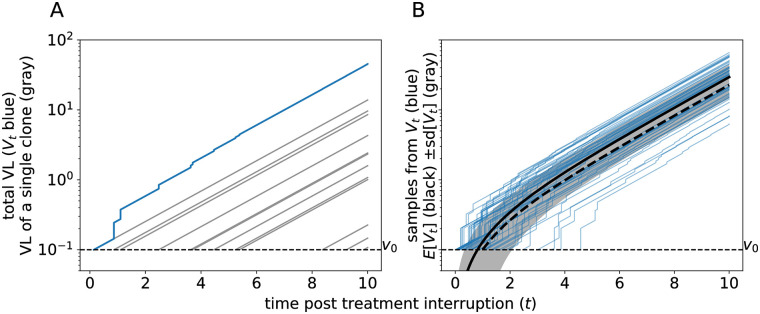
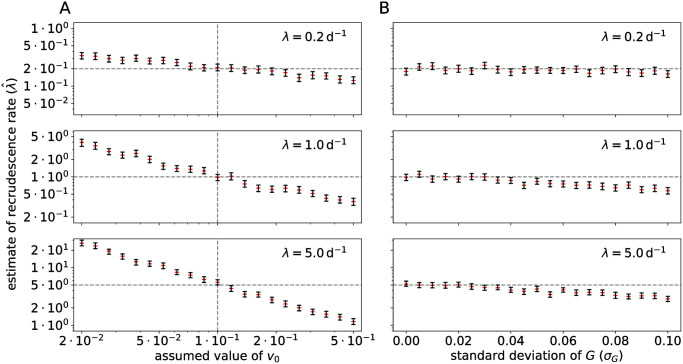
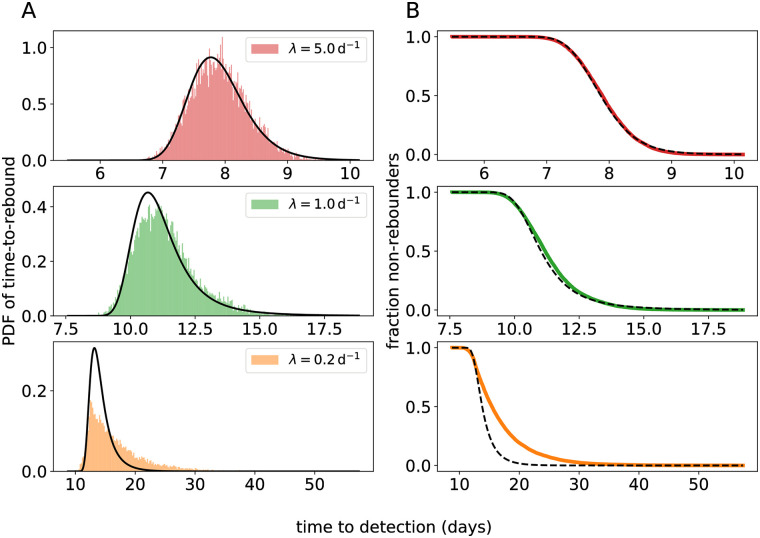
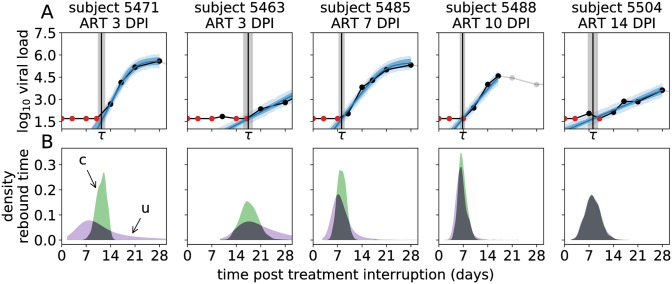
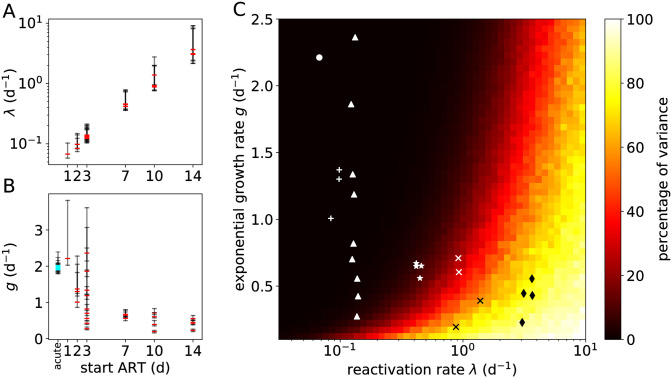
In order to assess the efficacy of novel HIV-1 treatments leading to a functional cure, the time to viral rebound is frequently used as a surrogate endpoint. The longer the time to viral rebound, the more efficacious the therapy. In support of such an approach, mathematical models serve as a connection between the size of the latent reservoir and the time to HIV-1 rebound after treatment interruption. The simplest of such models assumes that a single successful latent cell reactivation event leads to observable viremia after a period of exponential viral growth. Here we consider a generalization developed by Pinkevych et al. and Hill et al. of this simple model in which multiple reactivation events can occur, each contributing to the exponential growth of the viral load. We formalize and improve the previous derivation of the dynamics predicted by this model, and use the model to estimate relevant biological parameters from SIV rebound data. We confirm a previously described effect of very early antiretroviral therapy (ART) initiation on the rate of recrudescence and the viral load growth rate after treatment interruption. We find that every day ART initiation is delayed results in a 39% increase in the recrudescence rate (95% credible interval: [18%, 62%]), and a 11% decrease of the viral growth rate (95% credible interval: [4%, 20%]). We show that when viral rebound occurs early relative to the viral load doubling time, a model with multiple successful reactivation events fits the data better than a model with only a single successful reactivation event.
为了评估导致功能性治愈的新型 HIV-1 治疗方法的疗效,病毒反弹时间通常被用作替代终点。病毒反弹时间越长,治疗效果越好。支持这种方法的是,数学模型将潜伏储库的大小与治疗中断后 HIV-1 反弹的时间联系起来。最简单的模型假设单个成功的潜伏细胞再激活事件会导致在指数病毒生长后出现可观察到的病毒血症。在这里,我们考虑了 Pinkevych 等人和 Hill 等人对该简单模型的扩展,其中可以发生多个再激活事件,每个事件都有助于病毒载量的指数增长。我们形式化并改进了该模型预测动力学的先前推导,并使用该模型从 SIV 反弹数据估计相关的生物学参数。我们证实了先前描述的早期抗逆转录病毒治疗 (ART) 启动对治疗中断后复发率和病毒载量增长率的影响。我们发现,ART 启动每延迟一天,复发率就会增加 39%(95%可信区间:[18%,62%]),病毒增长率下降 11%(95%可信区间:[4%,20%])。我们表明,当病毒反弹相对于病毒载量倍增时间较早时,具有多个成功再激活事件的模型比只有单个成功再激活事件的模型更能拟合数据。