Clinic for Horses (Surgery, Orthopaedics), Faculty of Veterinary Medicine, Justus-Liebig-University, Giessen, Frankfurter str. 108, 35392, Giessen, Germany.
Clinic for Horses, University of Veterinary Medicine Hannover, Foundation, Hannover, Bünteweg 9, 30559, Hannover, Germany.
BMC Vet Res. 2020 Oct 1;16(1):370. doi: 10.1186/s12917-020-02571-5.
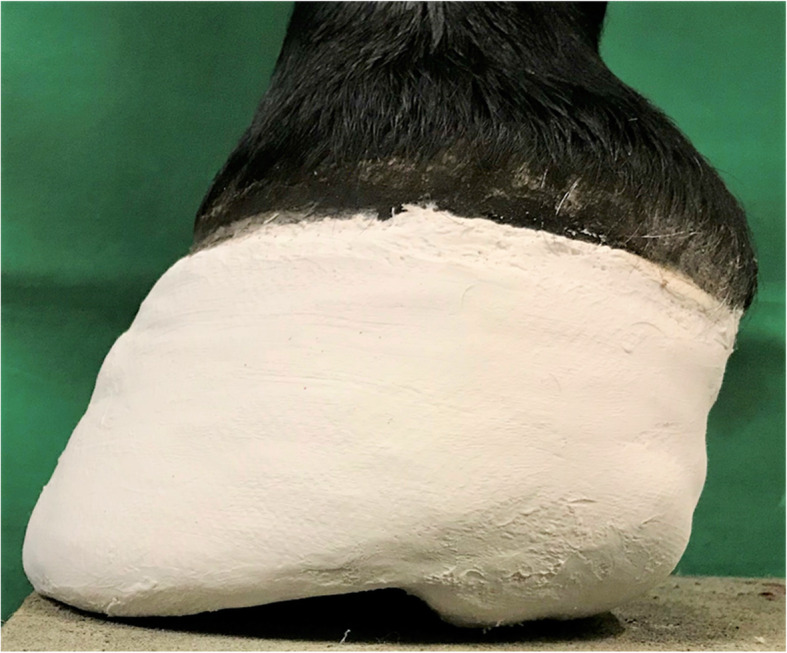
In a laminitic horse, the maximal loading of the toe region occurs during the breakover phase. To date, no kinetic data demonstrates the effect of supportive orthopaedic therapy in horses with laminitis on breakover phase. Thus, the purpose of this study was to examine the effect of heel elevation on the breakover phase. Eight horses with acute laminitis treated medically as well as with application of a hoof cast with heel wedge (HCHW) were included in this study. Immediately following cessation of clinical signs of acute laminitis, two measurements using the Hoof™ System were taken: the first with HCHW and the second immediately following removal of the HCHW, i.e. in barefoot condition (BFC). The hoof print was divided into three regions: toe, middle hoof, and heel. Kinetic parameters included vertical force (VF), stance duration, contact area (CA) for all hoof regions during stance phase, duration of breakover, VF in the toe region at onset of breakover and location of centre of force.
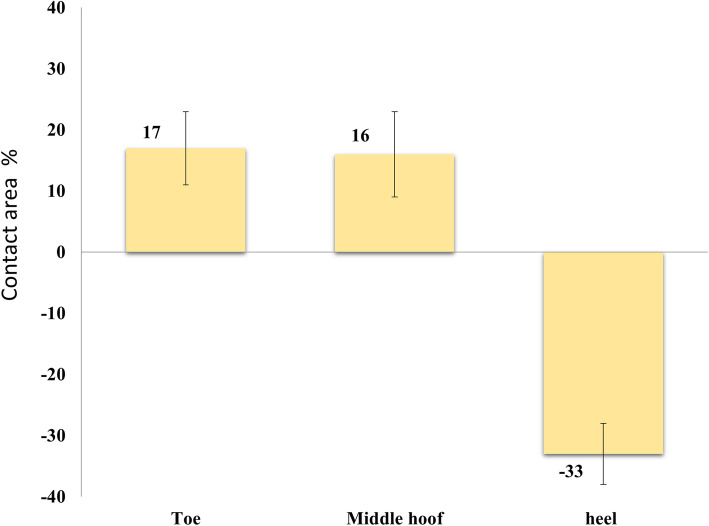
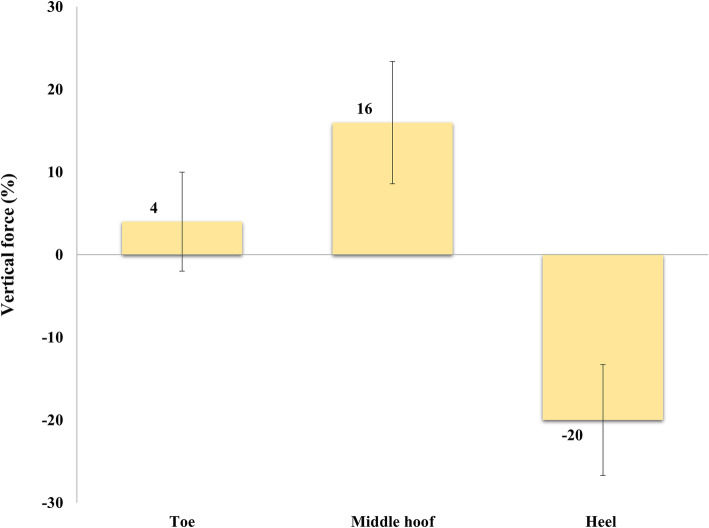
The VF and CA were higher in the heel region (63 and 61%, respectively) and decreased significantly after removal of the HCHW (43 and 28% after removal, respectively). The breakover phase in horses with HCHW lasted 2% of stance phase and was significantly shorter than that in BFC, which lasted 6% of stance phase. The VF at onset of breakover for the toe region in horses with HCHW was significantly lower than that in BFC. The centre of the force was located at the heel region in all horses with the HCHW, and at the middle the hoof region in BFC.
Heel elevation in horses with laminitis as examined on a concrete surface significantly shortens breakover phase and decreases the vertical force in the toe region during breakover. HCHW provides adequate support to the palmar hoof structures by increasing the contact area in the heel region and incorporating the palmar part of frog and sole into weight bearing, thus decreasing the stress on the lamellae. Hoof cast with heel elevation could be a beneficial orthopaedic supportive therapy for horses suffering from acute laminitis.
在马蹄变形的马中,脚趾区域的最大负荷发生在着地阶段。迄今为止,没有动力学数据证明支持性矫形疗法对马蹄变形马着地阶段的影响。因此,本研究的目的是研究鞋跟抬高对着地阶段的影响。本研究纳入了 8 匹患有急性蹄叶炎的马,这些马接受了医学治疗以及应用带有鞋跟楔形物的蹄铸型(HCHW)治疗。在急性蹄叶炎的临床症状停止后,立即使用 Hoof™ 系统进行了两次测量:第一次是在使用 HCHW 时进行的,第二次是在移除 HCHW 后,即赤脚状态(BFC)下进行的。蹄印被分为三个区域:脚趾、中间蹄和鞋跟。动力学参数包括垂直力(VF)、站立持续时间、所有蹄区域在站立阶段的接触面积(CA)、着地阶段、着地开始时脚趾区域的 VF 和力中心的位置。
在鞋跟区域(分别为 63%和 61%)的 VF 和 CA 更高,并且在移除 HCHW 后显著降低(分别为 43%和 28%)。HCHW 治疗的马的着地阶段持续站立阶段的 2%,明显短于 BFC 的 6%。HCHW 治疗的马在脚趾区域的着地开始时的 VF 明显低于 BFC。在所有使用 HCHW 的马中,力中心都位于鞋跟区域,而在 BFC 中,力中心都位于中间蹄区域。
在混凝土表面上检查患有蹄叶炎的马的鞋跟抬高显著缩短了着地阶段,并降低了着地阶段脚趾区域的垂直力。HCHW 通过增加鞋跟区域的接触面积并将掌部的青蛙和鞋底纳入承重,从而减轻了对蹄叶的压力,为掌部 hoof 结构提供了足够的支撑,因此是一种对患有急性蹄叶炎的马有益的矫形支持性治疗。