Aoun Rita, Takawira Catherine, Lopez Mandi J
Laboratory for Equine and Comparative Orthopedic Research, Department of Veterinary Clinical Sciences, School of Veterinary Medicine, Louisiana State University, Baton Rouge, Louisiana, USA.
Vet Surg. 2025 Jan;54(1):31-51. doi: 10.1111/vsu.14162. Epub 2024 Sep 15.
To provide an overview of available research about effects of horseshoes on equine kinetics and kinematics.
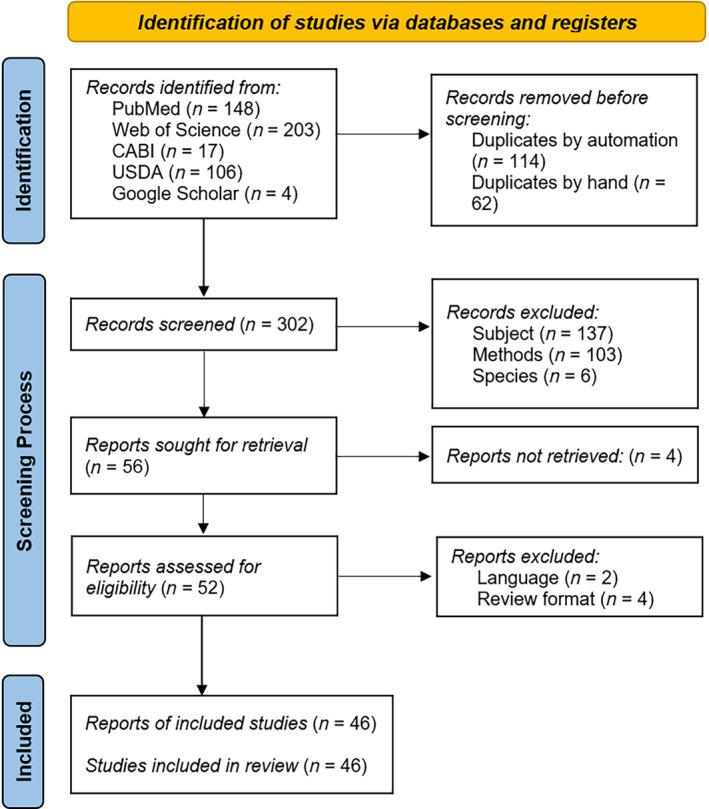
The terms, "horse/equine," "hoof," "shoes/horseshoes," "kinetics," and "kinematics" were searched in PubMed, Web of Science, Center for Agriculture and Bioscience International, and United States Department of Agriculture National Agricultural Library for manuscripts from first availability to 2024. Independent reviewers used preferred reporting items for systematic reviews and meta-analyses guidelines to map and extract evidence-based data from sources. Metrics included participant demographics, research methods, major findings, and study limitations. Knowledge gaps were also identified.
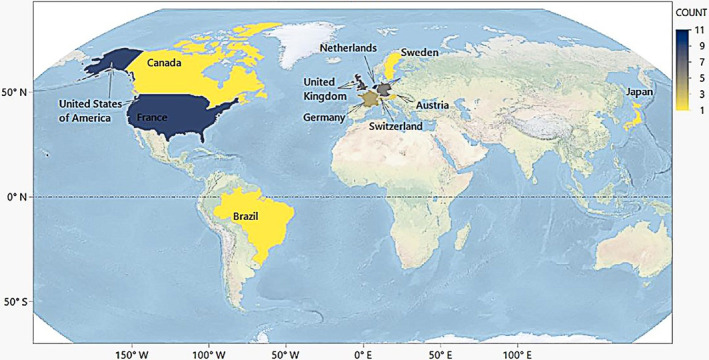
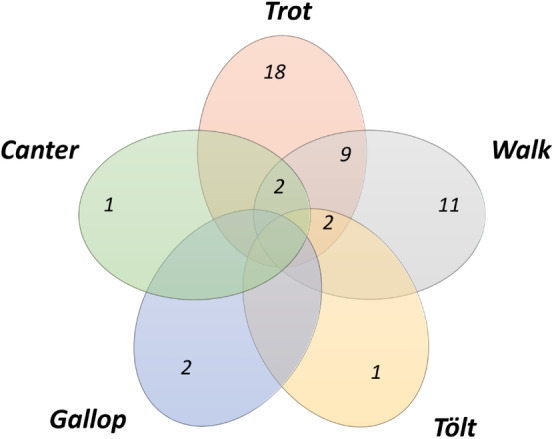
A total of 46 studies were included. Most utilized non-lame horses to compare original shoe designs or modifications to unshod or a standard open-heel shoe. Horse demographics and gait, study design and outcome measures varied widely. Prevalent data collection equipment included force platforms and pressure plates, wearable force measuring technology, and videography. Many studies reported shoeing effects on limb forces and motion, but there was little consensus among unrelated studies. Common limitations included insufficient data resolution, no randomization, small sample size, single breed, and outcome measures specific or unique to the study. Knowledge gaps included data collection from all limbs and the impact of conformation and limb and hoof morphology and health condition on outcomes.
Information from manuscripts that met inclusion criteria confirmed distinct, variable effects of shoe characteristics on equine gait parameters.
Details from published work can serve as resource for clinical decisions and to guide standardization among investigations on shoe configuration effects on equine motion.
概述关于马蹄铁对马动力学和运动学影响的现有研究。
在PubMed、科学网、国际农业与生物科学中心和美国农业部国家农业图书馆中搜索“马/马匹”“蹄”“蹄铁”“动力学”和“运动学”等术语,以查找从首次发表到2024年的手稿。独立评审人员使用系统评价和荟萃分析的首选报告项目指南,从来源中梳理和提取循证数据。指标包括参与者的人口统计学特征、研究方法、主要发现和研究局限性。还确定了知识空白。
共纳入46项研究。大多数研究使用无跛行的马匹,比较原始蹄铁设计或改良后的蹄铁与未装蹄铁或标准开放式后跟蹄铁。马匹的人口统计学特征和步态、研究设计和结局指标差异很大。普遍使用的数据收集设备包括测力平台和压力板、可穿戴测力技术和摄像技术。许多研究报告了装蹄对肢体力量和运动的影响,但无关研究之间几乎没有共识。常见的局限性包括数据分辨率不足、未随机分组、样本量小、单一品种以及特定于该研究的结局指标。知识空白包括从所有肢体收集数据,以及体型、肢体和蹄的形态及健康状况对结局的影响。
符合纳入标准的手稿中的信息证实了蹄铁特征对马步态参数有明显的、可变的影响。
已发表研究的详细信息可作为临床决策的资源,并指导关于蹄铁配置对马运动影响的研究之间的标准化。