
孕激素通过肝孕激素受体膜成分 1 在胰岛素作用有限或受损的情况下增加血糖。
Progesterone increases blood glucose via hepatic progesterone receptor membrane component 1 under limited or impaired action of insulin.
机构信息
College of Veterinary Medicine, Chungnam National University, 99 Daehak-ro, Suite 401Veterinary medicine Bldg., Yuseong, Daejeon, 34134, Republic of Korea.
Department of Convergence Medicine, Asan Medical Center, University of Ulsan College of Medicine, Seoul, 05505, Republic of Korea.
出版信息
Sci Rep. 2020 Oct 1;10(1):16316. doi: 10.1038/s41598-020-73330-7.
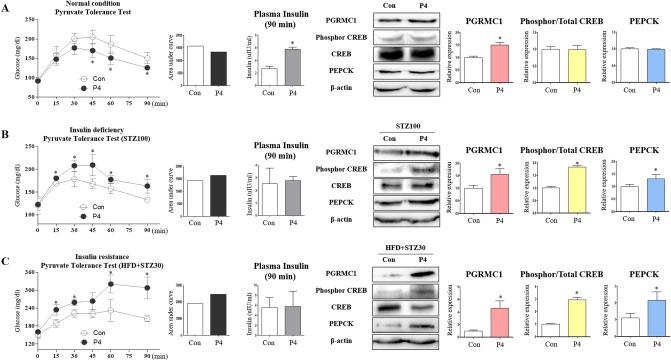
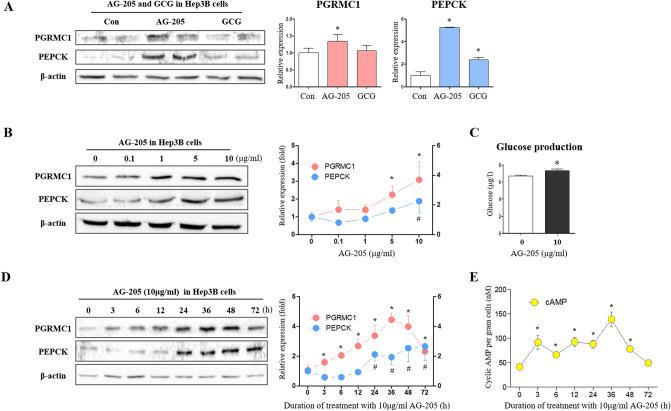
Hepatic gluconeogenesis is the main pathway for blood glucose maintenance activated during fasting. Retardation of insulin action, such as in diabetes mellitus, activates gluconeogenesis during the fed state. While the role of progesterone (P4) in diabetes is controversial, the P4 receptor, progesterone receptor membrane component 1 (PGRMC1), is known to stimulate pancreatic insulin secretion. We investigated the role of P4, via hepatic PGRMC1, during gluconeogenesis. The PGRMC1 binding chemical, AG-205, induced PGRMC1 monomer (25 kDa) abundance, and increased PEPCK expression and glucose production in parallel with cyclic AMP (cAMP) induction in Hep3B cells. PGRMC1-mediated cyclic AMP was inhibited by an adenylate cyclase inhibitor (MDL-12,330A). PEPCK suppression in Pgrmc1 KO hepatocyte was not observed after treatment of MDL-12,330A. PGRMC1 knockdown or overexpression systems in Hep3B cells confirmed that PGRMC1 mediates PEPCK expression via phosphorylation of cAMP-response element binding protein (CREB). CREB phosphorylation and PEPCK expression in primary hepatocytes were greater than that in PGRMC1 knock-out hepatocytes. Progesterone increased PGRMC1 expression, which induced cAMP and PEPCK induction and glucose production. In vivo, P4 suppressed gluconeogenesis following plasma insulin induction under normal conditions in a mouse model. However, P4 increased blood glucose via gluconeogenesis in parallel with increases in PGRMC1 and PEPCK expression in mice in both insulin-deficient and insulin-resistant conditions. We conclude that P4 increases hepatic glucose production via PGRMC1, which may exacerbate hyperglycaemia in diabetes where insulin action is limited.
肝糖异生是饥饿时维持血糖的主要途径,胰岛素作用的延迟,如在糖尿病中,会在进食状态下激活糖异生。虽然孕激素(P4)在糖尿病中的作用存在争议,但孕激素受体膜成分 1(PGRMC1)已知可刺激胰腺胰岛素分泌。我们研究了 P4 通过肝 PGRMC1 在糖异生中的作用。PGRMC1 结合化学物质 AG-205 诱导 PGRMC1 单体(25 kDa)的丰度增加,并与 Hep3B 细胞中环腺苷酸(cAMP)的诱导平行增加 PEPCK 的表达和葡萄糖的产生。PGRMC1 介导的 cAMP 被腺苷酸环化酶抑制剂(MDL-12,330A)抑制。在 MDL-12,330A 处理后,未观察到 Pgrmc1 KO 肝细胞中 PEPCK 的抑制。在 Hep3B 细胞中的 PGRMC1 敲低或过表达系统证实,PGRMC1 通过环磷酸腺苷反应元件结合蛋白(CREB)的磷酸化来介导 PEPCK 的表达。在原代肝细胞中,CREB 磷酸化和 PEPCK 的表达大于 PGRMC1 敲除肝细胞。孕激素增加 PGRMC1 的表达,这诱导了 cAMP 和 PEPCK 的诱导和葡萄糖的产生。在体内,在正常条件下,在胰岛素诱导后的血浆中,P4 抑制了糖异生,但在胰岛素缺乏和胰岛素抵抗的情况下,P4 通过增加 PGRMC1 和 PEPCK 的表达来增加血糖,导致血糖升高。我们的结论是,P4 通过 PGRMC1 增加肝葡萄糖生成,这可能会加剧胰岛素作用有限的糖尿病中的高血糖。


 Zotero 插件