Marchi Nina, Excoffier Laurent
CMPG Institute of Ecology and Evolution University of Berne Berne Switzerland.
Swiss Institute of Bioinformatics Lausanne Switzerland.
Evol Appl. 2020 Jun 2;13(9):2254-2263. doi: 10.1111/eva.12998. eCollection 2020 Oct.
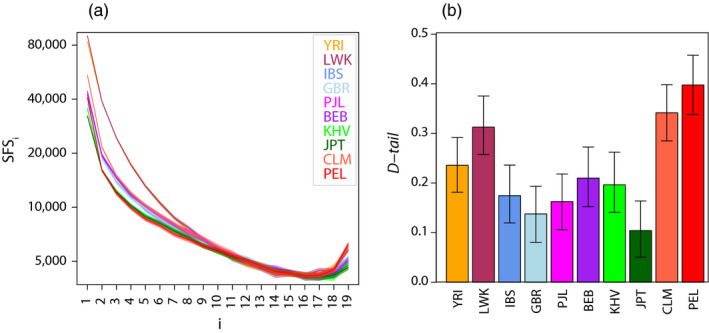
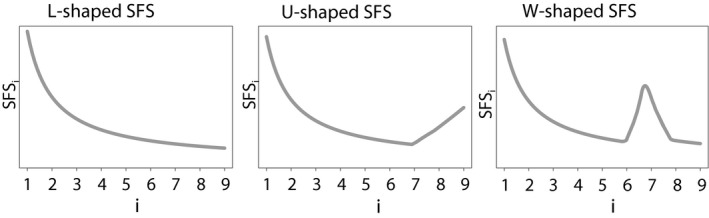
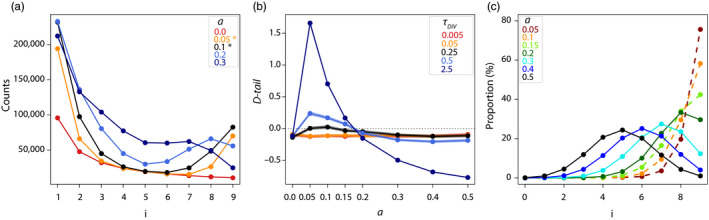
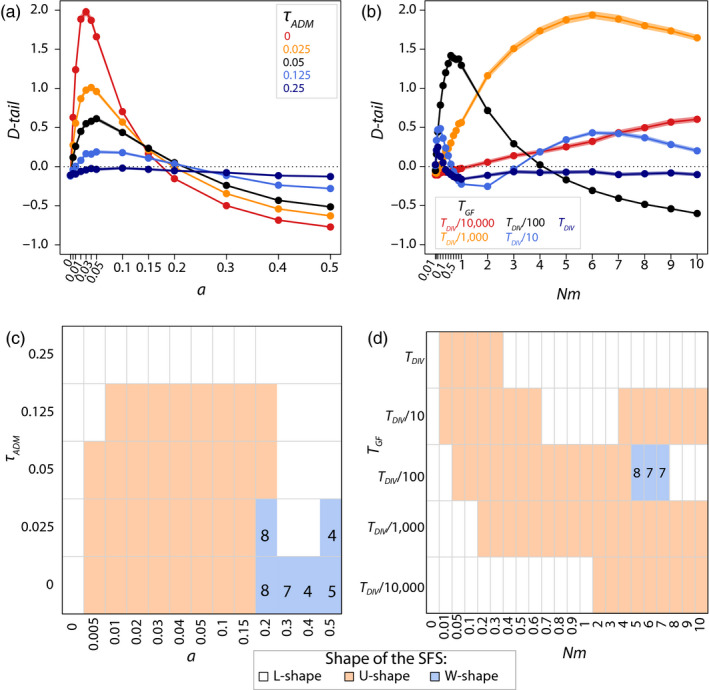
Most human populations exhibit an excess of high-frequency variants, leading to a U-shaped site-frequency spectrum (uSFS). This pattern has been generally interpreted as a signature of ongoing episodes of positive selection, or as evidence for a mis-assignment of ancestral/derived allelic states, but uSFS has also been observed in populations receiving gene flow from a ghost population, in structured populations, or after range expansions. In order to better explain the prevalence of high-frequency variants in humans and other populations, we describe here which patterns of gene flow and population demography can lead to uSFS by using extensive coalescent simulations. We find that uSFS can often be observed in a population if gene flow brings a few ancestral alleles from a well-differentiated population. Gene flow can either consist in single pulses of admixture or continuous immigration, but different demographic conditions are necessary to observe uSFS in these two scenarios. Indeed, an extremely low and recent gene flow is required in the case of single admixture events, while with continuous immigration, uSFS occurs only if gene flow started recently at a high rate or if it lasted for a long time at a low rate. Overall, we find that a neutral uSFS occurs under more restrictive conditions in populations having received single pulses of gene flow than in populations exposed to continuous gene flow. We also show that the uSFS observed in human populations from the 1000 Genomes Project can easily be explained by gene flow from surrounding populations without requiring past episodes of positive selection. These results imply that uSFS should be common in non-isolated populations, such as most wild or domesticated plants and animals.
大多数人类群体中高频变异过剩,导致出现U型位点频率谱(uSFS)。这种模式通常被解释为正在进行的正选择事件的标志,或者是祖先/衍生等位基因状态错误分配的证据,但在从幽灵种群接受基因流的群体、结构化群体或范围扩张后的群体中也观察到了uSFS。为了更好地解释人类和其他群体中高频变异的普遍性,我们在此通过广泛的溯祖模拟描述了哪些基因流和种群动态模式会导致uSFS。我们发现,如果基因流从一个分化良好的群体带来一些祖先等位基因,那么在一个群体中通常可以观察到uSFS。基因流可以由单次混合脉冲或持续移民组成,但在这两种情况下观察到uSFS需要不同的人口统计学条件。事实上,在单次混合事件的情况下,需要极低且近期的基因流,而对于持续移民,只有当基因流近期以高速率开始或者以低速率持续很长时间时才会出现uSFS。总体而言,我们发现,与暴露于持续基因流的群体相比,在接受单次基因流脉冲的群体中,中性uSFS在更严格的条件下出现。我们还表明,1000基因组计划中人类群体中观察到的uSFS可以很容易地通过来自周围群体的基因流来解释,而无需过去的正选择事件。这些结果意味着uSFS在非隔离群体中应该很常见,例如大多数野生或驯化的动植物。