Caicedo Ana L, Williamson Scott H, Hernandez Ryan D, Boyko Adam, Fledel-Alon Adi, York Thomas L, Polato Nicholas R, Olsen Kenneth M, Nielsen Rasmus, McCouch Susan R, Bustamante Carlos D, Purugganan Michael D
Department of Genetics, North Carolina State University, Raleigh, North Carolina, USA.
PLoS Genet. 2007 Sep;3(9):1745-56. doi: 10.1371/journal.pgen.0030163. Epub 2007 Aug 6.
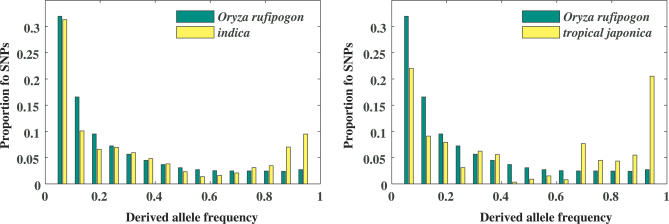
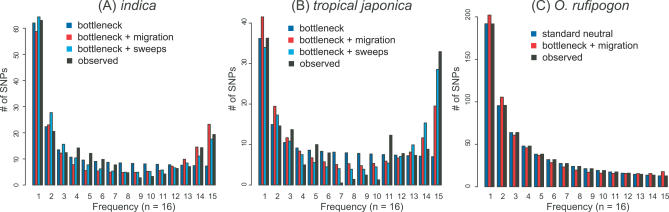
Domesticated Asian rice (Oryza sativa) is one of the oldest domesticated crop species in the world, having fed more people than any other plant in human history. We report the patterns of DNA sequence variation in rice and its wild ancestor, O. rufipogon, across 111 randomly chosen gene fragments, and use these to infer the evolutionary dynamics that led to the origins of rice. There is a genome-wide excess of high-frequency derived single nucleotide polymorphisms (SNPs) in O. sativa varieties, a pattern that has not been reported for other crop species. We developed several alternative models to explain contemporary patterns of polymorphisms in rice, including a (i) selectively neutral population bottleneck model, (ii) bottleneck plus migration model, (iii) multiple selective sweeps model, and (iv) bottleneck plus selective sweeps model. We find that a simple bottleneck model, which has been the dominant demographic model for domesticated species, cannot explain the derived nucleotide polymorphism site frequency spectrum in rice. Instead, a bottleneck model that incorporates selective sweeps, or a more complex demographic model that includes subdivision and gene flow, are more plausible explanations for patterns of variation in domesticated rice varieties. If selective sweeps are indeed the explanation for the observed nucleotide data of domesticated rice, it suggests that strong selection can leave its imprint on genome-wide polymorphism patterns, contrary to expectations that selection results only in a local signature of variation.
亚洲栽培稻(Oryza sativa)是世界上最古老的栽培作物物种之一,在人类历史上,以稻米为食的人口比以其他任何植物为食的人口都多。我们报告了水稻及其野生祖先普通野生稻(O. rufipogon)在111个随机选择的基因片段中的DNA序列变异模式,并利用这些模式推断导致水稻起源的进化动态。在亚洲栽培稻品种中,全基因组范围内高频衍生单核苷酸多态性(SNP)过量,这种模式在其他作物物种中尚未见报道。我们开发了几种替代模型来解释水稻多态性的当代模式,包括:(i)选择性中性种群瓶颈模型;(ii)瓶颈加迁移模型;(iii)多次选择性清除模型;以及(iv)瓶颈加选择性清除模型。我们发现,一个简单的瓶颈模型(一直是驯化物种的主要人口统计学模型)无法解释水稻中衍生核苷酸多态性位点频率谱。相反,一个纳入了选择性清除的瓶颈模型,或者一个更复杂的包括种群细分和基因流的人口统计学模型,对于栽培稻品种的变异模式来说是更合理的解释。如果选择性清除确实是栽培稻观察到的核苷酸数据的解释,这表明强选择可以在全基因组多态性模式上留下印记,这与选择仅导致局部变异特征的预期相反。