Ren Xiaotong, Chou Yilin, Jiang Xiaodan, Hao Ran, Wang Yuexin, Chen Yanyan, Li Xuemin
Department of Ophthalmology, Peking University Third Hospital, Beijing, China.
Department of Ophthalmology, Daqing Oilfield General Hospital, Daqing, Heilongjiang, China.
J Ophthalmol. 2020 Sep 9;2020:9539674. doi: 10.1155/2020/9539674. eCollection 2020.
To assess the effects of oral vitamin B1 and mecobalamin on dry eye disease (DED) and patient satisfaction with treatment.
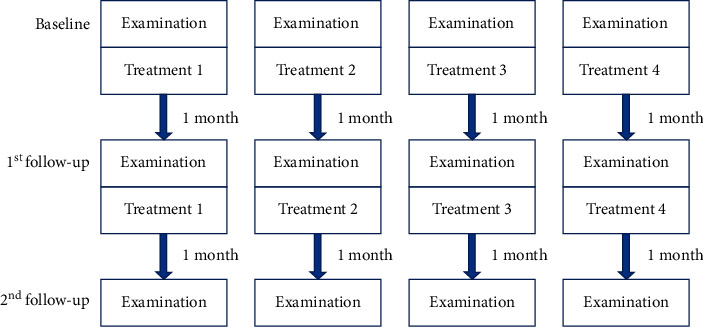
In this randomized controlled study, DED patients were divided into 4 groups based on treatment: group 1, only artificial tears; group 2, corticosteroid eye drops and artificial tears; group 3, oral vitamin B1, mecobalamin, and artificial tears; and group 4, oral vitamin B1, mecobalamin, corticosteroid eye drops, and artificial tears. DED symptoms, signs, and patient satisfaction with treatment were assessed at baseline and at 1 and 2 months after treatment.
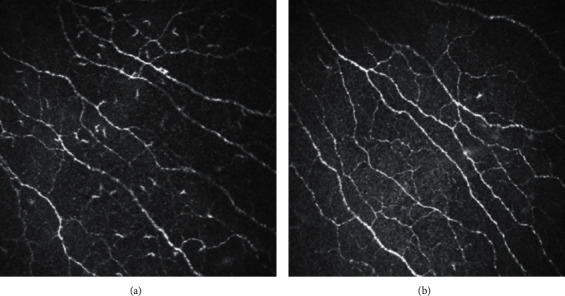
In total, 152 eyes from 76 patients (age, 55.25 ± 18.16 years) were included. In group 3, there were significant differences in dryness, foreign body sensation, burning, and tear film breakup time first (TBUTF) between 1 and 2 months after treatment and in satisfaction scores before and after treatment ( < 0.05). In group 3, there were also significant differences in dryness, foreign body sensation, photophobia, and TBUTA and between baseline and 2 months after treatment ( < 0.05). There was a significant difference in foreign body sensation between 1 and 2 months after treatment in groups 3 and 4 ( < 0.05). Furthermore, we also find obvious improvement in corneal nerve fiber density (CNFD) between baseline and 1 and 2 months after treatment in groups 3 and 4 ( < 0.05).
Oral vitamin B1 and mecobalamin can relieve some dry eye symptoms such as dryness, pain, and photophobia and improve DED signs and patient satisfaction. Thus, vitamin B1 and mecobalamin are potential treatment options for patients with DED.
评估口服维生素B1和甲钴胺对干眼症(DED)的影响以及患者对治疗的满意度。
在这项随机对照研究中,DED患者根据治疗方法分为4组:第1组,仅使用人工泪液;第2组,使用皮质类固醇眼药水和人工泪液;第3组,口服维生素B1、甲钴胺和人工泪液;第4组,口服维生素B1、甲钴胺、皮质类固醇眼药水和人工泪液。在基线以及治疗后1个月和2个月时评估DED症状、体征和患者对治疗的满意度。
总共纳入了76例患者(年龄55.25±18.16岁)的152只眼睛。在第3组中,治疗后1个月和2个月之间在干涩感、异物感、烧灼感和首次泪膜破裂时间(TBUTF)方面以及治疗前后的满意度评分存在显著差异(P<0.05)。在第3组中,干涩感、异物感、畏光以及TBUTA在基线和治疗后2个月之间也存在显著差异(P<0.05)。在第3组和第4组中,治疗后1个月和2个月之间在异物感方面存在显著差异(P<0.05)。此外,我们还发现第3组和第4组在基线与治疗后1个月和2个月之间角膜神经纤维密度(CNFD)有明显改善(P<0.05)。
口服维生素B1和甲钴胺可缓解一些干眼症状,如干涩、疼痛和畏光,并改善DED体征和患者满意度。因此,维生素B1和甲钴胺是DED患者潜在的治疗选择。