Fan Qin, Zhu Hongling, Zhao Jiaxin, Zhuang Lingfang, Zhang Hang, Xie Hongyang, Zhang Ruiyan, Granada Juan F, Xiang Xiaogang, Hu Weiguo, Yan Xiaoxiang
Department of Cardiology, Ruijin Hospital, Shanghai Jiaotong University School of Medicine, 197 Rui Jin Road II, Shanghai, 200025, China.
Institute of Cardiovascular Diseases, Shanghai Jiaotong University School of Medicine, Shanghai, China.
ESC Heart Fail. 2020 Dec;7(6):4108-4117. doi: 10.1002/ehf2.13022. Epub 2020 Oct 2.
In patients with coronavirus disease 2019 (COVID-19), the involvement of the cardiovascular system significantly relates to poor prognosis. However, the risk factors for acute myocardial injury have not been sufficiently studied. Thus, we aimed to determine the characteristics of myocardial injury and define the association between routine blood markers and cardiac troponin I, in order to perform a predictive model.
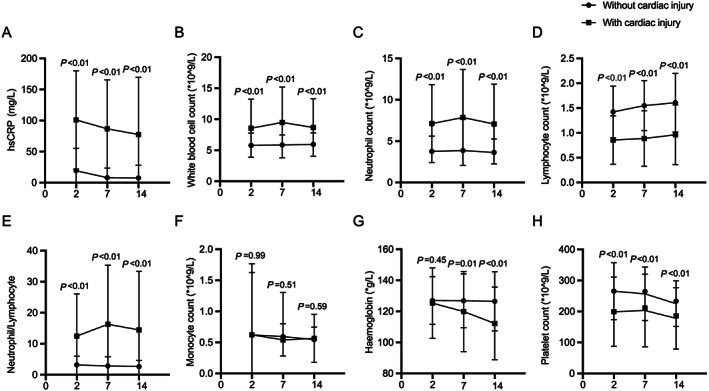
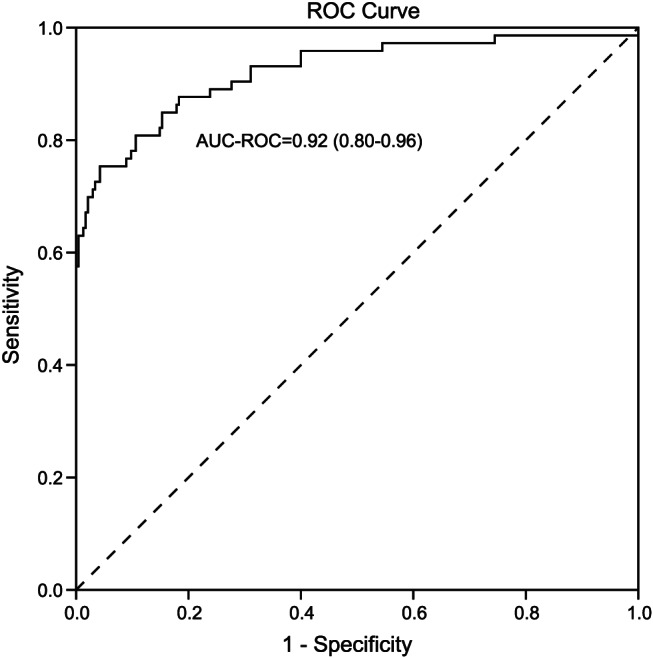
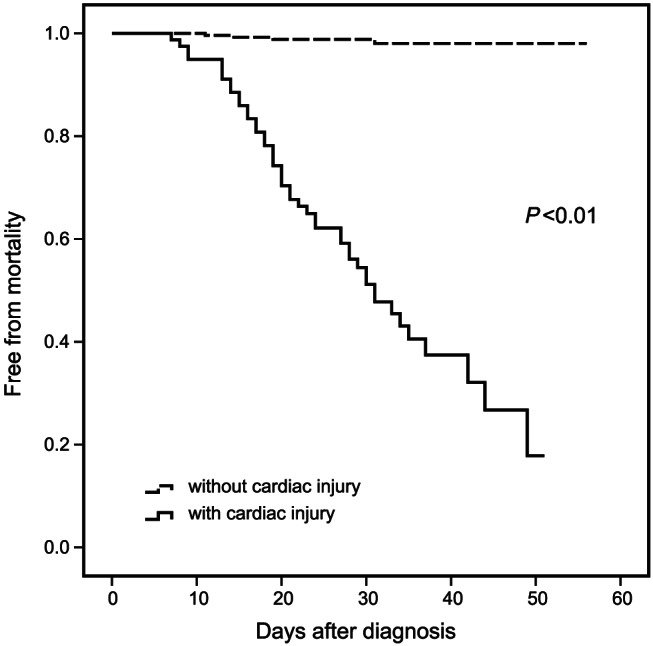
This retrospective cohort study included patients with confirmed COVID-19 from Wuhan Tongji Hospital (Wuhan, China). Data were compared between those with and without myocardial injury. Kaplan-Meier analysis and Cox regression models were used to describe the association between myocardial injury and poor prognosis. Simple correlation analyses were used to find factors associated with high-sensitivity cardiac troponin I levels. Univariate and multivariate logistic regression methods were used to explore the risk factors associated with myocardial injury. The area under the receiver operating characteristic curve was used to determine the predictive value of the model. Of 353 patients included in the study, 79 presented myocardial injury. Patients with myocardial injury had higher levels of inflammation markers, poorer liver and kidney function, and more complications compared with patients without myocardial injury. High-sensitivity cardiac troponin I levels were significantly associated with neutrophil/lymphocyte ratio, creatinine, d-dimer, lactate dehydrogenase, and inflammatory cytokines and negatively associated with oxygen saturation. It was significantly associated with poor prognosis after adjusting for age, sex, and complications. Multivariate regression showed that myocardial injury was associated with a high neutrophil/lymphocyte ratio (odds ratio 2.30, 95% CI 1.11-4.75, per standard deviation increase, P = 0.02), creatinine (3.58, 1.35-8.06, P = 0.01), and lactate dehydrogenase (3.39, 1.42-8.06, P = 0.01) levels. Using a predictive model, the area under the receiver operating characteristic curve was 0.92 (0.88-0.96).
In patients with COVID-19, neutrophil/lymphocyte ratio, creatinine, and lactate dehydrogenase are blood markers that could help identify patients with a high risk of myocardial injury at an early stage.
在2019冠状病毒病(COVID-19)患者中,心血管系统受累与预后不良显著相关。然而,急性心肌损伤的危险因素尚未得到充分研究。因此,我们旨在确定心肌损伤的特征,并明确常规血液标志物与心肌肌钙蛋白I之间的关联,以便建立一个预测模型。
这项回顾性队列研究纳入了来自武汉同济医院(中国武汉)的确诊COVID-19患者。对有心肌损伤和无心肌损伤的患者的数据进行了比较。采用Kaplan-Meier分析和Cox回归模型来描述心肌损伤与预后不良之间的关联。采用简单相关分析来寻找与高敏心肌肌钙蛋白I水平相关的因素。采用单因素和多因素逻辑回归方法来探索与心肌损伤相关的危险因素。采用受试者工作特征曲线下面积来确定模型的预测价值。在纳入研究的353例患者中,79例出现心肌损伤。与无心肌损伤的患者相比,有心肌损伤的患者炎症标志物水平更高,肝肾功能更差,并发症更多。高敏心肌肌钙蛋白I水平与中性粒细胞/淋巴细胞比值、肌酐、D-二聚体、乳酸脱氢酶和炎性细胞因子显著相关,与血氧饱和度呈负相关。在调整年龄、性别和并发症后,它与预后不良显著相关。多因素回归显示,心肌损伤与高中性粒细胞/淋巴细胞比值(比值比2.30,95%可信区间1.11-4.75,每标准差增加,P = 0.02)、肌酐(3.58,1.35-8.06,P = 0.01)和乳酸脱氢酶(3.39,1.42-8.06,P = 0.01)水平相关。使用预测模型,受试者工作特征曲线下面积为0.92(0.88-0.96)。
在COVID-19患者中,中性粒细胞/淋巴细胞比值、肌酐和乳酸脱氢酶是血液标志物,可有助于早期识别心肌损伤高危患者。