Li Dehe, Hu Yinhuan, Pfaff Holger, Wang Liuming, Deng Lu, Lu Chuntao, Xia Shixiao, Cheng Siyu, Zhu Ximin, Wu Xiaoyue
School of Medicine and Health Management, Tongji Medical College, Huazhong University of Science and Technology, Wuhan, Hubei, China.
Center for Health Services Research Cologne, University of Cologne, Cologne, Germany.
J Med Internet Res. 2020 Oct 29;22(10):e22716. doi: 10.2196/22716.
Internet hospitals show great potential for adequately fulfilling people's demands for high-quality outpatient services, and with the normalization of the epidemic prevention and control of COVID-19, internet hospitals play an increasingly important role in delivering health services to the public. However, the factors that influence patients' intention to use the online inquiry services provided by internet hospitals remain unclear. Understanding the patients' behavioral intention is necessary to support the development of internet hospitals in China and promote patients' intention to use online inquiry services provided by internet hospitals during the prevention and control of the COVID-19 epidemic.
The purpose of this study is to identify the determinants of patients' intention to use the online inquiry services provided by internet hospitals based on the theory of planned behavior (TPB).
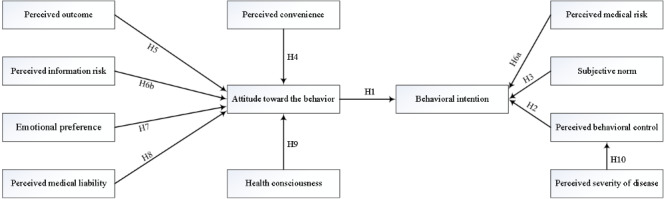
The hypotheses of our research model were developed based on the TPB. A questionnaire was developed through patient interviews, verified using a presurvey, and used for data collection for this study. The cluster sampling technique was used to include respondents with chronic diseases. Structural equation modeling was used to test the research hypotheses.
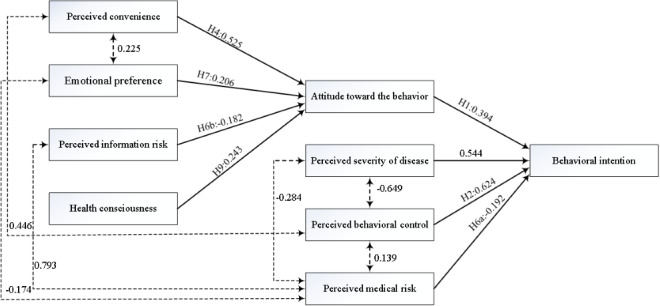
A total of 638 valid responses were received from patients with chronic diseases. The goodness-of-fit indexes corroborated that the research model was a good fit for the collected data. The model explained 45.9% of the variance in attitude toward the behavior and 60.5% of the variance in behavioral intention. Perceived behavioral control and perceived severity of disease had the strongest total effects on behavioral intention (β=.624, P=.004 and β=.544, P=.003, respectively). Moreover, perceived convenience, perceived information risk, emotional preference, and health consciousness had indirect effects on behavioral intention, and these effects were mediated by attitude toward the behavior. Among the four constructs, perceived convenience had the highest indirect effect on behavioral intention (β=.207; P=.001).
Perceived behavioral control and perceived severity of disease are the most important determinants of patients' intention to use the online inquiry services provided by internet hospitals. Therefore, internet hospitals should further optimize the design of online service delivery and ensure a reasonable assembly of high-quality experts, which will benefit the promotion of patients' adoption intention toward online inquiry services for health purposes. Perceived convenience, emotional preference, and perceived risks also have effects on behavioral intention. Therefore, the relevant quality control standards and regulations for internet hospitals should be further developed and improved, and the measures to protect personal information should be strengthened to ensure the patient safety. Our study supports the use of the TPB in explaining patients' intention to use online inquiry services provided by internet hospitals.
互联网医院在充分满足人们对高质量门诊服务的需求方面具有巨大潜力,并且随着新冠疫情防控常态化,互联网医院在为公众提供健康服务方面发挥着越来越重要的作用。然而,影响患者使用互联网医院提供的在线问诊服务意愿的因素仍不明确。了解患者的行为意愿对于支持中国互联网医院的发展以及在新冠疫情防控期间促进患者使用互联网医院提供的在线问诊服务的意愿是必要的。
本研究旨在基于计划行为理论(TPB)确定患者使用互联网医院提供的在线问诊服务意愿的决定因素。
我们的研究模型假设基于TPB构建。通过患者访谈编制问卷,经预调查验证后用于本研究的数据收集。采用整群抽样技术纳入慢性病患者。使用结构方程模型检验研究假设。
共收到638份慢性病患者的有效回复。拟合优度指标证实研究模型与收集的数据拟合良好。该模型解释了行为态度方差的45.9%和行为意愿方差的60.5%。感知行为控制和感知疾病严重程度对行为意愿的总效应最强(β = 0.624,P = 0.004和β = 0.544,P = 0.003)。此外,感知便利性、感知信息风险、情感偏好和健康意识对行为意愿有间接影响,且这些影响通过行为态度介导。在这四个构念中,感知便利性对行为意愿的间接影响最大(β = 0.207;P = 0.001)。
感知行为控制和感知疾病严重程度是患者使用互联网医院提供的在线问诊服务意愿的最重要决定因素。因此,互联网医院应进一步优化在线服务提供设计,确保优质专家的合理配置,这将有利于促进患者出于健康目的采用在线问诊服务的意愿。感知便利性、情感偏好和感知风险也对行为意愿有影响。因此,应进一步制定和完善互联网医院的相关质量控制标准和规定,并加强个人信息保护措施以确保患者安全。我们的研究支持使用TPB来解释患者使用互联网医院提供的在线问诊服务的意愿。