Guangzhou First People's Hospital, School of Medicine, South China University of Technology, Guangzhou, China.
School of Management, Harbin Institute of Technology, Harbin, China.
JMIR Mhealth Uhealth. 2020 Apr 6;8(4):e17258. doi: 10.2196/17258.
With the increasingly rapid development of Web 2.0 technologies, the application of mobile health (mHealth) care in the field of health management has become popular. Accordingly, patients are able to access consulting services and effective health information online without temporal and geographical constraints. The elaboration-likelihood model (ELM) is a dual-process persuasion theory that describes the change of attitudes and behavior.
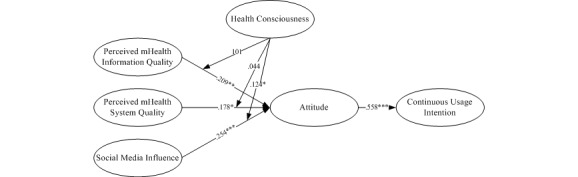
In this study, we drew on the ELM to investigate patients' continuous usage intentions regarding mHealth services. In addition, we further examined which route-central or peripheral-has a stronger impact on a patient's usage of health care management.
To meet these objectives, five hypotheses were developed and empirically validated using a field survey to test the direct and indirect effects, via attitude, of the two routes on continuous usage intention.
We found that patients' perceived mHealth information quality and perceived mHealth system quality had a positive effect on their personal attitudes. The results revealed that social media influence had a positive effect on a patient's attitude toward mHealth services. In particular, our findings suggest that a patient's health consciousness has a positive effect on the relationship between social media influence and attitude.
This study contributes to the mHealth services literature by introducing the ELM as a referent theory for research, as well as by specifying the moderating role of health consciousness. For practitioners, this study introduces influence processes as policy tools that managers can employ to motivate the uptake of mHealth services within their organizations.
随着 Web 2.0 技术的飞速发展,移动医疗(mHealth)在健康管理领域的应用变得流行起来。因此,患者能够不受时间和地理限制地在线访问咨询服务和有效的健康信息。精细加工可能性模型(ELM)是一种双过程说服理论,用于描述态度和行为的变化。
本研究借鉴 ELM 来调查患者对 mHealth 服务的持续使用意向。此外,我们进一步研究了哪种途径——中心途径还是边缘途径——对患者的医疗保健管理使用有更强的影响。
为了实现这些目标,我们提出了五个假设,并通过实地调查进行了实证验证,以测试两种途径通过态度对连续使用意向的直接和间接影响。
我们发现,患者对 mHealth 信息质量和 mHealth 系统质量的感知对其个人态度有积极影响。结果表明,社交媒体影响对患者对 mHealth 服务的态度有积极影响。特别是,我们的研究结果表明,患者的健康意识对社交媒体影响和态度之间的关系有积极影响。
本研究通过将 ELM 作为研究的参照理论,并明确健康意识的调节作用,为 mHealth 服务文献做出了贡献。对于从业者来说,本研究将影响过程作为政策工具引入,管理者可以在组织内使用这些工具来激励 mHealth 服务的采用。