
互联网医院助力中国新冠疫情防控:多中心用户画像研究
Internet Hospitals Help Prevent and Control the Epidemic of COVID-19 in China: Multicenter User Profiling Study.
作者信息
Gong Kai, Xu Zhong, Cai Zhefeng, Chen Yuxiu, Wang Zhanxiang
机构信息
The Internet Hospital of the First Affiliated Hospital of Xia'men University, Xia'men City, China.
Zoenet Health Company Limited, Xia'men City, China.
出版信息
J Med Internet Res. 2020 Apr 14;22(4):e18908. doi: 10.2196/18908.
BACKGROUND
During the spread of the novel coronavirus disease (COVID-19), internet hospitals in China were engaged with epidemic prevention and control, offering epidemic-related online services and medical support to the public.
OBJECTIVE
The aim of this study is to explore the role of internet hospitals during the prevention and control of the COVID-19 outbreak in China.
METHODS
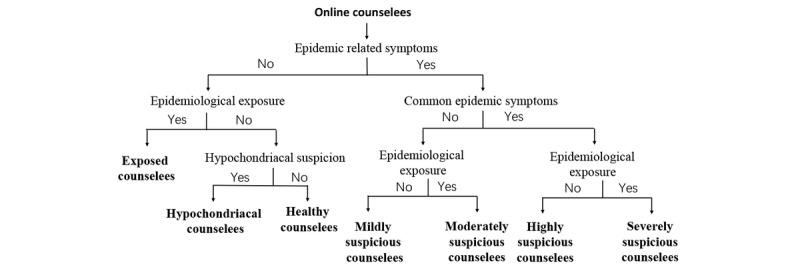
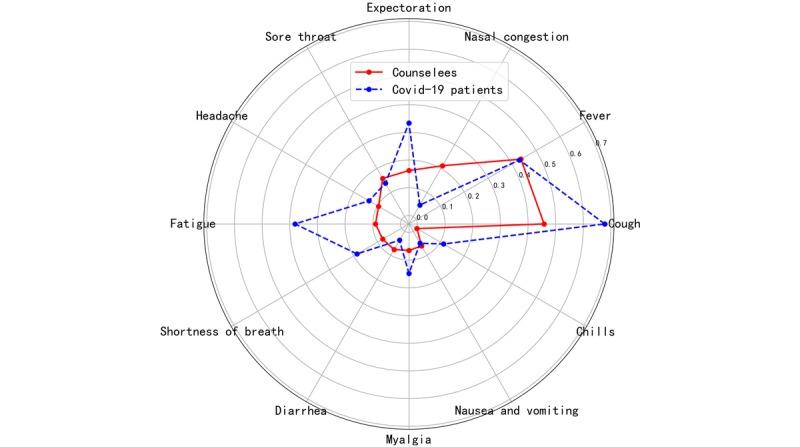
Online epidemic-related consultations from multicenter internet hospitals in China during the COVID-19 epidemic were collected. The counselees were described and classified into seven type groups. Symptoms were recorded and compared with reported patients with COVID-19. Hypochondriacal suspicion and offline visit motivation were detected within each counselees' group to evaluate the social panic of the epidemic along with the consequent medical-seeking behaviors. The counselees' motivation and the doctors' recommendation for an offline visit were compared. Risk factors affecting the counselees' tendency of hypochondriacal suspicion and offline visit motivation were explored by logistic regression models. The epidemic prevention and control measures based on internet hospitals were listed, and the corresponding effects were discussed.
RESULTS
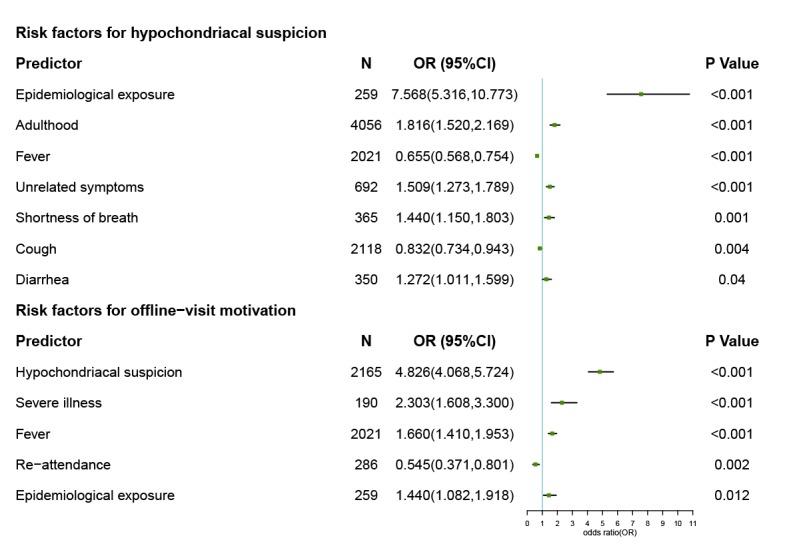
A total of 4913 consultations were enrolled for analysis with the median age of the counselees at 28 years (IQR 22-33 years). There were 104 (2.12%) healthy counselees, 147 (2.99%) hypochondriacal counselees, 34 (0.69%) exposed counselees, 853 (17.36%) mildly suspicious counselees, 42 (0.85%) moderately suspicious counselees, 3550 (72.26%) highly suspicious counselees, and 183 (3.72%) severely suspicious counselees. A total of 94.20% (n=4628) of counselees had epidemic-related symptoms with a distribution similar to those of COVID-19. The hypochondriacal suspicion (n=2167, 44.11%) was common. The counselees' motivation and the doctors' recommendation for offline visits were inconsistent (P<.001) with a Cohen kappa score of 0.039, indicating improper medical-seeking behaviors. Adult counselees (odds ratio [OR]=1.816, P<.001) with epidemiological exposure (OR 7.568, P<.001), shortness of breath (OR 1.440, P=.001), diarrhea (OR 1.272, P=.04), and unrelated symptoms (OR 1.509, P<.001) were more likely to have hypochondriacal suspicion. Counselees with severe illnesses (OR 2.303, P<.001), fever (OR 1.660, P<.001), epidemiological exposure history (OR 1.440, P=.01), and hypochondriacal suspicion (OR 4.826, P<.001) were more likely to attempt an offline visit. Reattending counselees (OR 0.545, P=.002) were less motivated to go to the offline clinic.
CONCLUSIONS
Internet hospitals can serve different types of epidemic counselees, offer essential medical supports to the public during the COVID-19 outbreak, reduce the social panic, promote social distancing, enhance the public's ability of self-protection, correct improper medical-seeking behaviors, reduce the chance of nosocomial cross-infection, and facilitate epidemiological screening, thus, playing an important role on preventing and controlling COVID-19.
背景
在新型冠状病毒肺炎(COVID-19)疫情传播期间,中国的互联网医院参与了疫情防控工作,为公众提供与疫情相关的在线服务和医疗支持。
目的
本研究旨在探讨互联网医院在中国COVID-19疫情防控中的作用。
方法
收集COVID-19疫情期间中国多家互联网医院的在线疫情相关咨询。对咨询者进行描述并分为七个类型组。记录症状并与报告的COVID-19患者进行比较。在每个咨询者组中检测疑病怀疑和线下就诊动机,以评估疫情的社会恐慌以及随之而来的就医行为。比较咨询者的动机和医生对线下就诊的建议。通过逻辑回归模型探讨影响咨询者疑病怀疑倾向和线下就诊动机的危险因素。列出基于互联网医院的疫情防控措施,并讨论相应效果。
结果
共纳入4913例咨询进行分析,咨询者的中位年龄为28岁(四分位间距22 - 33岁)。有104例(2.12%)健康咨询者,147例(2.99%)疑病咨询者,34例(0.69%)暴露咨询者,853例(17.36%)轻度怀疑咨询者,42例(0.85%)中度怀疑咨询者,3550例(72.26%)高度怀疑咨询者,183例(3.72%)重度怀疑咨询者。共有94.20%(n = 4628)的咨询者有与疫情相关的症状,其分布与COVID-19患者相似。疑病怀疑较为常见(n = 2167,44.11%)。咨询者的动机与医生对线下就诊的建议不一致(P <.001),Cohen kappa值为0.039,表明就医行为不当。成年咨询者(比值比[OR] = 1.816,P <.001)、有流行病学暴露史(OR 7.568,P <.001)、呼吸急促(OR 1.440,P =.001)、腹泻(OR 1.272,P =.04)以及有无关症状(OR 1.509,P <.001)的咨询者更易出现疑病怀疑。患有重症(OR 2.303,P <.001)、发热(OR 1.660,P <.001)、有流行病学暴露史(OR 1.440,P =.01)以及疑病怀疑(OR 4.826,P <.001)的咨询者更倾向于尝试线下就诊。复诊咨询者(OR 0.545,P =.002)去线下门诊的动机较低。
结论
互联网医院可为不同类型的疫情咨询者服务,在COVID-19疫情期间为公众提供必要的医疗支持,减少社会恐慌,促进社交距离,增强公众的自我保护能力,纠正不当就医行为,减少医院交叉感染的机会,并便于进行流行病学筛查,因此在COVID-19防控中发挥着重要作用。
 Zotero 插件