Department of Ophthalmology and Visual Sciences, John Moran Eye Center, University of Utah, Salt Lake City, Utah.
Department of Ophthalmology and Visual Sciences, John Moran Eye Center, University of Utah, Salt Lake City, Utah; Department of Internal Medicine, University of Utah School of Medicine, Salt Lake City, Utah.
Ophthalmol Glaucoma. 2021 May-Jun;4(3):260-267. doi: 10.1016/j.ogla.2020.09.016. Epub 2020 Sep 30.
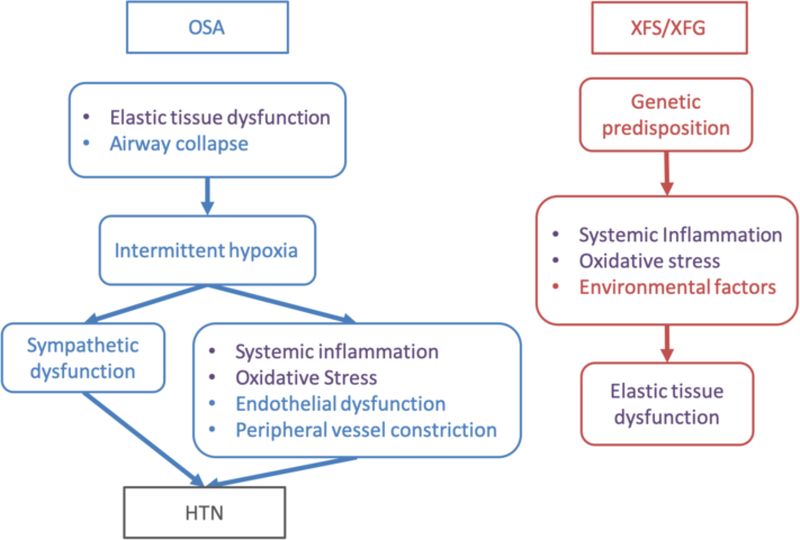
Exfoliation syndrome (XFS), the most common recognizable cause of open-angle glaucoma worldwide, is a systemic disorder with genetic predisposition due to variations in lysyl oxidase-like 1 (LOXL1) function, leading to altered elastin matrices in ocular and systemic tissues. Obstructive sleep apnea (OSA) is a highly prevalent disorder also involving elastic tissue dysfunction and is associated with glaucoma. Because of the similarities between the disorders, we sought to uncover any relationship in the prevalence of these diagnoses.
Case-control, retrospective cohort study.
A cohort of 81 735 patients diagnosed with OSA at ages 50 to 90 years was identified from medical records from 1996 to 2017 in the Utah Population Database. Case subjects were matched to random controls on sex and birth year in a 4:1 ratio.
International Classification of Diseases, Ninth Revision (ICD-9) codes or their Tenth Revision equivalent were used to define a diagnosis of OSA (ICD-9 327.23) and a diagnosis of XFS (ICD-9 365.52 and 366.11). Conditional logistic regression odds ratios (ORs) accounting for individual matching on sex and birth year were used to estimate the risk of XFS in patients with OSA. Models included adjustment for race, obesity, tobacco use, hypertension (HTN), atrial fibrillation (AF), and chronic obstructive pulmonary disease (COPD).
Whether patients with OSA have an increased risk of diagnosis of XFS compared with controls without OSA.
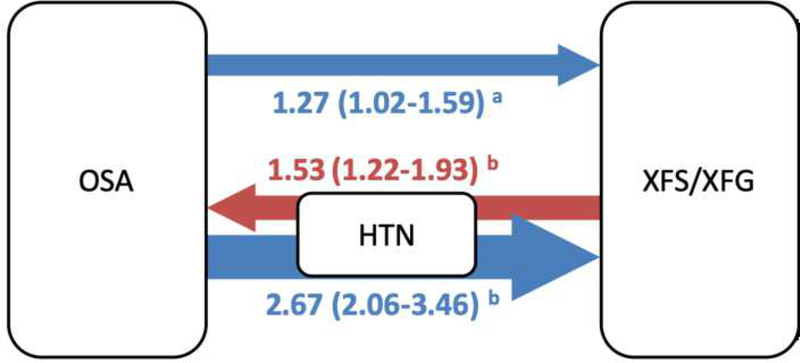
There was an increased risk of an XFS diagnosis in patients with OSA compared with non-OSA controls (OR, 1.27; 95% confidence interval [CI], 1.02-1.59; P = 0.03). In a stratification of patients by HTN diagnosis history, patients with OSA and HTN exhibited an increased risk of XFS compared with non-OSA controls with HTN (OR, 2.67; 95% CI, 2.06-3.46; P < 0.0001).
Patients with OSA may be at an increased risk of XFS compared with patients without OSA, particularly in patients with a history of HTN.
剥脱综合征(XFS)是全球最常见的开角型青光眼可识别病因,是一种具有遗传易感性的系统性疾病,其原因是赖氨酰氧化酶样 1(LOXL1)功能发生变异,导致眼组织和全身组织中的弹性蛋白基质发生改变。阻塞性睡眠呼吸暂停(OSA)是一种高度流行的疾病,也涉及弹性组织功能障碍,与青光眼有关。鉴于两种疾病之间存在相似性,我们试图发现这些诊断之间是否存在任何相关性。
病例对照,回顾性队列研究。
从 1996 年至 2017 年犹他州人群数据库中的医疗记录中确定了年龄在 50 至 90 岁之间的 OSA 诊断为 81735 名患者。病例组通过性别和出生年份以 4:1 的比例与随机对照组相匹配。
使用国际疾病分类,第九版(ICD-9)代码或其第十版等效代码来定义 OSA(ICD-9 327.23)和 XFS(ICD-9 365.52 和 366.11)的诊断。考虑到性别和出生年份的个体匹配,使用条件逻辑回归比值比(OR)来估计 OSA 患者中 XFS 的风险。模型包括对种族、肥胖、吸烟、高血压(HTN)、心房颤动(AF)和慢性阻塞性肺疾病(COPD)进行调整。
与无 OSA 的对照组相比,OSA 患者是否有更高的 XFS 诊断风险。
与无 OSA 对照组相比,OSA 患者的 XFS 诊断风险增加(OR,1.27;95%置信区间[CI],1.02-1.59;P=0.03)。在根据 HTN 诊断史对患者进行分层后,与无 OSA 且伴有 HTN 的对照组相比,患有 OSA 且伴有 HTN 的患者的 XFS 风险增加(OR,2.67;95%CI,2.06-3.46;P<0.0001)。
与无 OSA 的患者相比,OSA 患者可能面临更高的 XFS 风险,尤其是有 HTN 病史的患者。