Giglio Rosaria Vincenza, Nikolic Dragana, Volti Giovanni Li, Stoian Anca Pantea, Banerjee Yajnavalka, Magan-Fernandez Antonio, Castellino Giuseppa, Patti Angelo Maria, Chianetta Roberta, Castracani Carlo Castruccio, Montalto Giuseppe, Rizvi Ali A, Sesti Giorgio, Rizzo Manfredi
Department of Health Promotion Sciences Maternal and Infantile Care, Internal Medicine and Medical Specialties (PROMISE), University of Palermo, 90127 Palermo, Italy.
Department of Biomedical and Biotechnological Sciences, University of Catania, 95125 Catania, Italy.
Metabolites. 2020 Sep 30;10(10):391. doi: 10.3390/metabo10100391.
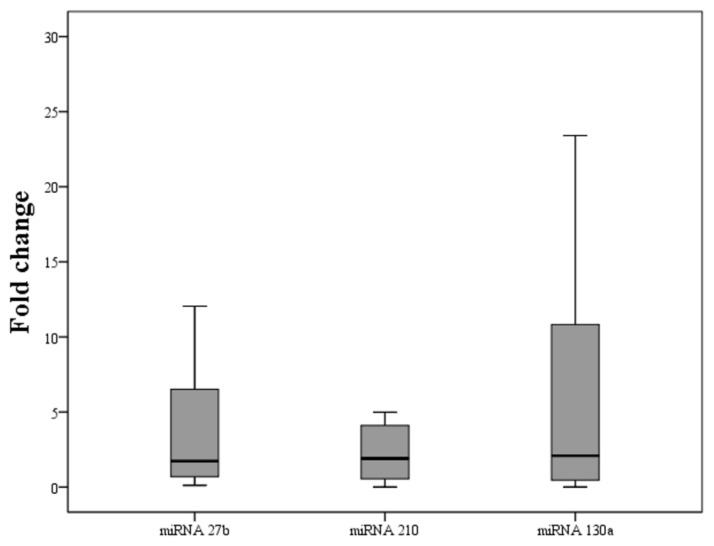
Liraglutide has shown favourable effects on several cardiometabolic risk factors, beyond glucose control. MicroRNAs (miRNAs) regulate gene expression, resulting in post-transcriptional modifications of cell response and function. Specific miRNAs, including miRNA-27b, miRNA-130a, and miRNA-210, play a role in cardiometabolic disease. We aimed to determine the effect of liraglutide on the serum levels of miRNA-27b, miRNA-130a and miRNA-210. Twenty-five subjects with type-2 diabetes mellitus (T2DM), naïve to incretin-based therapy, were treated with liraglutide (1.2 mg/day as an add-on to metformin) for 4 months. miRNAs were quantified using real-time polymerase chain reaction. After liraglutide treatment, we found significant reductions in fasting glucose (from 9.8 ± 5.3 to 6.7 ± 1.6 mmol/L, = 0.0042), glycosylated haemoglobin (HbA1c) (from 8.1 ± 0.8 to 6.6 ± 1.0%, = 0.0008), total cholesterol (from 5.0 ± 1.0 to 4.0 ± 0.7 mmol/L, = 0.0011), triglycerides (from 1.9 ± 1.0 to 1.5 ± 0.8 mmol/L, = 0.0104) and low-density lipoprotein cholesterol (from 2.9 ± 1.2 to 2.2 ± 0.6 mmol/L, = 0.0125), while the serum levels of miRNA-27b, miRNA-130a and miRNA-210a were significantly increased (median (interquartile range, IQR) changes: 1.73 (7.12) ( = 0.0401), 1.91 (3.64) ( = 0.0401) and 2.09 (11.0) ( = 0.0486), respectively). Since the changes in miRNAs were independent of changes in all the metabolic parameters investigated, liraglutide seems to exert a direct epigenetic effect in T2DM patients, regulating microRNAs involved in the maintenance of endothelial cell homeostasis. These changes might be implicated in liraglutide's benefits and may represent useful targets for cardiometabolic management.
利拉鲁肽已显示出对多种心血管代谢危险因素具有有益作用,不仅仅是控制血糖。微小RNA(miRNA)可调节基因表达,导致细胞反应和功能的转录后修饰。特定的miRNA,包括miRNA - 27b、miRNA - 130a和miRNA - 210,在心血管代谢疾病中发挥作用。我们旨在确定利拉鲁肽对miRNA - 27b、miRNA - 130a和miRNA - 210血清水平的影响。25名初治的2型糖尿病(T2DM)患者,未接受过基于肠促胰岛素的治疗,接受利拉鲁肽(1.2mg/天,作为二甲双胍的附加治疗)治疗4个月。使用实时聚合酶链反应对miRNA进行定量。利拉鲁肽治疗后,我们发现空腹血糖显著降低(从9.8±5.3降至6.7±1.6mmol/L,P = 0.0042)、糖化血红蛋白(HbA1c)(从8.1±0.8降至6.6±1.0%,P = 0.0008)、总胆固醇(从5.0±1.0降至4.0±0.7mmol/L,P = 0.0011)、甘油三酯(从1.9±1.0降至1.5±0.8mmol/L,P = 0.0104)和低密度脂蛋白胆固醇(从2.9±1.2降至2.2±0.6mmol/L,P = 0.0125),而miRNA - 27b、miRNA - 130a和miRNA - 210a的血清水平显著升高(中位数(四分位间距,IQR)变化分别为:1.73(7.12)(P = 0.0401)、1.91(3.64)(P = 0.0401)和2.09(11.0)(P = 0.0486))。由于miRNA的变化独立于所研究的所有代谢参数的变化,利拉鲁肽似乎在T2DM患者中发挥直接的表观遗传效应,调节参与维持内皮细胞稳态的微小RNA。这些变化可能与利拉鲁肽的益处有关,并且可能代表心血管代谢管理的有用靶点。