• 文献检索
  • 文档翻译
  • 深度研究
  • 学术资讯
  • Suppr Zotero 插件Zotero 插件
  • 邀请有礼
  • 套餐&价格
  • 历史记录
应用&插件
Suppr Zotero 插件Zotero 插件浏览器插件Mac 客户端Windows 客户端微信小程序
定价
高级版会员购买积分包购买API积分包
服务
文献检索文档翻译深度研究API 文档MCP 服务
关于我们
关于 Suppr公司介绍联系我们用户协议隐私条款
关注我们

Suppr 超能文献

核心技术专利:CN118964589B侵权必究
粤ICP备2023148730 号-1Suppr @ 2026

文献检索

告别复杂PubMed语法,用中文像聊天一样搜索,搜遍4000万医学文献。AI智能推荐,让科研检索更轻松。

立即免费搜索

文件翻译

保留排版,准确专业,支持PDF/Word/PPT等文件格式,支持 12+语言互译。

免费翻译文档

深度研究

AI帮你快速写综述,25分钟生成高质量综述,智能提取关键信息,辅助科研写作。

立即免费体验

澳大利亚昆士兰州东南部罗斯河病毒的时空分布模式:城乡交界热点的确定。

Spatial and temporal patterns of Ross River virus in south east Queensland, Australia: identification of hot spots at the rural-urban interface.

机构信息

Mosquito Control Laboratory, QIMR Berghofer Medical Research Institute, Brisbane, Australia.

School of Biomedical Sciences, Faculty of Health, and Institute for Health and Biomedical Innovation, Queensland University of Technology, Brisbane, Australia.

出版信息

BMC Infect Dis. 2020 Oct 2;20(1):722. doi: 10.1186/s12879-020-05411-x.

DOI:10.1186/s12879-020-05411-x
PMID:33008314
原文链接:https://pmc.ncbi.nlm.nih.gov/articles/PMC7530966/
Abstract

BACKGROUND

Ross River virus (RRV) is responsible for the most common vector-borne disease of humans reported in Australia. The virus circulates in enzootic cycles between multiple species of mosquitoes, wildlife reservoir hosts and humans. Public health concern about RRV is increasing due to rising incidence rates in Australian urban centres, along with increased circulation in Pacific Island countries. Australia experienced its largest recorded outbreak of 9544 cases in 2015, with the majority reported from south east Queensland (SEQ). This study examined potential links between disease patterns and transmission pathways of RRV.

METHODS

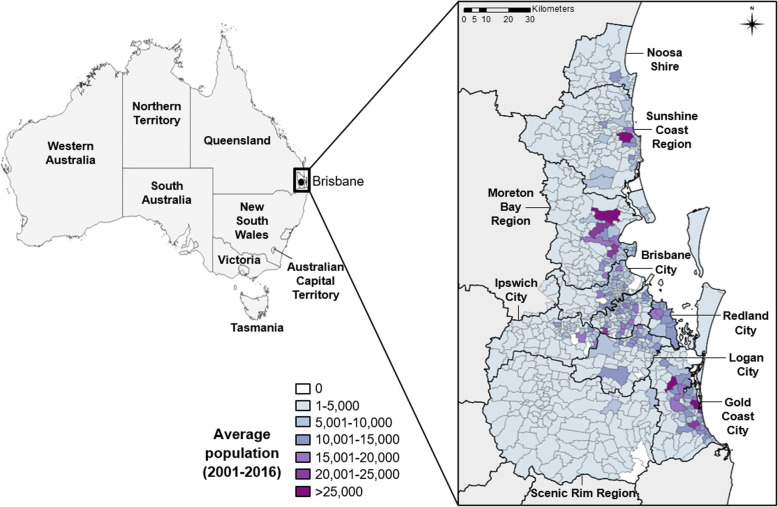
The spatial and temporal distribution of notified RRV cases, and associated epidemiological features in SEQ, were analysed for the period 2001-2016. This included fine-scale analysis of disease patterns across the suburbs of the capital city of Brisbane, and those of 8 adjacent Local Government Areas, and host spot analyses to identify locations with significantly high incidence.

RESULTS

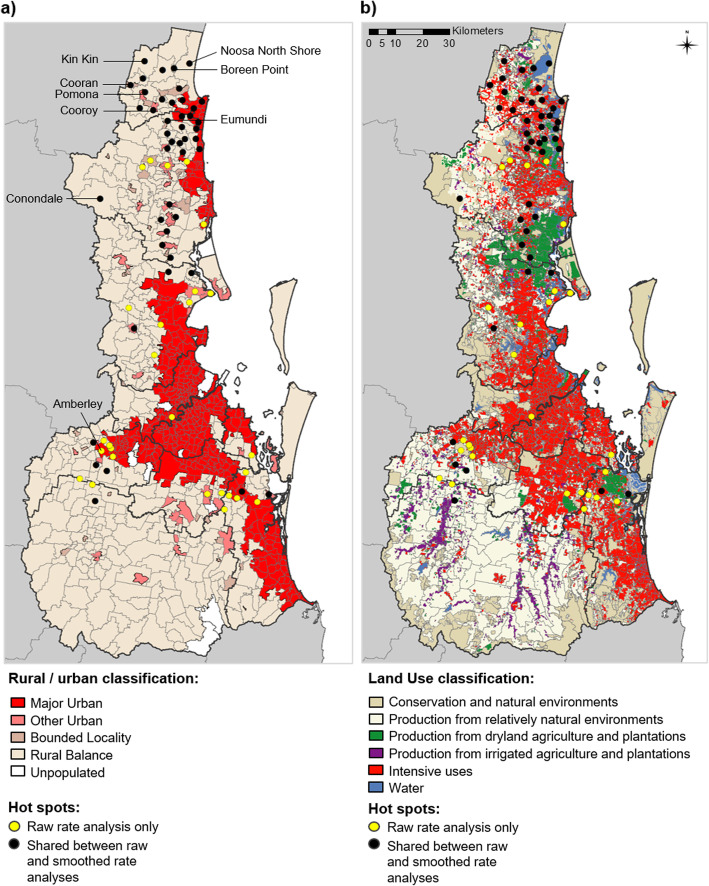
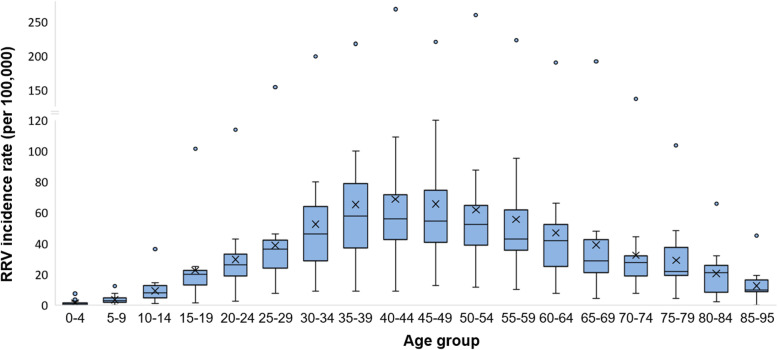
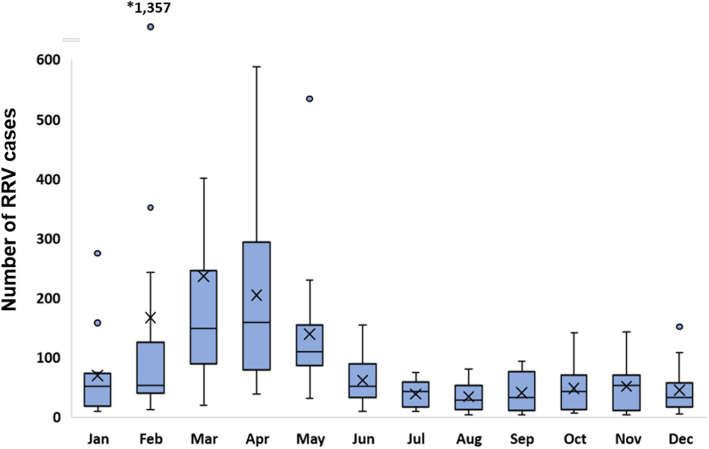
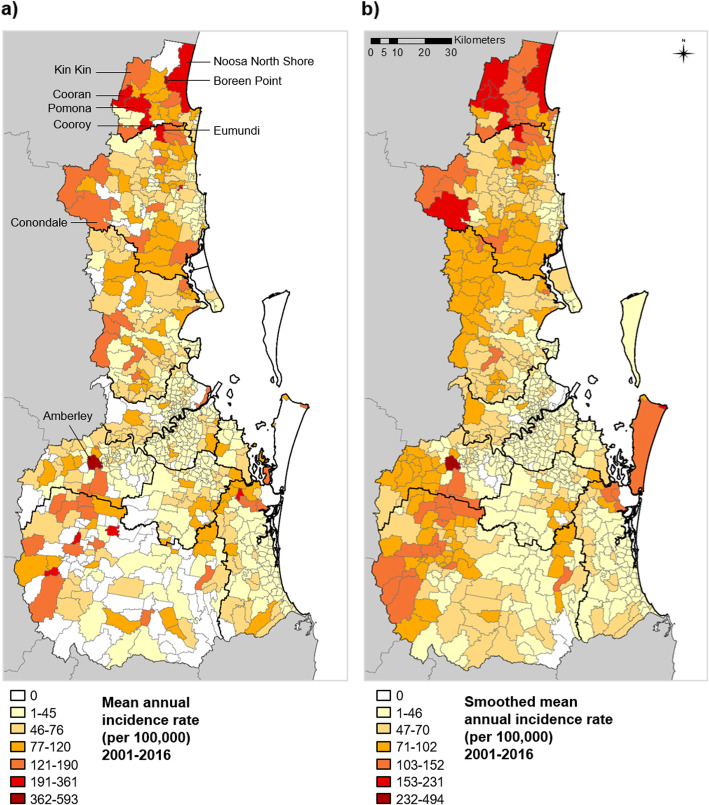
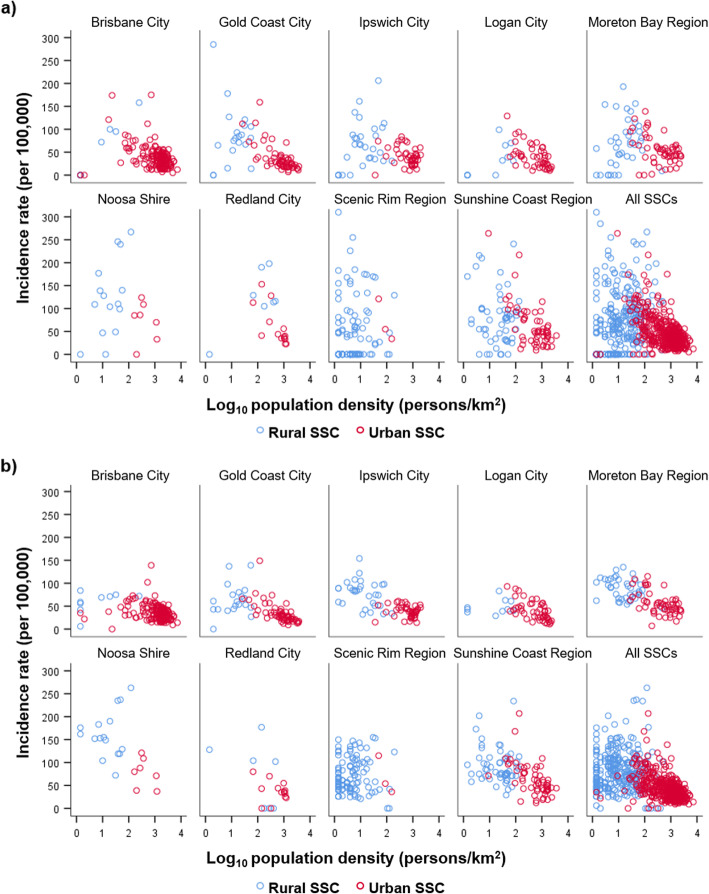
The mean annual incidence rate for the region was 41/100,000 with a consistent seasonal peak in cases between February and May. The highest RRV incidence was in adults aged from 30 to 64 years (mean incidence rate: 59/100,000), and females had higher incidence rates than males (mean incidence rates: 44/100,000 and 34/100,000, respectively). Spatial patterns of disease were heterogeneous between years, and there was a wide distribution of disease across both urban and rural areas of SEQ. Overall, the highest incidence rates were reported from predominantly rural suburbs to the north of Brisbane City, with significant hot spots located in peri-urban suburbs where residential, agricultural and conserved natural land use types intersect.

CONCLUSIONS

Although RRV is endemic across all of SEQ, transmission is most concentrated in areas where urban and peri-urban environments intersect. The drivers of RRV transmission across rural-urban landscapes should be prioritised for further investigation, including identification of specific vectors and hosts that mediate human spillover.

摘要

背景

罗斯河病毒(RRV)是澳大利亚报告的最常见的虫媒病。该病毒在多种蚊子、野生动物宿主和人类之间循环,形成地方性流行循环。由于澳大利亚城市中心的发病率上升,以及太平洋岛国的循环增加,人们对 RRV 的公共卫生关注度不断提高。澳大利亚在 2015 年经历了有记录以来最大的 9544 例暴发,其中大部分报告来自昆士兰州东南部(SEQ)。本研究探讨了 RRV 疾病模式和传播途径之间的潜在联系。

方法

对 2001-2016 年期间 SEQ 地区报告的 RRV 病例的时空分布及相关流行病学特征进行了分析。这包括对布里斯班首府郊区以及 8 个相邻地方政府区域的疾病模式进行精细分析,并进行宿主点分析以确定发病率显著较高的地点。

结果

该地区的年平均发病率为 41/100,000,病例在 2 月至 5 月之间呈持续季节性高峰。RRV 发病率最高的是 30 至 64 岁的成年人(平均发病率:59/100,000),女性的发病率高于男性(平均发病率分别为 44/100,000 和 34/100,000)。疾病的空间模式在不同年份之间存在异质性,且 SEQ 的城市和农村地区均有广泛的疾病分布。总体而言,布里斯班市以北的农村郊区报告的发病率最高,城市周边郊区存在显著的热点,这些地区的住宅、农业和自然保护区类型相交。

结论

尽管 RRV 在 SEQ 地区普遍流行,但传播最集中在城市和城市周边环境相交的地区。应优先研究农村-城市景观中 RRV 传播的驱动因素,包括确定介导人类溢出的特定媒介和宿主。
https://cdn.ncbi.nlm.nih.gov/pmc/blobs/98a6/7530966/5ae64afb0e81/12879_2020_5411_Fig6_HTML.jpg
https://cdn.ncbi.nlm.nih.gov/pmc/blobs/98a6/7530966/1694c0fa425a/12879_2020_5411_Fig1_HTML.jpg
https://cdn.ncbi.nlm.nih.gov/pmc/blobs/98a6/7530966/2884cf48fb4e/12879_2020_5411_Fig2_HTML.jpg
https://cdn.ncbi.nlm.nih.gov/pmc/blobs/98a6/7530966/e5289b1775f2/12879_2020_5411_Fig3_HTML.jpg
https://cdn.ncbi.nlm.nih.gov/pmc/blobs/98a6/7530966/06f5dff3c430/12879_2020_5411_Fig4_HTML.jpg
https://cdn.ncbi.nlm.nih.gov/pmc/blobs/98a6/7530966/bb613f368a22/12879_2020_5411_Fig5_HTML.jpg
https://cdn.ncbi.nlm.nih.gov/pmc/blobs/98a6/7530966/5ae64afb0e81/12879_2020_5411_Fig6_HTML.jpg
https://cdn.ncbi.nlm.nih.gov/pmc/blobs/98a6/7530966/1694c0fa425a/12879_2020_5411_Fig1_HTML.jpg
https://cdn.ncbi.nlm.nih.gov/pmc/blobs/98a6/7530966/2884cf48fb4e/12879_2020_5411_Fig2_HTML.jpg
https://cdn.ncbi.nlm.nih.gov/pmc/blobs/98a6/7530966/e5289b1775f2/12879_2020_5411_Fig3_HTML.jpg
https://cdn.ncbi.nlm.nih.gov/pmc/blobs/98a6/7530966/06f5dff3c430/12879_2020_5411_Fig4_HTML.jpg
https://cdn.ncbi.nlm.nih.gov/pmc/blobs/98a6/7530966/bb613f368a22/12879_2020_5411_Fig5_HTML.jpg
https://cdn.ncbi.nlm.nih.gov/pmc/blobs/98a6/7530966/5ae64afb0e81/12879_2020_5411_Fig6_HTML.jpg

相似文献

1
Spatial and temporal patterns of Ross River virus in south east Queensland, Australia: identification of hot spots at the rural-urban interface.澳大利亚昆士兰州东南部罗斯河病毒的时空分布模式:城乡交界热点的确定。
BMC Infect Dis. 2020 Oct 2;20(1):722. doi: 10.1186/s12879-020-05411-x.
2
Spatial-temporal epidemiological analyses of two sympatric, co-endemic alphaviral diseases in Queensland, Australia.澳大利亚昆士兰州两种同域、共流行的甲病毒病的时空流行病学分析。
Vector Borne Zoonotic Dis. 2011 Apr;11(4):375-82. doi: 10.1089/vbz.2009.0256. Epub 2011 Apr 5.
3
Associations Between Ross River Virus Infection in Humans and Vector-Vertebrate Community Ecology in Brisbane, Australia.人类感染罗斯河病毒与澳大利亚布里斯班的媒介-脊椎动物群落生态学之间的关联。
Vector Borne Zoonotic Dis. 2020 Sep;20(9):680-691. doi: 10.1089/vbz.2019.2585. Epub 2020 May 4.
4
Exploratory spatial analysis of social and environmental factors associated with the incidence of Ross River virus in Brisbane, Australia.澳大利亚布里斯班与罗斯河病毒发病率相关的社会和环境因素的探索性空间分析。
Am J Trop Med Hyg. 2007 May;76(5):814-9.
5
Different responses of Ross River virus to climate variability between coastline and inland cities in Queensland, Australia.澳大利亚昆士兰州沿海和内陆城市罗斯河病毒对气候变化的不同反应。
Occup Environ Med. 2002 Nov;59(11):739-44. doi: 10.1136/oem.59.11.739.
6
The geography of Ross River virus infection in South Australia, 2000-2013.2000 - 2013年南澳大利亚罗斯河病毒感染的地理分布
Commun Dis Intell (2018). 2020 May 18;44. doi: 10.33321/cdi.2020.44.39.
7
Analysis and prediction of Ross River virus transmission in New South Wales, Australia.澳大利亚新南威尔士州罗斯河病毒传播的分析与预测
Vector Borne Zoonotic Dis. 2014 Jun;14(6):422-38. doi: 10.1089/vbz.2012.1284. Epub 2014 Apr 18.
8
Ross River virus disease clusters and spatial relationship with mosquito biting exposure in Redland Shire, southern Queensland, Australia.澳大利亚昆士兰州南部雷德兰兹郡罗斯河病毒病集群及其与蚊虫叮咬暴露的空间关系。
J Med Entomol. 2006 Sep;43(5):1042-59. doi: 10.1603/0022-2585(2006)43[1042:rrvdca]2.0.co;2.
9
Hydrological features and the ecological niches of mammalian hosts delineate elevated risk for Ross River virus epidemics in anthropogenic landscapes in Australia.水文特征和哺乳动物宿主的生态位划定了在澳大利亚人为景观中爆发罗斯河病毒流行的高风险。
Parasit Vectors. 2018 Mar 20;11(1):192. doi: 10.1186/s13071-018-2776-x.
10
Epidemiologic, Entomologic, and Virologic Factors of the 2014-15 Ross River Virus Outbreak, Queensland, Australia.2014-15 年澳大利亚昆士兰州罗斯河病毒爆发的流行病学、昆虫学和病毒学因素。
Emerg Infect Dis. 2019 Dec;25(12):2243-2252. doi: 10.3201/eid2512.181810.

引用本文的文献

1
Populations of the Australian Saltmarsh Mosquito Vary Between Panmixia and Temporally Stable Local Genetic Structure.澳大利亚盐沼蚊种群在随机交配和时间上稳定的局部遗传结构之间存在差异。
Evol Appl. 2025 Jun 23;18(6):e70119. doi: 10.1111/eva.70119. eCollection 2025 Jun.
2
Development of a Rapid Surveillance System for Ross River Virus in Mosquitoes Through Reverse-Transcription Loop-Mediated Isothermal Amplification (RT-LAMP).通过逆转录环介导等温扩增技术(RT-LAMP)建立蚊虫中罗斯河病毒快速监测系统。
Transbound Emerg Dis. 2025 Feb 28;2025:1772438. doi: 10.1155/tbed/1772438. eCollection 2025.
3
Ascertainment of Community Exposure Sites to Ross River Virus During the 2020 Outbreak in Brisbane, Australia.

本文引用的文献

1
Epidemiologic, Entomologic, and Virologic Factors of the 2014-15 Ross River Virus Outbreak, Queensland, Australia.2014-15 年澳大利亚昆士兰州罗斯河病毒爆发的流行病学、昆虫学和病毒学因素。
Emerg Infect Dis. 2019 Dec;25(12):2243-2252. doi: 10.3201/eid2512.181810.
2
Flooding and Arboviral Disease: Predicting Ross River Virus Disease Outbreaks Across Inland Regions of South-Eastern Australia.洪水与虫媒病毒病:预测澳大利亚东南部内陆地区的罗斯河病毒病疫情
J Med Entomol. 2020 Jan 9;57(1):241-251. doi: 10.1093/jme/tjz120.
3
Interpreting mosquito feeding patterns in Australia through an ecological lens: an analysis of blood meal studies.
澳大利亚布里斯班2020年罗斯河病毒疫情期间社区暴露地点的确定。
J Infect Dis. 2025 Mar 17;231(3):e501-e510. doi: 10.1093/infdis/jiae578.
4
Arbovirus Transmission in Australia from 2002 to 2017.2002年至2017年澳大利亚虫媒病毒的传播情况
Biology (Basel). 2024 Jul 15;13(7):524. doi: 10.3390/biology13070524.
5
Exposure dynamics of Ross River virus in horses - Horses as potential sentinels (a One Health approach).罗斯河病毒在马群中的暴露动态-马作为潜在的哨兵(一种健康一体化方法)。
Epidemiol Infect. 2024 Apr 12;152:e67. doi: 10.1017/S0950268824000554.
6
Enhanced attenuation of chikungunya vaccines expressing antiviral cytokines.表达抗病毒细胞因子的基孔肯雅疫苗的增强衰减作用。
NPJ Vaccines. 2024 Mar 12;9(1):59. doi: 10.1038/s41541-024-00843-x.
7
A Multi-Species Simulation of Mosquito Disease Vector Development in Temperate Australian Tidal Wetlands Using Publicly Available Data.利用公开数据对澳大利亚温带潮汐湿地蚊虫疾病媒介发育进行的多物种模拟。
Trop Med Infect Dis. 2023 Apr 3;8(4):215. doi: 10.3390/tropicalmed8040215.
8
Prediction of Ross River virus incidence in Queensland, Australia: building and comparing models.预测澳大利亚昆士兰州罗斯河病毒的发病率:模型的建立与比较。
PeerJ. 2022 Nov 8;10:e14213. doi: 10.7717/peerj.14213. eCollection 2022.
9
N-Linked Glycans Shape Skin Immune Responses during Arthritis and Myositis after Intradermal Infection with Ross River Virus.N-连接聚糖塑造皮内感染罗斯河病毒后关节炎和肌炎时的皮肤免疫应答
J Virol. 2022 Sep 14;96(17):e0099922. doi: 10.1128/jvi.00999-22. Epub 2022 Aug 24.
10
Vector-Borne Viral Diseases as a Current Threat for Human and Animal Health-One Health Perspective.从“同一健康”视角看媒介传播病毒性疾病对人类和动物健康构成的当前威胁
J Clin Med. 2022 May 27;11(11):3026. doi: 10.3390/jcm11113026.
从生态角度解读澳大利亚的蚊子觅食模式:对血食研究的分析。
Parasit Vectors. 2019 Apr 4;12(1):156. doi: 10.1186/s13071-019-3405-z.
4
Ecological and life history traits are associated with Ross River virus infection among sylvatic mammals in Australia.生态和生活史特征与澳大利亚森林哺乳动物中的罗斯河病毒感染有关。
BMC Ecol. 2019 Jan 15;19(1):2. doi: 10.1186/s12898-019-0220-5.
5
Temperature explains broad patterns of Ross River virus transmission.温度解释了罗斯河病毒传播的广泛模式。
Elife. 2018 Aug 28;7:e37762. doi: 10.7554/eLife.37762.
6
The non-human reservoirs of Ross River virus: a systematic review of the evidence.罗斯河病毒的非人类宿主:证据的系统评价。
Parasit Vectors. 2018 Mar 19;11(1):188. doi: 10.1186/s13071-018-2733-8.
7
Ross River Virus and the Necessity of Multiscale, Eco-epidemiological Analyses.罗斯河病毒与多尺度生态流行病学分析的必要性。
J Infect Dis. 2018 Feb 14;217(5):807-815. doi: 10.1093/infdis/jix615.
8
Climatic suitability influences species specific abundance patterns of Australian flying foxes and risk of Hendra virus spillover.气候适宜性影响澳大利亚狐蝠的物种特定丰度模式和亨德拉病毒溢出风险。
One Health. 2016 Jul 29;2:115-121. doi: 10.1016/j.onehlt.2016.07.004. eCollection 2016 Dec.
9
New evidence for endemic circulation of Ross River virus in the Pacific Islands and the potential for emergence.罗斯河病毒在太平洋岛屿地方性传播的新证据及出现疫情的可能性。
Int J Infect Dis. 2017 Apr;57:73-76. doi: 10.1016/j.ijid.2017.01.041. Epub 2017 Feb 8.
10
Epidemic host community contribution to mosquito-borne disease transmission: Ross River virus.流行宿主群落对蚊媒疾病传播的贡献:罗斯河病毒
Epidemiol Infect. 2017 Mar;145(4):656-666. doi: 10.1017/S0950268816002739. Epub 2016 Nov 28.