Martin Gerardo A, Yanez-Arenas Carlos, Roberts Billie J, Chen Carla, Plowright Raina K, Webb Rebecca J, Skerratt Lee F
One Health Research Group, College of Public Health, Medical and Veterinary Sciences, James Cook University, Townsville, QLD, Australia.
Laboratorio de Conservación de la Biodiversidad, Parque Científico y Tecnológico de Yucatán, Universidad Nacional Autónoma de México, Mérida, Yucatán, México.
One Health. 2016 Jul 29;2:115-121. doi: 10.1016/j.onehlt.2016.07.004. eCollection 2016 Dec.
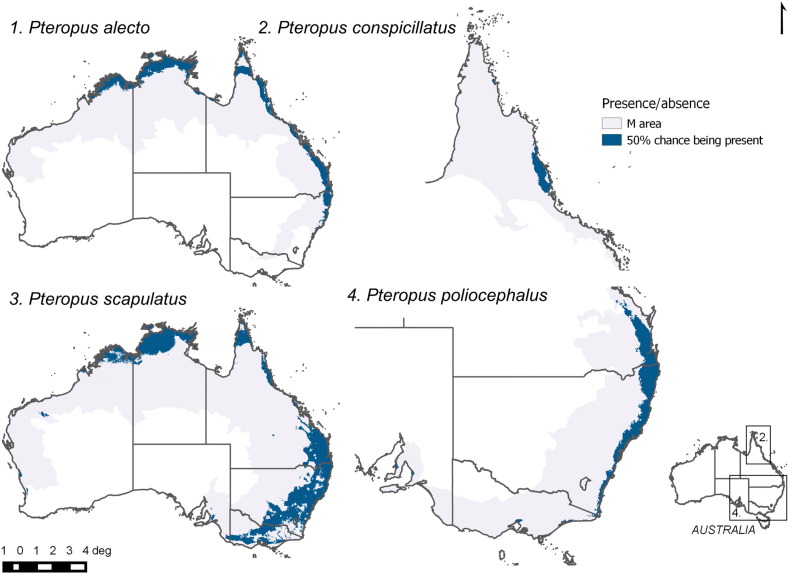
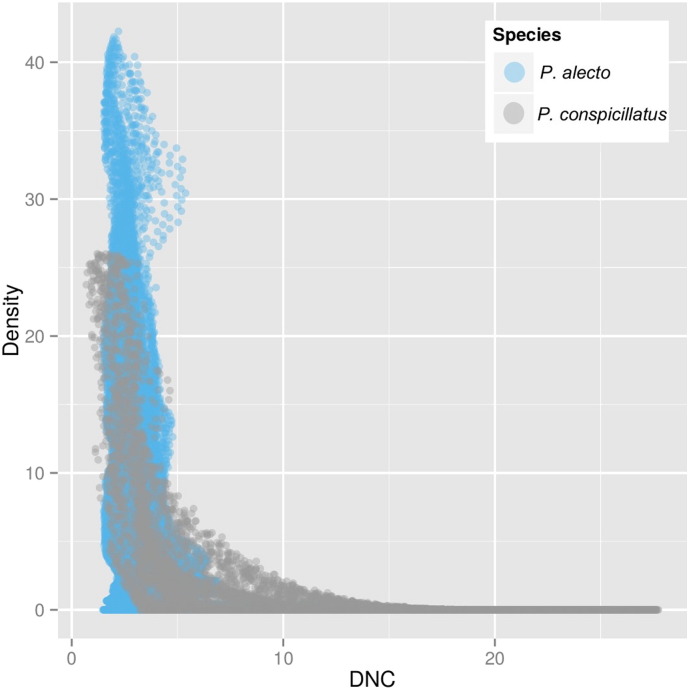
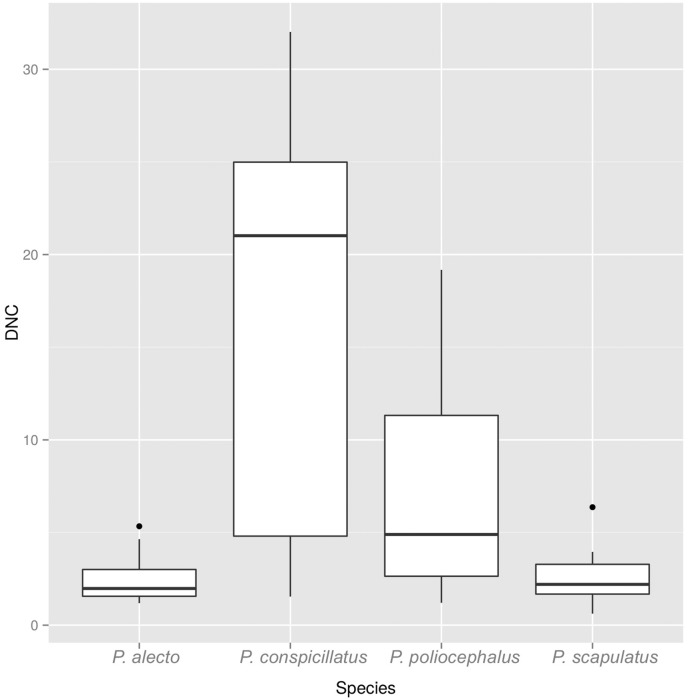
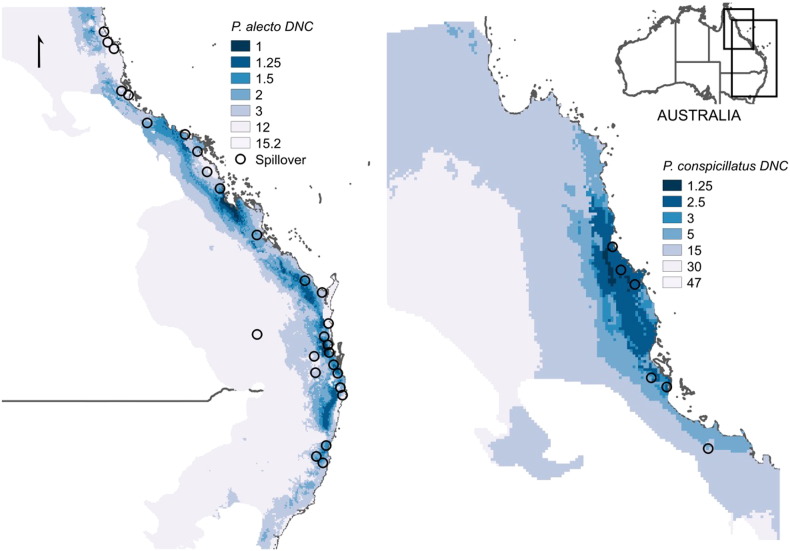
Hendra virus is a paramyxovirus of Australian flying fox bats. It was first detected in August 1994, after the death of 20 horses and one human. Since then it has occurred regularly within a portion of the geographical distribution of all Australian flying fox (fruit bat) species. There is, however, little understanding about which species are most likely responsible for spillover, or why spillover does not occur in other areas occupied by reservoir and spillover hosts. Using ecological niche models of the four flying fox species we were able to identify which species are most likely linked to spillover events using the concept of distance to the niche centroid of each species. With this novel approach we found that 20 out of 27 events occur disproportionately closer to the niche centroid of two species (. and . ). With linear regressions we found a negative relationship between distance to the niche centroid and abundance of these two species. Thus, we suggest that the bioclimatic niche of these two species is likely driving the spatial pattern of spillover of Hendra virus into horses and ultimately humans.
亨德拉病毒是澳大利亚狐蝠的一种副粘病毒。1994年8月,在20匹马和1人死亡后首次被发现。从那时起,它在澳大利亚所有狐蝠(果蝠)物种地理分布的一部分区域定期出现。然而,对于哪些物种最有可能导致病毒外溢,或者为什么在储存宿主和溢出宿主占据的其他区域没有发生病毒外溢,人们了解甚少。利用四种狐蝠物种的生态位模型,我们能够通过每个物种到生态位中心的距离概念,确定哪些物种最有可能与病毒外溢事件有关。通过这种新颖的方法,我们发现27起事件中有20起发生在距离两个物种(. 和. )的生态位中心不成比例地更近的地方。通过线性回归,我们发现到生态位中心的距离与这两个物种的丰度之间存在负相关关系。因此,我们认为这两个物种的生物气候生态位可能驱动了亨德拉病毒向马并最终向人类溢出的空间模式。