Social Determinants of Health Research Center, Research Institute for Health Development, Kurdistan University of Medical Sciences, Pasdaran Ave, Sanandaj, Iran.
Clinical Research Development Center, Kowsar Hospital, Kurdistan University of Medical Sciences, Sanandaj, Iran.
BMC Public Health. 2020 Oct 2;20(1):1499. doi: 10.1186/s12889-020-09618-0.
This study aims to determine the prevalence of physical inactivity in Iranian adolescents aged 10-12 years and the impact of socioeconomic inequality on it.
In this descriptive study, the study population consisted of 10-12 years old adolescents from an Iranian population from Kurdistan, Fars and Markazi provinces in 2018. The sample size was 1590 individuals. The sampling method was cluster sampling. Data was collected using demographic questionnaire, modifiable activity questionnaire (MAQ) and socioeconomic questionnaire. Cut points on the MAQ for light activity, moderate activity and heavy activity were MET< 3, MET = 3-6 and MET> 6, respectively. Linear and logistic regression were used to estimate the final model and the Oaxaca analysis method was applied. All analyses were performed in Stata/SE 14.0.
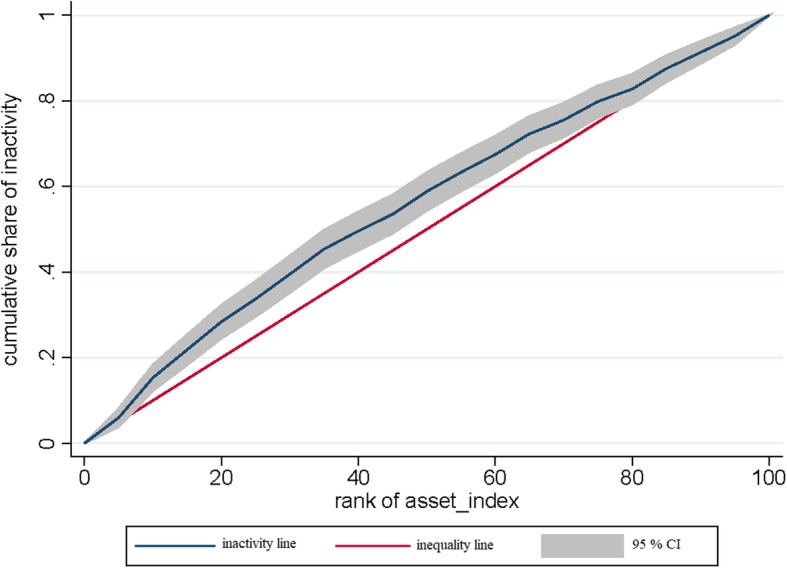
Of the 1590 participants, 52.82% were male. The results showed that 25.79% of the subjects were physically inactive and 7.30% engaged in moderate physical activity during the week. The average physical activity during 1 week was more in boys than in girls (P-value< 0.05). Adolescents of mothers with secondary and high school education were more likely to have physical inactivity than mothers with a high school diploma or higher (AOR: 1.35, 95% CI: 1.02-1.77). The concentration index was -.11, indicating a greater concentration of physical inactivity in adolescents with low socioeconomic levels.
One-fourth of the study population had physical inactivity in this age group. Socioeconomic levels, parental literacy, and sex of adolescents were associated with the level of physical activity.
本研究旨在确定伊朗 10-12 岁青少年身体活动不足的流行率以及社会经济不平等对其的影响。
在这项描述性研究中,研究人群包括 2018 年来自伊朗库尔德斯坦、法尔斯和马赞德兰省的 10-12 岁青少年。样本量为 1590 人。抽样方法为聚类抽样。使用人口统计学问卷、可修改活动问卷(MAQ)和社会经济问卷收集数据。MAQ 上的轻活动、中度活动和重活动切点分别为 MET<3、MET=3-6 和 MET>6。线性和逻辑回归用于估计最终模型,并应用了 Oaxaca 分析方法。所有分析均在 Stata/SE 14.0 中进行。
在 1590 名参与者中,有 52.82%是男性。结果表明,25.79%的受试者身体活动不足,7.30%的受试者在一周内进行中度身体活动。男孩的平均每周身体活动量高于女孩(P 值<0.05)。母亲受过中学和高中教育的青少年比母亲有高中文凭或更高学历的青少年更有可能身体活动不足(AOR:1.35,95%CI:1.02-1.77)。集中指数为-0.11,表明身体活动不足在社会经济水平较低的青少年中更为集中。
该年龄组四分之一的研究人群存在身体活动不足的情况。青少年的社会经济水平、父母文化程度和性别与身体活动水平有关。