Biggi Stefano, Banci Lorenzo, Tedino Riccardo, Capuzzo Andrea, Cattaneo Gabriele, Tornago Stefano, Camera Andrea
Clinica Città di Alessandria - Policlinico di Monza, via Moccagatta 30, 15122, Alessandria, AL, Italy.
Fondazione Lorenzo Spotorno - Onlus, Albenga, SV, Italy.
BMC Musculoskelet Disord. 2020 Oct 2;21(1):646. doi: 10.1186/s12891-020-03674-8.
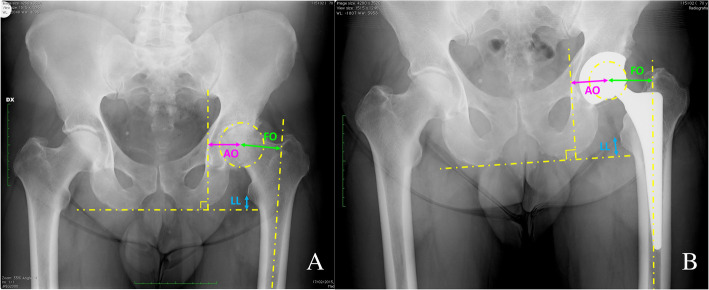
A proper restoration of hip biomechanics is fundamental to achieve satisfactory outcomes after total hip arthroplasty (THA). A global hip offset (GO) postoperatively reduction of more than 5 mm was known to impair hip functionality after THA. This study aimed to verify the restoration of the GO radiographic parameter after primary THA by the use of a cementless femoral stem available in three different offset options without length changing.
From a consecutive series of 201 patients (201 hips) underwent primary cementless THA in our center with a minimum 3-year follow up, 80 patients (80 hips) were available for complete radiographic evaluation for GO and limb length (LL) and clinical evaluation with Harris hip score (HHS). All patients received the same femoral stem with three different offset options (option A with - 5 mm offset, option B and option C with + 5 mm offset, constant for each sizes) without changing stem length.
Mean GO significantly increased by + 3 mm (P < 0.05) and mean LL significantly decreased by + 5 mm (P < 0.05) after surgery, meaning that postoperatively the limb length of the operated side increased by + 5 mm. HHS significantly improved from 56.3 points preoperatively to 95.8 postoperatively (P < 0.001). Offset option A was used in 1 hip (1%), B in 59 hips (74%) and C in 20 hips (25%).
The femur is lateralized with a mean of + 5 mm after surgery than, the native anatomy, whatever type of stem was used. Thus, the use of this 3-offset options femoral stem is effective in restoring the native biomechanical hip parameters as GO, even if 2 offset options were considered sufficient to restore GO.
全髋关节置换术(THA)后,髋关节生物力学的适当恢复是取得满意疗效的基础。已知THA术后整体髋关节偏移(GO)减少超过5毫米会损害髋关节功能。本研究旨在通过使用一种无柄股骨柄来验证初次THA后GO影像学参数的恢复情况,该股骨柄有三种不同的偏移选项且长度不变。
在我们中心连续进行的201例(201髋)初次无柄THA患者中,有80例患者(80髋)进行了至少3年的随访,可进行GO和肢体长度(LL)的完整影像学评估以及Harris髋关节评分(HHS)的临床评估。所有患者均接受了相同的股骨柄,有三种不同的偏移选项(选项A偏移-5毫米,选项B和选项C偏移+5毫米,每种尺寸恒定),且不改变股骨柄长度。
术后平均GO显著增加了+3毫米(P<0.05),平均LL显著减少了+5毫米(P<0.05),这意味着术后患侧肢体长度增加了+5毫米。HHS从术前的56.3分显著提高到术后的95.8分(P<0.001)。1例髋(1%)使用了偏移选项A,59例髋(74%)使用了选项B,20例髋(25%)使用了选项C。
无论使用何种类型的股骨柄,术后股骨向外移位的平均值比正常解剖结构多+5毫米。因此,使用这种具有三种偏移选项的股骨柄可有效恢复如GO等天然的髋关节生物力学参数,即使认为两种偏移选项足以恢复GO。