Kintampo Health Research Centre, Ghana Health Service, P.O. Box 200, Kintampo, Ghana.
Department of Behavioral Science and Health Education, College for Public Health and Social Justice, Saint Louis University, St. Louis, MO, USA.
Trials. 2020 Oct 2;21(1):825. doi: 10.1186/s13063-020-04667-7.
Physician shortage is a major barrier to hypertension (HTN) control in Ghana, with only one physician to 10,000 patients in 2015, thus limiting its capacity for HTN control at the primary care level such as the Community Health Planning and Services (CHPS) compounds, where most Ghanaians receive care. A Task-Shifting Strategy for HTN control (TASSH) based on the WHO Cardiovascular (CV) Risk Package is an evidence-based strategy for mitigating provider- and systems-level barriers to optimal HTN control. Despite its effectiveness, TASSH remains untested in CHPS zones. Additionally, primary care practices in low- and middle-income countries (LMICs) lack resources and expertise needed to coordinate multilevel system changes without assistance. The proposed study will evaluate the effectiveness of practice facilitation (PF) as a quality improvement strategy for implementing TASSH within CHPS zones in Ghana.
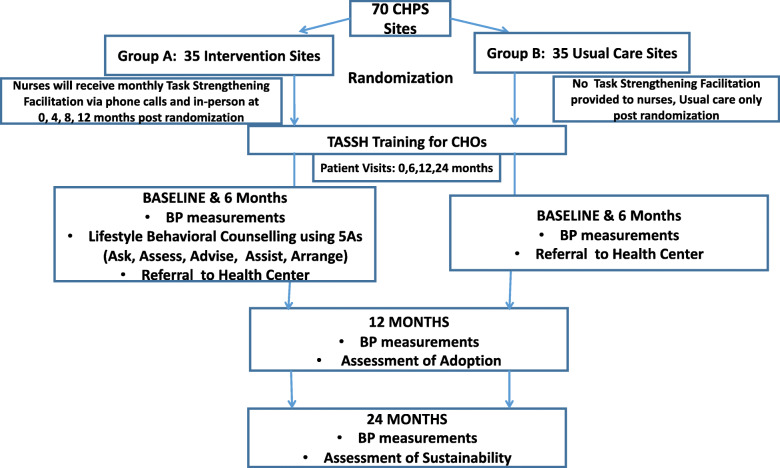
Guided by the Consolidated Framework for Implementation Research and the Reach, Effectiveness, Adoption, Implementation, and Maintenance framework, we will evaluate, in a hybrid clinical effectiveness-implementation design, the effect of PF on the uptake of an evidence-based TASSH, among 700 adults who present to 70 CHPS zones with uncontrolled HTN. Components of the PF strategy include (a) an advisory board that provides leadership support for implementing the intervention within the CHPS zones and (b) trained task-strengthening facilitators (TSFs) who serve as practice coaches to provide training, and performance feedback to community health officers (CHOs) who will deliver TASSH at the CHPS zones. For this purpose, the TSFs are trained to identify, counsel, and refer adults with uncontrolled HTN to community health centers in Bono East Region of Ghana.
Uptake of community-based evidence-supported interventions for hypertension control in Ghana is urgently needed to address the CVD epidemic and its associated morbidity, mortality, and societal costs. Findings from this study will provide policymakers and other stakeholders the "how to do it" empirical literature on the uptake of evidence-based task-strengthening interventions for HTN control in Ghana and will serve as a model for similar action in other low, middle-income countries.
ClinicalTrials.gov, NCT03490695 . Registered on 6 April 2018.
Version 1, date: 21 August, 2019.
在加纳,医师短缺是高血压(HTN)控制的主要障碍,2015 年每 10,000 名患者仅有 1 名医生,因此限制了其在初级保健层面(如社区卫生规划和服务(CHPS)化合物)控制 HTN 的能力,而加纳大多数人都在那里接受治疗。基于世界卫生组织心血管(CV)风险包的高血压控制任务转移策略(TASSH)是缓解提供者和系统层面障碍以实现最佳 HTN 控制的循证策略。尽管这种策略有效,但 TASSH 在 CHPS 区仍未得到检验。此外,中低收入国家(LMICs)的初级保健实践缺乏协调多层次系统变化所需的资源和专业知识,没有援助就难以实施。拟议的研究将评估实践促进(PF)作为在加纳 CHPS 区实施 TASSH 的质量改进策略的有效性。
本研究以实施研究综合框架和实施、有效性、采用、实施和维持框架为指导,将采用混合临床有效性-实施设计,评估 PF 对 700 名患有未控制 HTN 的成年人在 70 个 CHPS 区采用基于证据的 TASSH 的影响。PF 策略的组成部分包括:(a)一个顾问委员会,为在 CHPS 区实施干预措施提供领导支持;(b)经过培训的任务强化促进者(TSF),他们担任实践教练,为在 CHPS 区提供 TASSH 的社区卫生官员(CHO)提供培训和绩效反馈。为此,TSF 经过培训,可以识别、咨询和转诊患有未控制 HTN 的成年人到加纳博诺东区的社区卫生中心。
加纳迫切需要采用基于社区的循证干预措施来控制高血压,以应对心血管疾病流行及其相关的发病率、死亡率和社会成本。这项研究的结果将为决策者和其他利益相关者提供关于在加纳采用基于证据的 TASSH 控制高血压的“如何做”的实证文献,并为其他低收入、中等收入国家的类似行动提供模式。
ClinicalTrials.gov,NCT03490695。注册于 2018 年 4 月 6 日。
第 1 版,日期:2019 年 8 月 21 日。