Key Laboratory of Land Surface Pattern and Simulation, Institute of Geographic Sciences and Natural Resources Research, Chinese Academy of Sciences, Beijing, 100101, China.
University of Chinese Academy of Sciences, Beijing, 100049, China.
Nat Commun. 2020 Oct 2;11(1):4945. doi: 10.1038/s41467-020-18743-8.
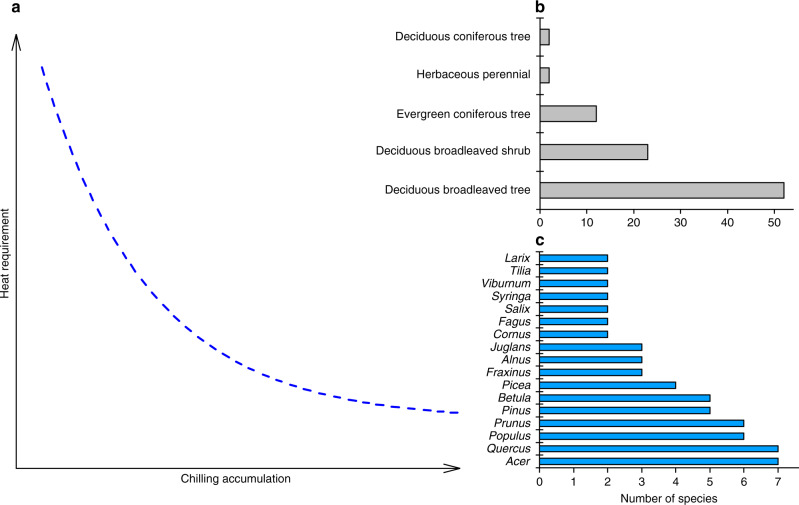
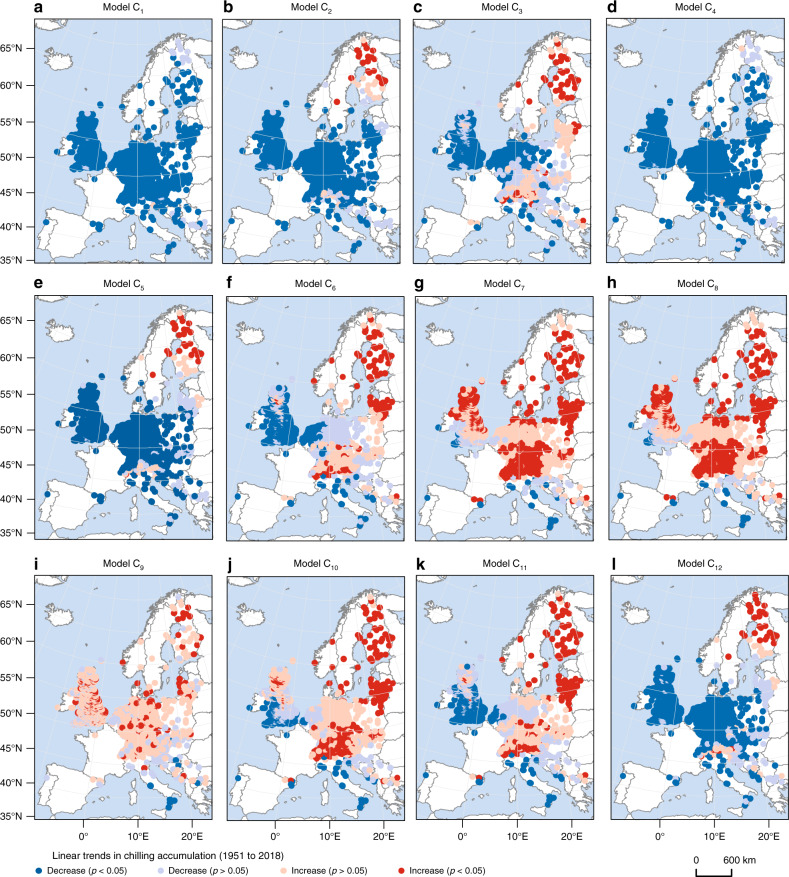
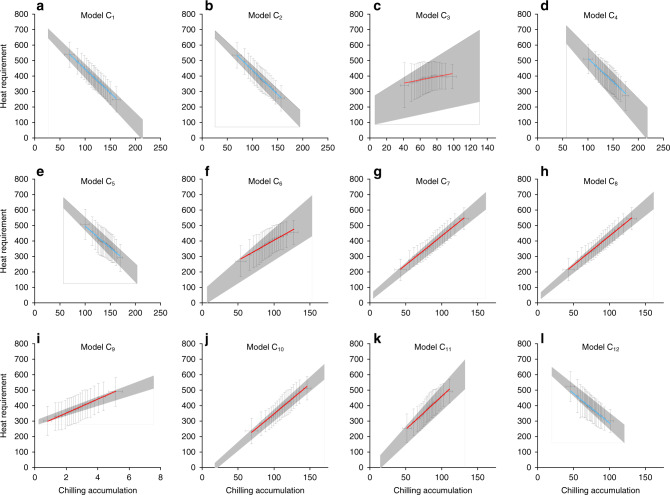
Spring warming substantially advances leaf unfolding and flowering time for perennials. Winter warming, however, decreases chilling accumulation (CA), which increases the heat requirement (HR) and acts to delay spring phenology. Whether or not this negative CA-HR relationship is correctly interpreted in ecosystem models remains unknown. Using leaf unfolding and flowering data for 30 perennials in Europe, here we show that more than half (7 of 12) of current chilling models are invalid since they show a positive CA-HR relationship. The possible reason is that they overlook the effect of freezing temperature on dormancy release. Overestimation of the advance in spring phenology by the end of this century by these invalid chilling models could be as large as 7.6 and 20.0 days under RCPs 4.5 and 8.5, respectively. Our results highlight the need for a better representation of chilling for the correct understanding of spring phenological responses to future climate change.
春季变暖会大大提前多年生植物的叶片展开和开花时间。然而,冬季变暖会减少冷积累(CA),这增加了热量需求(HR),并延迟春季物候。生态系统模型是否正确解释了这种负的 CA-HR 关系仍然未知。本文使用了欧洲 30 种多年生植物的叶片展开和开花数据,结果表明,目前有超过一半(12 个中的 7 个)的冷量模型是无效的,因为它们显示出 CA-HR 呈正相关。其可能的原因是它们忽略了冻结温度对休眠解除的影响。这些无效的冷量模型高估了本世纪末春季物候的提前,在 RCP4.5 和 RCP8.5 下分别可达 7.6 和 20.0 天。研究结果强调了需要更好地表示冷量,以正确理解未来气候变化对春季物候的响应。