Disease Control and Environmental Health, Makerere University School of Public Health, Uganda.
Department of Biotechnology and Diagnostic Sciences, Makerere University College of Veterinary Medicine, Animal Resources and Biosecurity, Kampala, Uganda.
J Epidemiol Glob Health. 2020 Dec;10(4):250-257. doi: 10.2991/jegh.k.200825.001. Epub 2020 Aug 28.
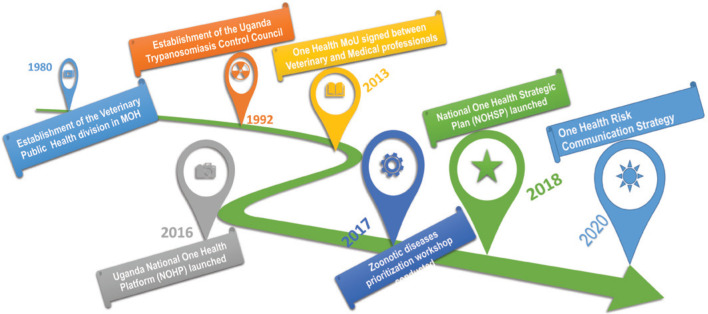
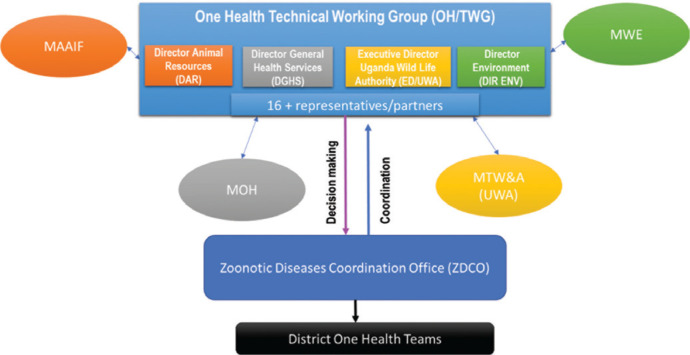
Uganda is considered as a 'hot spot' for emerging and re-emerging infectious disease epidemics. The country has experienced several epidemics including; Ebola, Marburg, plague, Rift Valley fever, yellow fever and Crimean Congo haemorrhagic fever. Epidemics overwhelm health systems, devastate economies and cause global health insecurity. These public health challenges arising from the interaction of humans-animals-environment link require a holistic approach referred to as One Health (OH). OH is the collaborative effort of multiple disciplines working locally, nationally, and globally, to attain optimal health for people, animals, and the environment. Given its situation, Uganda has embraced the OH approach in order to be able to predict, prepare and respond to these public health challenges effectively, though still in infancy stages. In this paper, we present major achievements and challenges of OH implementation, and make recommendations for systematic and sustainable OH implementation. Achievements include: formation of the National One Health (NOH) platform with a Memorandum of Understanding between sectors; a national priority list of zoonotic diseases, the NOH Strategic Plan and a One Health communication strategy to strengthen engagement across sectors and stakeholders. There have also been efforts to integrate OH in academia. The challenges are related to inadequate; coordination across sectors, government commitment, advocacy and awareness creation and research. For systematic and sustainable OH engagements, urgent efforts should be made through government support to address current and related future challenges.
乌干达被认为是新出现和再出现传染病流行的“热点”地区。该国经历了几次流行病,包括埃博拉、马尔堡、鼠疫、裂谷热、黄热病和克里米亚-刚果出血热。流行病使卫生系统不堪重负,摧毁经济,造成全球健康不安全。这些源于人类-动物-环境相互作用的公共卫生挑战需要采取一种被称为“同一健康”(One Health,OH)的整体方法。OH 是指多个学科在地方、国家和全球范围内协同努力,以实现人类、动物和环境的最佳健康。鉴于其情况,乌干达已经采用了 OH 方法,以便能够有效地预测、准备和应对这些公共卫生挑战,尽管仍处于起步阶段。在本文中,我们介绍了 OH 实施的主要成就和挑战,并为系统和可持续的 OH 实施提出了建议。成就包括:形成了具有部门间谅解备忘录的国家同一健康(NOH)平台;国家人畜共患病优先清单、NOH 战略计划和同一健康沟通战略,以加强各部门和利益攸关方之间的参与。此外,还努力将 OH 纳入学术界。挑战与部门间协调不足、政府承诺、宣传和提高认识以及研究有关。为了进行系统和可持续的 OH 参与,应通过政府支持,紧急解决当前和相关的未来挑战。