Spangler Derek P, McGinley Jared J
Human Research and Engineering Directorate, U.S. Army Research Laboratory, Aberdeen, MD, United States.
Department of Psychology, Towson University, Towson, MD, United States.
Front Psychol. 2020 Sep 9;11:2093. doi: 10.3389/fpsyg.2020.02093. eCollection 2020.
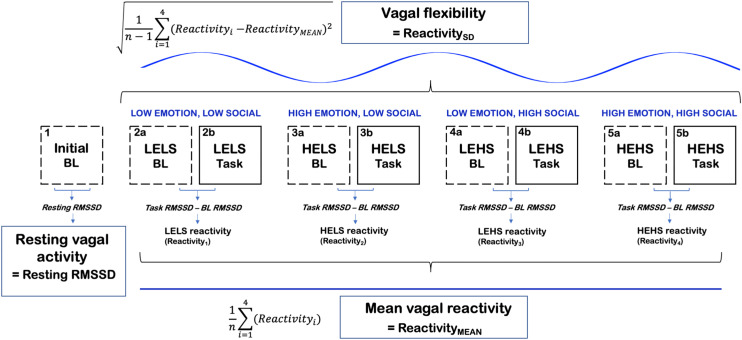
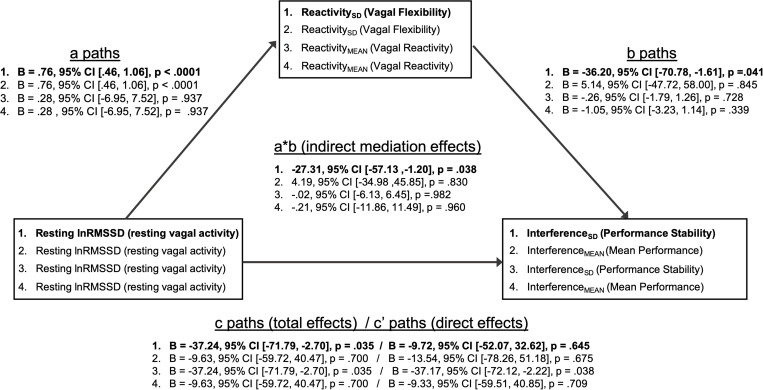
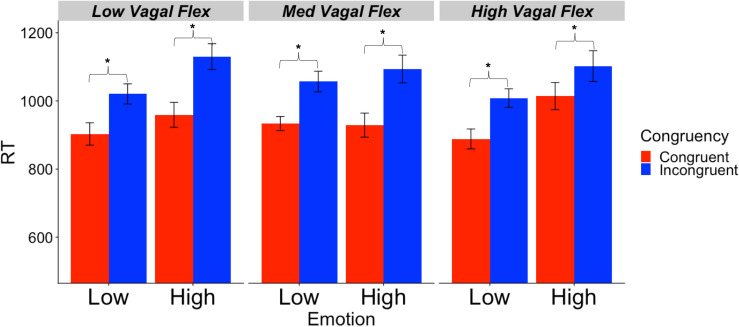
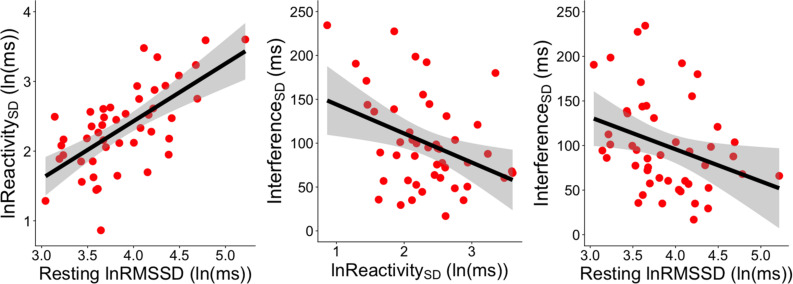
Vagal flexibility describes the ability to modulate cardiac vagal responses to fit a dynamic range of challenges. Extant theory on vagal function implies that vagal flexibility is a mediating mechanism through which resting vagal activity, a putative individual difference related to self-regulation, affects adaptive behavior and cognition. Nevertheless, little research has directly tested this hypothesis, thereby leaving fundamental mechanisms of vagal function and adaptability unclear. To this end, 47 healthy subjects completed a 5 min baseline followed by Stroop tasks combined with concurrent auditory distractors. There were four different Stroop task conditions that varied the social and emotional content of the auditory distractors. Electrocardiogram was continuously recorded to assess vagal responses to each condition as heart rate variability [root mean square of successive differences (RMSSDs)] reactivity. Vagal flexibility significantly mediated the association between resting vagal activity and stability of inhibition performance (Stroop interference) scores. In particular, higher resting RMSSD was related to higher standard deviation of RMSSD reactivity scores, reflecting greater differences in RMSSD reactivity between distractor conditions (i.e., greater vagal flexibility). Greater vagal flexibility was in turn related to more stability in Stroop interference across the same conditions. The mean of RMSSD reactivity scores across conditions was not significantly related to resting RMSSD or stability in Stroop performance, and mean RMSSD reactivity did not mediate relations between resting RMSSD and stability in Stroop performance. Overall, findings suggest that vagal flexibility may promote the effects of resting vagal activity on stabilizing cognitive inhibition in the face of environmental perturbations.
迷走神经灵活性描述了调节心脏迷走神经反应以适应一系列动态挑战的能力。关于迷走神经功能的现有理论表明,迷走神经灵活性是一种中介机制,通过它,静息迷走神经活动(一种与自我调节相关的假定个体差异)影响适应性行为和认知。然而,很少有研究直接验证这一假设,因此迷走神经功能和适应性的基本机制仍不明确。为此,47名健康受试者先完成5分钟的基线测试,然后进行斯特鲁普任务,并伴有同步听觉干扰。有四种不同的斯特鲁普任务条件,这些条件改变了听觉干扰的社会和情感内容。连续记录心电图,以评估迷走神经对每种条件的反应,即心率变异性[逐次差值的均方根(RMSSD)]反应性。迷走神经灵活性显著介导了静息迷走神经活动与抑制表现(斯特鲁普干扰)分数稳定性之间的关联。具体而言,较高的静息RMSSD与RMSSD反应性分数的较高标准差相关,这反映了不同干扰条件下RMSSD反应性的更大差异(即更大的迷走神经灵活性)。更大的迷走神经灵活性反过来又与相同条件下斯特鲁普干扰的更高稳定性相关。各条件下RMSSD反应性分数的平均值与静息RMSSD或斯特鲁普表现的稳定性无显著相关性,且平均RMSSD反应性并未介导静息RMSSD与斯特鲁普表现稳定性之间的关系。总体而言,研究结果表明,迷走神经灵活性可能促进静息迷走神经活动在面对环境干扰时对稳定认知抑制的作用。