Galet Benjamin, Cheval Hélène, Ravassard Philippe
Molecular Pathophysiology of Parkinson's Disease Group, Paris Brain Institute (ICM), INSERM U, CNRS UMR 7225, Sorbonne University, Paris, France.
Front Neurol. 2020 Sep 4;11:1005. doi: 10.3389/fneur.2020.01005. eCollection 2020.
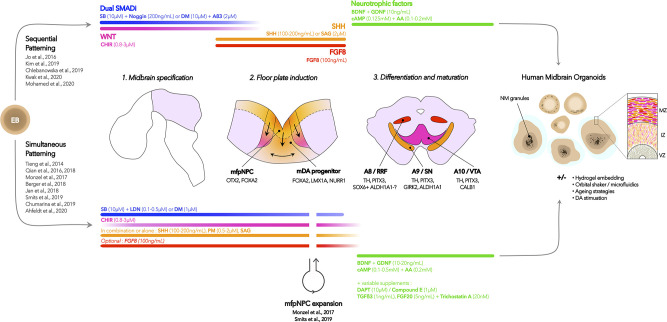
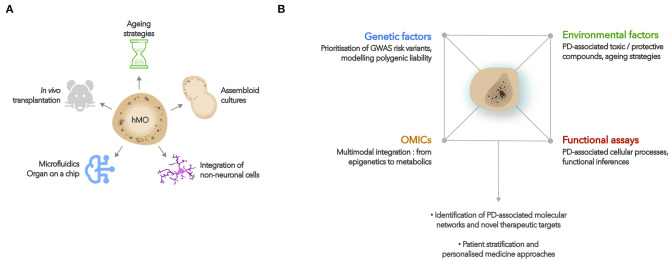
Induced pluripotent stem cell-derived organoids offer an unprecedented access to complex human tissues that recapitulate features of architecture, composition and function of organs. In the context of Parkinson's Disease (PD), human midbrain organoids (hMO) are of significant interest, as they generate dopaminergic neurons expressing markers of identity, which are the most vulnerable to degeneration. Combined with genome editing approaches, hMO may thus constitute a valuable tool to dissect the genetic makeup of PD by revealing the effects of risk variants on pathological mechanisms in a representative cellular environment. Furthermore, the flexibility of organoid co-culture approaches may also enable the study of neuroinflammatory and neurovascular processes, as well as interactions with other brain regions that are also affected over the course of the disease. We here review existing protocols to generate hMO, how they have been used so far to model PD, address challenges inherent to organoid cultures, and discuss applicable strategies to dissect the molecular pathophysiology of the disease. Taken together, the research suggests that this technology represents a promising alternative to 2D models, which could significantly improve our understanding of PD and help accelerate therapeutic developments.
诱导多能干细胞来源的类器官为研究复杂的人体组织提供了前所未有的途径,这些类器官能够重现器官的结构、组成和功能特征。在帕金森病(PD)的背景下,人类中脑类器官(hMO)备受关注,因为它们能产生表达身份标志物的多巴胺能神经元,而这些神经元是最易发生变性的。结合基因组编辑方法,hMO因此可能成为一种有价值的工具,通过在具有代表性的细胞环境中揭示风险变异对病理机制的影响来剖析PD的遗传构成。此外,类器官共培养方法的灵活性还可能有助于研究神经炎症和神经血管过程,以及与疾病过程中同样受到影响的其他脑区的相互作用。我们在此回顾了生成hMO的现有方案、它们目前如何被用于模拟PD、解决类器官培养固有的挑战,并讨论剖析该疾病分子病理生理学的适用策略。综上所述,研究表明这项技术是二维模型的一个有前景的替代方案,能够显著增进我们对PD的理解,并有助于加速治疗进展。