Department of Immunology, Memorial Sloan Kettering Cancer Center, Sloan Kettering Institute, New York, NY, United States.
Department of Medicine I, Faculty of Medicine, Medical Center, University of Freiburg, Freiburg, Germany.
Front Immunol. 2020 Aug 18;11:1854. doi: 10.3389/fimmu.2020.01854. eCollection 2020.
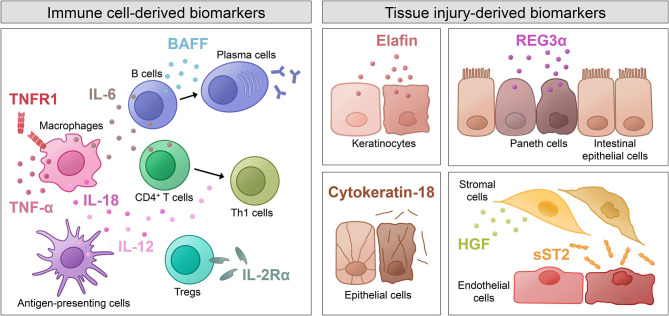
Allogeneic hematopoietic stem cell transplantation (allo-HSCT) is a well-established curative treatment for various malignant hematological diseases. However, its clinical success is substantially limited by major complications including graft-vs.-host disease (GVHD) and relapse of the underlying disease. Although these complications are known to lead to significant morbidity and mortality, standardized pathways for risk stratification of patients undergoing allo-HSCT are lacking. Recent advances in the development of diagnostic and prognostic tools have allowed the identification of biomarkers in order to predict outcome after allo-HSCT. This review will provide a summary of clinically relevant biomarkers that have been studied to predict the development of acute GVHD, the responsiveness of affected patients to immunosuppressive treatment and the risk of non-relapse mortality. Furthermore, biomarkers associated with increased risk of relapse and subsequent mortality will be discussed.
异基因造血干细胞移植(allo-HSCT)是治疗各种恶性血液病的一种成熟的治疗方法。然而,其临床成功率受到多种严重并发症的显著限制,包括移植物抗宿主病(GVHD)和基础疾病的复发。尽管这些并发症是导致发病率和死亡率显著增加的已知原因,但缺乏针对接受 allo-HSCT 患者的风险分层的标准化途径。在开发诊断和预后工具方面的最新进展,使得能够识别生物标志物,以预测 allo-HSCT 后的结果。本综述将总结已研究用于预测急性 GVHD 发展、受影响患者对免疫抑制治疗的反应性和非复发死亡率风险的临床相关生物标志物。此外,还将讨论与复发风险增加和随后死亡相关的生物标志物。