Shan Qingsong, Wei Changting, Jiang Yan, Song Jizhong, Zou Yousheng, Xu Leimeng, Fang Tao, Wang Tiantian, Dong Yuhui, Liu Jiaxin, Han Boning, Zhang Fengjuan, Chen Jiawei, Wang Yongjin, Zeng Haibo
MIIT Key Laboratory of Advanced Display Materials and Devices, Institute of Optoelectronics & Nanomaterials, School of Materials Science and Engineering, Nanjing University of Science and Technology, Nanjing, 210094 China.
Peter Grünberg Research Center, Laboratory of Broadband Wireless Communication and Sensor Network Technology, Ministry of Education, Nanjing University of Posts and Telecommunications, Nanjing, 210003 China.
Light Sci Appl. 2020 Sep 16;9:163. doi: 10.1038/s41377-020-00402-8. eCollection 2020.
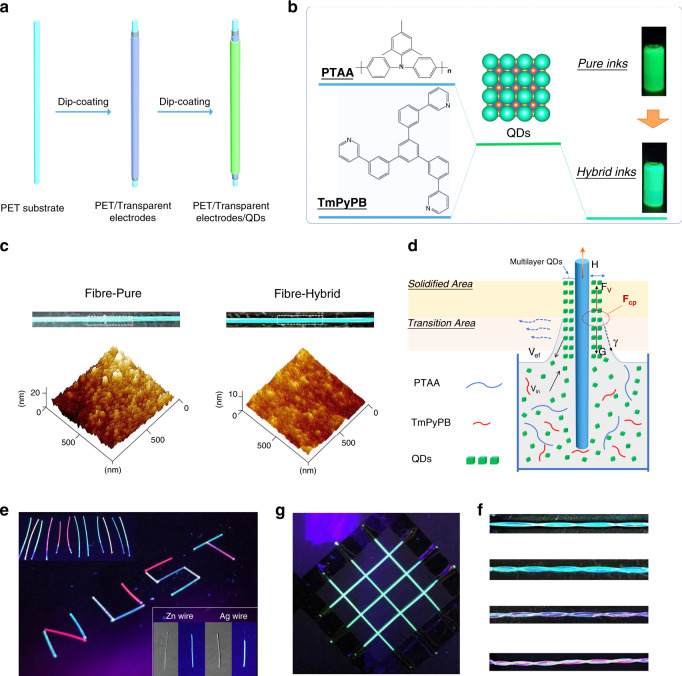
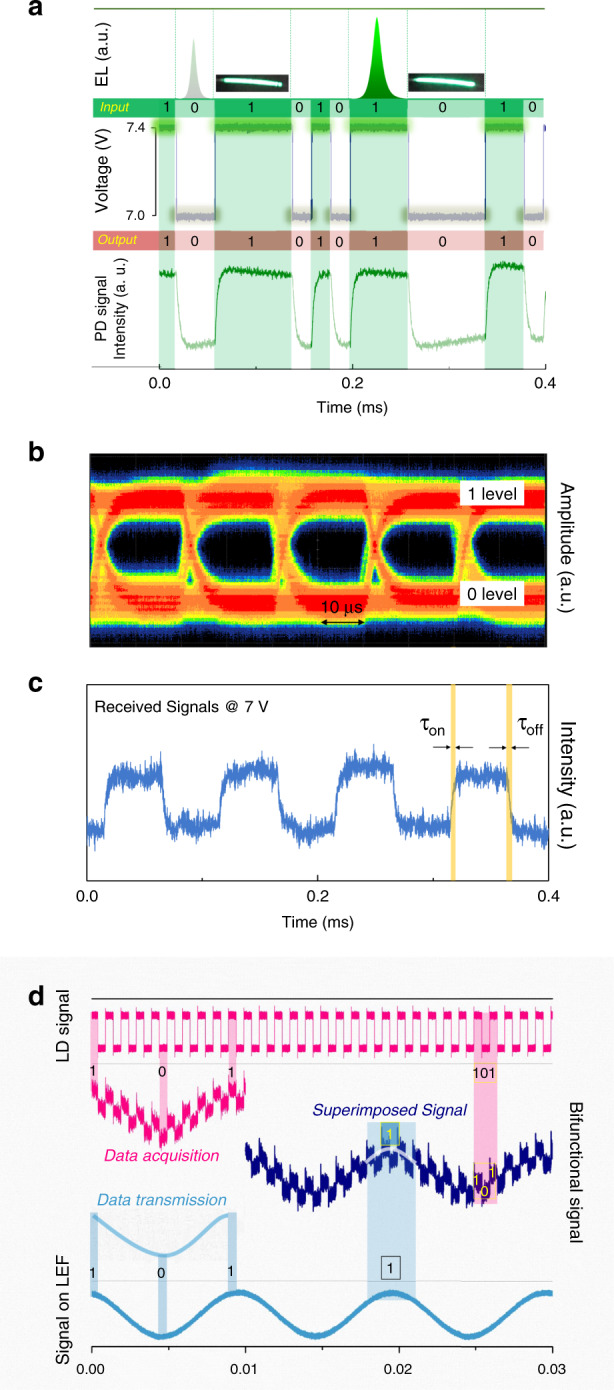
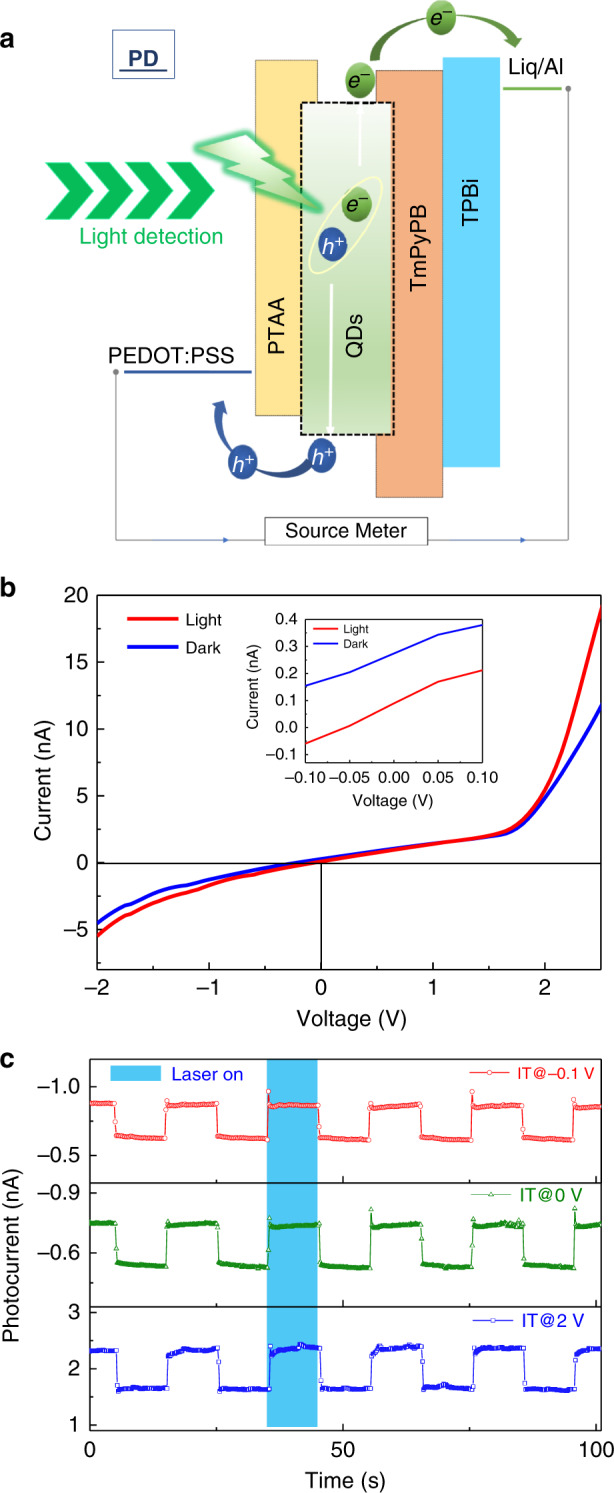
Light fidelity (LiFi), which is emerging as a compelling technology paradigm shifting the common means of high-capacity wireless communication technologies, requires wearable and full-duplex compact design because of its great significance in smart wearables as well as the 'Internet of Things'. However, the construction of the key component of wearable full-duplex LiFi, light-emitting/detecting bifunctional fibres, is still challenging because of the conflicting process between carrier separation and recombination, as well as the highly dynamic film-forming process. Here, we demonstrate light-emitting/detecting bifunctional fibres enabled by perovskite QDs with hybrid components. The hybrid perovskite inks endow fibres with super-smooth QD films. This, combined with the small exciton binding energy and high carrier mobility of perovskite QDs, enables successful integration of electroluminescence and photodetection into monofilaments. The bifunctional fibres possess the narrowest electroluminescence full width at half maximum of ~19 nm and, more importantly, the capability for simultaneously transmitting and receiving information. The successful fabrication of narrow emission full-duplex LiFi fibres paves the way for the fabrication and integration of low crosstalk interoperable smart wearables.
光保真度(LiFi)作为一种引人注目的技术范式,正在改变高容量无线通信技术的常见方式,由于其在智能可穿戴设备以及“物联网”中的重大意义,需要可穿戴和全双工紧凑型设计。然而,可穿戴全双工LiFi的关键组件——发光/检测双功能纤维的构建仍然具有挑战性,这是因为载流子分离和复合过程相互冲突,以及成膜过程高度动态。在此,我们展示了由具有混合组件的钙钛矿量子点实现的发光/检测双功能纤维。混合钙钛矿油墨赋予纤维超光滑的量子点薄膜。这与钙钛矿量子点的小激子结合能和高载流子迁移率相结合,使得电致发光和光电检测能够成功集成到单丝中。这种双功能纤维具有约19纳米的最窄电致发光半高宽,更重要的是,具有同时发送和接收信息的能力。窄发射全双工LiFi纤维的成功制造为低串扰可互操作智能可穿戴设备的制造和集成铺平了道路。