Umemura Takumi, Mutoh Yoshikazu, Kawamura Takato, Saito Masayuki, Mizuno Takahito, Ota Aiko, Kozaki Koji, Yamada Tetsuya, Ikeda Yoshiaki, Ichihara Toshihiko
Department of Pharmacy, Tosei General Hospital, 160, Nishi oiwakecho, Seto, Aichi 489-8642 Japan.
Department of Infection and Prevention, Tosei General Hospital, 160, Nishi oiwakecho, Seto, Aichi 489-8642 Japan.
J Pharm Health Care Sci. 2020 Oct 1;6:21. doi: 10.1186/s40780-020-00178-4. eCollection 2020.
Baloxavir marboxil (baloxavir) is a new anti-influenza virus agent that is comparable to oseltamivir phosphate (oseltamivir). Since the efficacy of baloxavir in preventing household transmission of influenza is not well established, we compared the secondary household influenza virus transmission rates between patients on baloxavir vs oseltamivir.
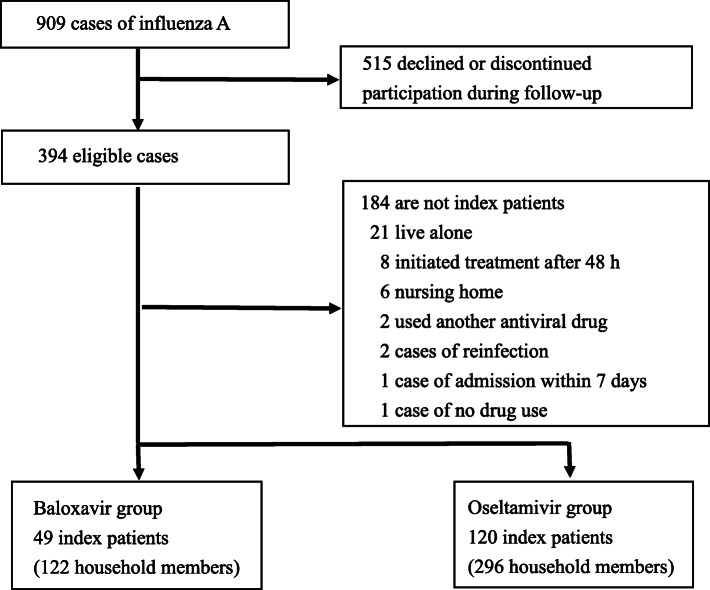
Between October 2018 and March 2019, we enrolled index patients (diagnosed with influenza and treated with baloxavir or oseltamivir) and household members. The secondary attack rate of household members was compared between index patients treated with baloxavir vs oseltamivir. Risk factors of household transmission were determined using multivariate logistic analyses.
In total, 169 index patients with influenza type A were enrolled. The median age was 27.0 (interquartile range; 11-57) years. The number of index patients treated with baloxavir and oseltamivir was 49 and 120, respectively. The secondary attack rate was 9.0% (95% confidence interval [CI]: 4.6-15.6) in the baloxavir group and 13.5% (95% CI: 9.8-17.9) in the oseltamivir group. In the multivariate analysis, independent risk factors were 0-6 years of age (odds ratio [OR] 2.78, 95% CI: 1.33-5.82, < 0.01) and not being on baloxavir treatment. (OR: 0.63, 95% CI: 0.30-1.32, = 0.22).
The household secondary attack rate of influenza was comparable in patients treated with baloxavir vs oseltamivir. Therefore, baloxavir can be used as an alternative therapy to oseltamivir in reducing household transmission of influenza.
Patients in this study were retrospectively registered. https://www.tosei.or.jp/clinical/pdf/2_influenza.pdf.
巴洛沙韦酯(巴洛沙韦)是一种新型抗流感病毒药物,其疗效与磷酸奥司他韦(奥司他韦)相当。由于巴洛沙韦在预防家庭内流感传播方面的疗效尚未明确,我们比较了接受巴洛沙韦治疗的患者与接受奥司他韦治疗的患者家庭内流感病毒的二次传播率。
2018年10月至2019年3月期间,我们纳入了索引患者(诊断为流感并接受巴洛沙韦或奥司他韦治疗)及其家庭成员。比较接受巴洛沙韦治疗的索引患者与接受奥司他韦治疗的索引患者家庭成员的继发感染率。使用多因素逻辑分析确定家庭传播的危险因素。
总共纳入了169例甲型流感索引患者。中位年龄为27.0岁(四分位间距;11 - 57岁)。接受巴洛沙韦和奥司他韦治疗的索引患者数量分别为49例和120例。巴洛沙韦组的继发感染率为9.0%(95%置信区间[CI]:4.6 - 15.6),奥司他韦组为13.5%(95% CI:9.8 - 17.9)。在多因素分析中,独立危险因素为0 - 6岁(比值比[OR] 2.78,95% CI:1.33 - 5.82,P < 0.01)以及未接受巴洛沙韦治疗(OR:0.63,95% CI:0.30 - 1.32,P = 0.22)。
接受巴洛沙韦治疗的患者与接受奥司他韦治疗的患者家庭内流感继发感染率相当。因此,在减少家庭内流感传播方面,巴洛沙韦可作为奥司他韦的替代疗法。
本研究中的患者为回顾性注册。https://www.tosei.or.jp/clinical/pdf/2_influenza.pdf。