Cascão Rita, Vidal Bruno, Carvalho Tânia, Lopes Inês Pascoal, Romão Vasco C, Goncalves João, Moita Luis Ferreira, Fonseca João Eurico
Unidade de Investigação em Reumatologia, Faculdade de Medicina, Instituto de Medicina Molecular-João Lobo Antunes, Centro Académico de Medicina de Lisboa, Universidade de Lisboa, Lisbon, Portugal.
Comparative Pathology Unit, Instituto de Medicina Molecular-João Lobo Antunes, Faculdade de Medicina, Universidade de Lisboa, Lisbon, Portugal.
Front Med (Lausanne). 2020 Sep 8;7:455. doi: 10.3389/fmed.2020.00455. eCollection 2020.
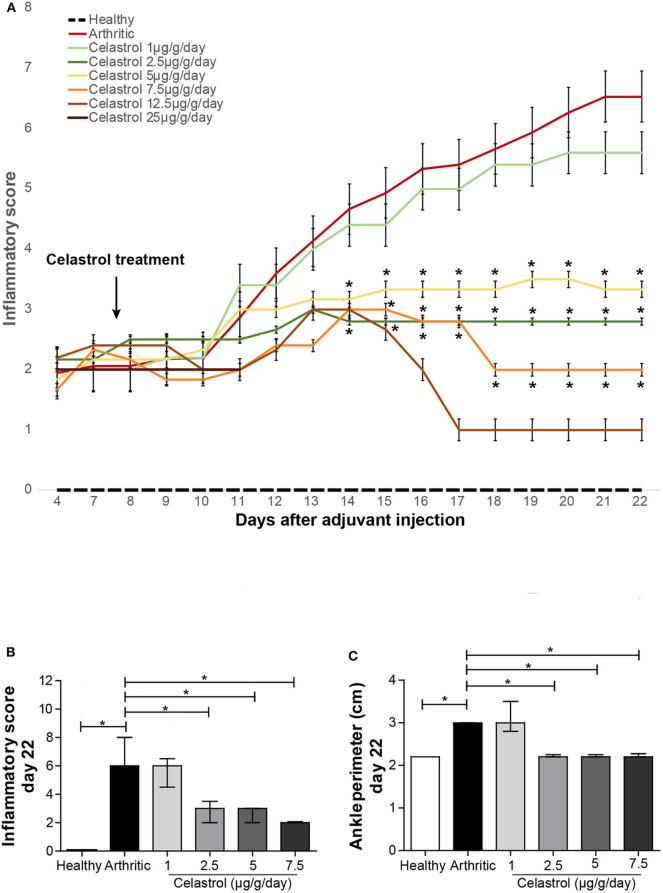
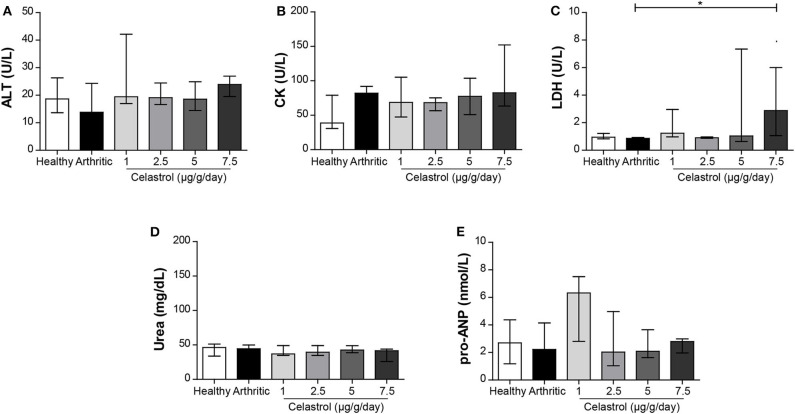
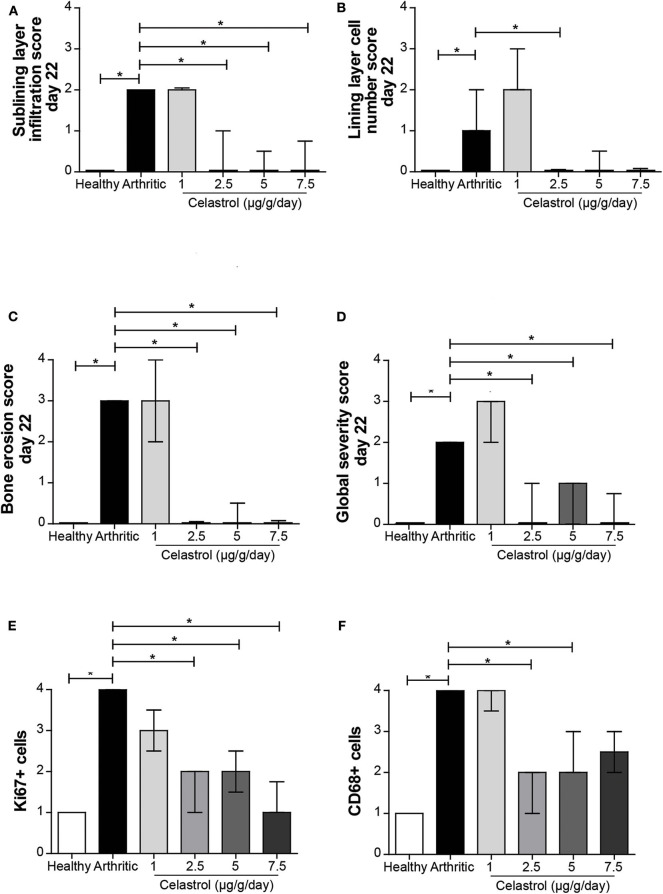
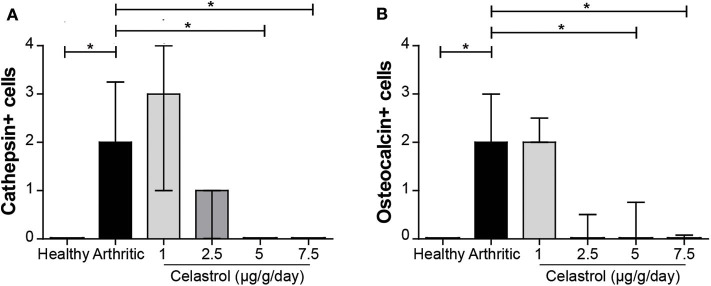
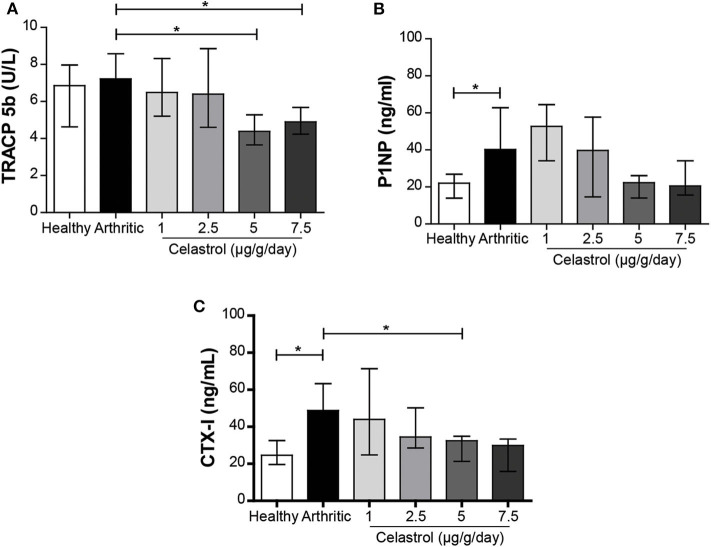
We previously demonstrated that celastrol has significant anti-inflammatory and bone protective effects when administered via the intraperitoneal route. For further preclinical evaluation, an effective oral administration of celastrol is crucial. Here we aimed to study the therapeutic dose range for its oral administration. Celastrol (1-25 μg/g/day, = 5/group) was administrated orally to female adjuvant-induced arthritis (AIA) rats after 8 days of disease induction for a period of 14 days. A group of healthy ( = 8) and arthritic ( = 15) gender- and age-matched Wistar rats was used as controls. During the treatment period, the inflammatory score, ankle perimeter, and body weight were measured. At the end of the treatment, the animals were sacrificed, blood was collected for clinical pathology, necropsy was performed with collection of internal organs for histopathological analysis, and paw samples were used for disease scoring. Doses higher than 2.5 μg/g/day of celastrol reduced the inflammatory score and ankle swelling, preserved joint structure, halted bone destruction, and diminished the number of synovial CD68+ macrophages. Bone resorption and turnover were also reduced at 5 and 7.5 μg/g/day doses. However, the dose of 7.5 μg/g/day was associated with thymic and liver lesions, and higher doses showed severe toxicity. Oral administration of celastrol above 2.5 μg/g/day ameliorates arthritis. This data supports and gives relevant information for the development of a preclinical test of celastrol in the setting of a chronic model of arthritis since rheumatoid arthritis is a long-term disease.
我们之前证明,通过腹腔注射途径给药时,雷公藤红素具有显著的抗炎和骨保护作用。为了进一步进行临床前评估,有效口服雷公藤红素至关重要。在此,我们旨在研究其口服给药的治疗剂量范围。在疾病诱导8天后,对雌性佐剂诱导性关节炎(AIA)大鼠口服给予雷公藤红素(1 - 25μg/g/天,每组n = 5),持续14天。一组健康的(n = 8)以及患有关节炎的(n = 15)性别和年龄匹配的Wistar大鼠作为对照。在治疗期间,测量炎症评分、踝关节周长和体重。治疗结束时,处死动物,采集血液进行临床病理学检查,进行尸检并收集内脏器官用于组织病理学分析,爪样本用于疾病评分。雷公藤红素剂量高于2.5μg/g/天可降低炎症评分和踝关节肿胀,保留关节结构,阻止骨质破坏,并减少滑膜CD68 +巨噬细胞数量。在5和7.5μg/g/天剂量下,骨吸收和骨转换也有所降低。然而,7.5μg/g/天的剂量与胸腺和肝脏损伤有关,更高剂量则显示出严重毒性。口服雷公藤红素剂量高于2.5μg/g/天可改善关节炎。由于类风湿性关节炎是一种长期疾病,该数据为雷公藤红素在慢性关节炎模型中的临床前试验开发提供了支持并给出了相关信息。