Pavlych Viktoriya, Di Muzio Claudia, Alunno Alessia, Carubbi Francesco
Rheumatology Unit, Department of Biotechnological and Applied Clinical Science, School of Medicine, University of L'Aquila, L'Aquila, Italy.
Rheumatology Unit, Department of Medicine, University of Perugia, Perugia, Italy.
Front Med (Lausanne). 2020 Sep 8;7:534. doi: 10.3389/fmed.2020.00534. eCollection 2020.
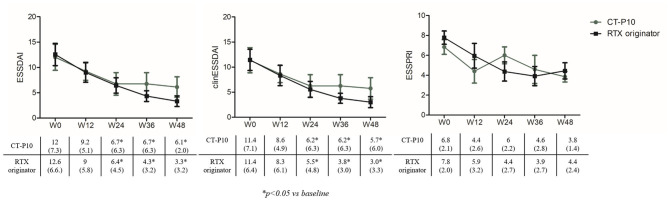
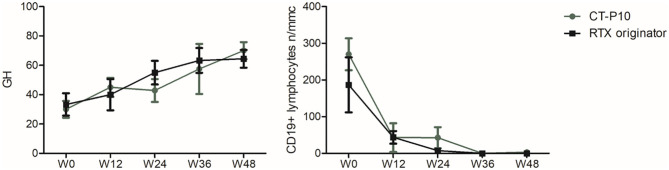
Over the last two decades, rituximab (RTX) has been widely used, albeit off-label, in primary Sjögren's syndrome (pSS). Several studies reported that B lymphocyte depletion with RTX is effective to treat some aspects within the disease spectrum, by reducing disease activity and affecting the inflammation and lymphoid organization that occur in target tissues. Notwithstanding, randomized controlled trials failed to confirm such evidence. With the recent release of several RTX biosimilars on the market, their efficacy and safety compared to the originator must be ascertained across different indications. This study aimed at comparing efficacy and safety of RTX originator and CT-P10 RTX biosimilar in pSS patients in a real-life setting. Clinical and laboratory records of pSS patients referring to a tertiary rheumatology clinic were retrospectively evaluated. Patients having received at least two courses of either RTX originator or CT-P10 with complete data at baseline and after 12, 24, 36, and 48 weeks of treatment were enrolled. Disease activity was assessed with the EULAR Sjögren's Syndrome Disease Activity Index (ESSDAI) and its clinical version without the biological domain (clinESSDAI). Patient-reported symptoms were assessed with the EULAR Sjögren's Syndrome Patient-Reported Index (ESSPRI). Adverse events (AEs) occurring during the study period were also recorded. Nine patients who received RTX originator and eight patients who received CT-P10 were enrolled. Baseline clinical and serological features, including ESSDAI and ESSPRI, were similar in the two treatment groups. An efficient depletion of circulating CD19 B lymphocytes was achieved in both treatment arms. Both RTX originator and CT-P10 significantly reduced ESSDAI and clinESSDAI by week 24, and no difference between the groups was observed at any timepoint. Conversely, changes of ESSPRI overtime did not differ between the two treatment arms and were not statistically significant compared to corresponding baseline values. With regard to safety, at 48 weeks of follow-up, only four mild AEs (two in the RTX originator and two in the CT-P10 group) were observed. Our study provides the first evidence that, at 48 weeks of follow-up, RTX originator and CT-P10 display similar efficacy and safety profiles in pSS.
在过去二十年中,利妥昔单抗(RTX)虽未获批适应症,但已在原发性干燥综合征(pSS)中广泛使用。多项研究报告称,RTX诱导的B淋巴细胞耗竭可有效治疗疾病谱中的某些方面,通过降低疾病活动度并影响靶组织中发生的炎症和淋巴组织。尽管如此,随机对照试验未能证实这一证据。随着近期几种RTX生物类似药在市场上的推出,必须在不同适应症中确定它们与原研药相比的疗效和安全性。本研究旨在比较原研RTX与CT-P10 RTX生物类似药在真实临床环境中治疗pSS患者的疗效和安全性。回顾性评估了一家三级风湿病诊所中pSS患者的临床和实验室记录。纳入了接受至少两个疗程原研RTX或CT-P10且在基线以及治疗12、24、36和48周后有完整数据的患者。使用欧洲抗风湿病联盟干燥综合征疾病活动指数(ESSDAI)及其不包括生物领域的临床版本(clinESSDAI)评估疾病活动度。使用欧洲抗风湿病联盟干燥综合征患者报告指数(ESSPRI)评估患者报告的症状。还记录了研究期间发生的不良事件(AE)。纳入了9例接受原研RTX的患者和8例接受CT-P10的患者。两个治疗组的基线临床和血清学特征,包括ESSDAI和ESSPRI,相似。两个治疗组均实现了循环CD19 B淋巴细胞的有效耗竭。到第24周时,原研RTX和CT-P10均显著降低了ESSDAI和clinESSDAI,且在任何时间点两组之间均未观察到差异。相反,两个治疗组ESSPRI随时间的变化无差异,与相应的基线值相比也无统计学意义。在安全性方面,随访48周时,仅观察到4例轻度AE(原研RTX组2例,CT-PI0组2例)。我们的研究首次证明,在随访48周时,原研RTX和CT-P10在pSS中显示出相似的疗效和安全性。