Guzmán-Rodríguez Jaquelina J, León-Galván Ma Fabiola, Barboza-Corona José E, Valencia-Posadas Mauricio, Loeza-Lara Pedro D, Sánchez-Ceja Mónica, Ochoa-Zarzosa Alejandra, López-Meza Joel E, Gutiérrez-Chávez Abner J
Life Science Division, Postgraduate Program in Bioscience, Irapuato-Salamanca Campus, University of Guanajuato, 36500 Irapuato, Guanajuato, Mexico.
Life Science Division, Department of Food, Irapuato-Salamanca Campus, University of Guanajuato, 36500 Irapuato, Guanajuato, Mexico.
J Vet Sci. 2020 Sep;21(5):e77. doi: 10.4142/jvs.2020.21.e77.
is one of the main microorganisms that causes bovine mastitis, and its well-known virulence characteristics and interactions with the environment are used to aid the design of more efficient therapies.
To determine whether the virulence traits, such as antibiotic resistance and biofilm-forming and internalization abilities, of isolated from bovine mastitis are related to dairy production system types.
The study was performed in the Mexican states of Guanajuato and Michoacan. Semi-intensive dairy farms (SIDFs) and family dairy farms (FDFs) (454 and 363 cows, respectively) were included. The 194 milk samples from mastitis affected quarters were collected and 92 strains of were isolated and identified by biochemical and molecular tests. Antibiotic resistance, biofilm and internalization assays were performed on 30 randomly selected isolated strains to determine virulence traits, and these strains were equally allocated to the 2 dairy production systems.
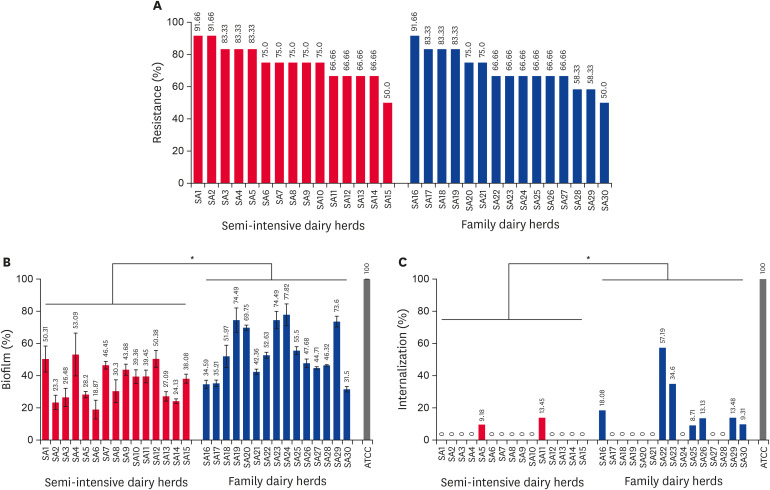
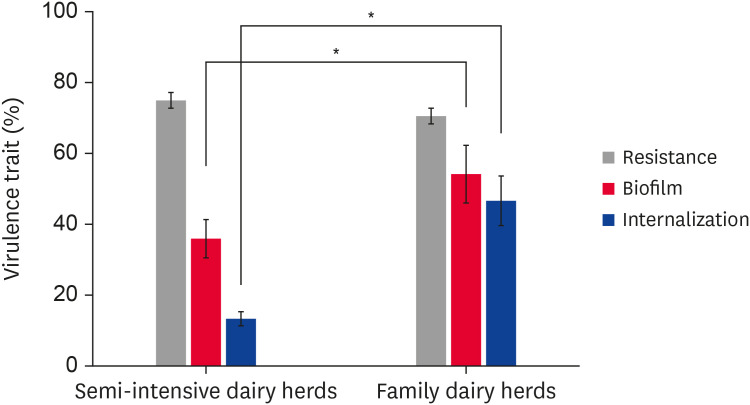
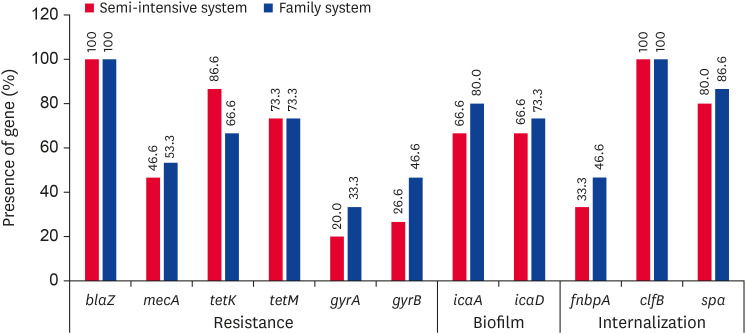
All 30 selected strains displayed a high degree of resistance (50%-91.7%) to the antibiotics tested, but no significant difference was found between SIDF and FDF isolates. strains from SIDFs had an average biofilm forming capacity of up to 36% (18.9%-53.1%), while strains from FDFs registered an average of up to 53% (31.5%-77.8%) ( > 0.05). Internalization assays revealed a higher frequency of internalization capacity for strains isolated from FDFs (33.3%) than for those isolated from SIDFs (6.7%) ( > 0.05). gen was detected in 46.6% of FDF strains and 33.3% of SIDF strains, and this difference was significant ( < 0.05).
Our findings show that the virulence traits of isolates analyzed in this study, depend significantly on several factors, such as phenotype, genotype, and environmental conditions, which are significantly related to dairy production system type and daily management practices.
是引起牛乳腺炎的主要微生物之一,其众所周知的毒力特征以及与环境的相互作用有助于设计更有效的治疗方法。
确定从牛乳腺炎中分离出的 的毒力特征,如抗生素抗性、生物膜形成能力和内化能力,是否与奶牛生产系统类型有关。
该研究在墨西哥的瓜纳华托州和米却肯州进行。纳入了半集约化奶牛场(SIDFs)和家庭奶牛场(FDFs)(分别有454头和363头牛)。收集了194份来自患乳腺炎乳房的牛奶样本,并通过生化和分子检测分离并鉴定出92株 。对30株随机选择的分离菌株进行抗生素抗性、生物膜和内化试验以确定毒力特征,这些菌株被平均分配到2种奶牛生产系统中。
所有30株选定菌株对所测试的抗生素均表现出高度抗性(50%-91.7%),但SIDF和FDF分离株之间未发现显著差异。来自SIDFs的 菌株平均生物膜形成能力高达36%(18.9%-53.1%),而来自FDFs的 菌株平均高达53%(31.5%-77.8%)(P>0.05)。内化试验显示,从FDFs分离出的菌株内化能力频率(33.3%)高于从SIDFs分离出的菌株(6.7%)(P>0.05)。在46.6%的FDF菌株和33.3%的SIDF菌株中检测到 基因,且这种差异具有显著性(P<0.05)。
我们的研究结果表明,本研究中分析的 分离株的毒力特征在很大程度上取决于几个因素,如表型、基因型和环境条件,这些因素与奶牛生产系统类型和日常管理实践显著相关。