Structural and Computational Biology Unit, European Molecular Biology Laboratory, Heidelberg, Germany.
Department of Molecular Structural Biology, Max Planck Institute of Biochemistry, Martinsried, Germany.
Elife. 2020 Oct 5;9:e59225. doi: 10.7554/eLife.59225.
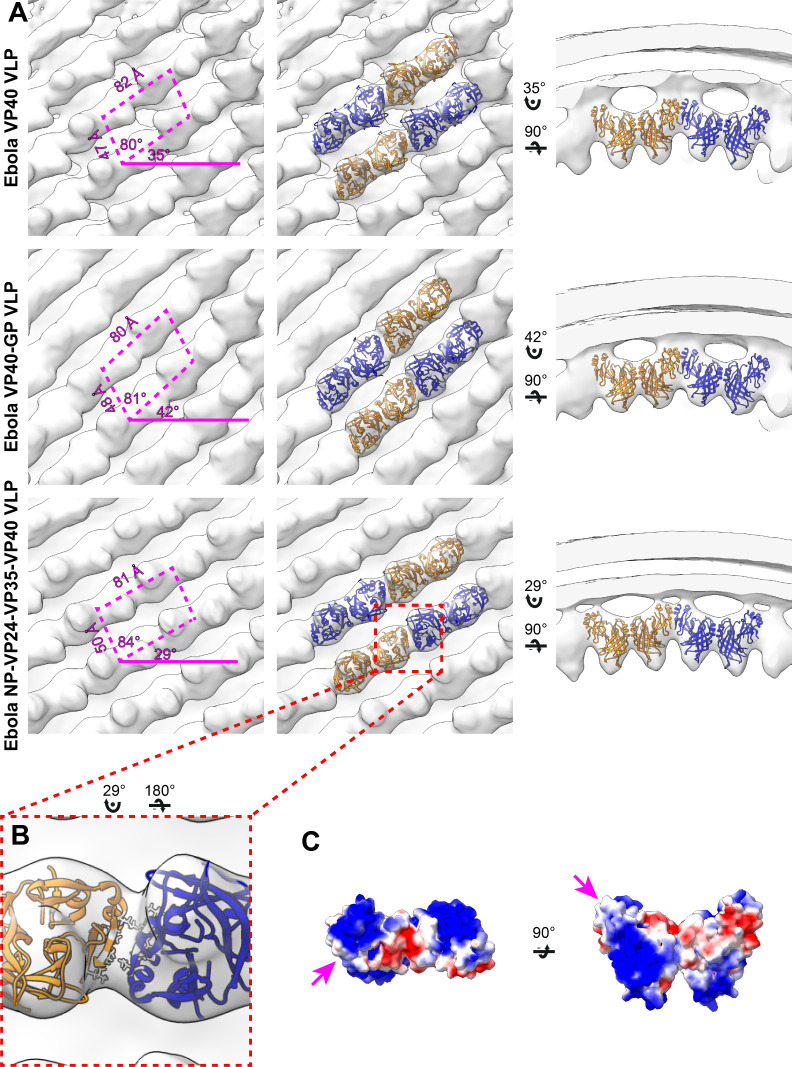
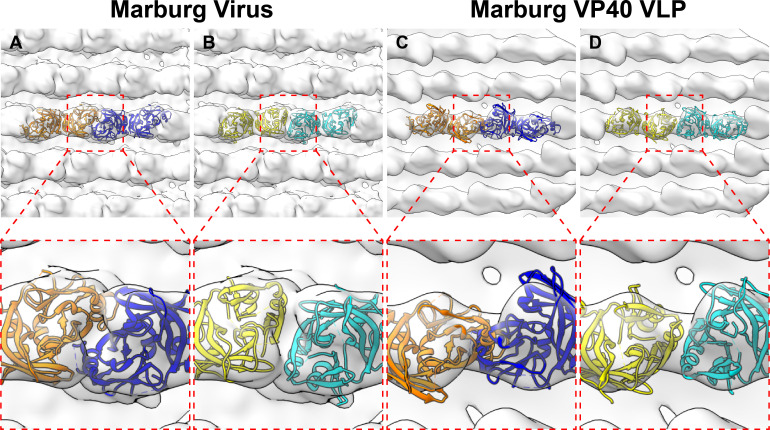
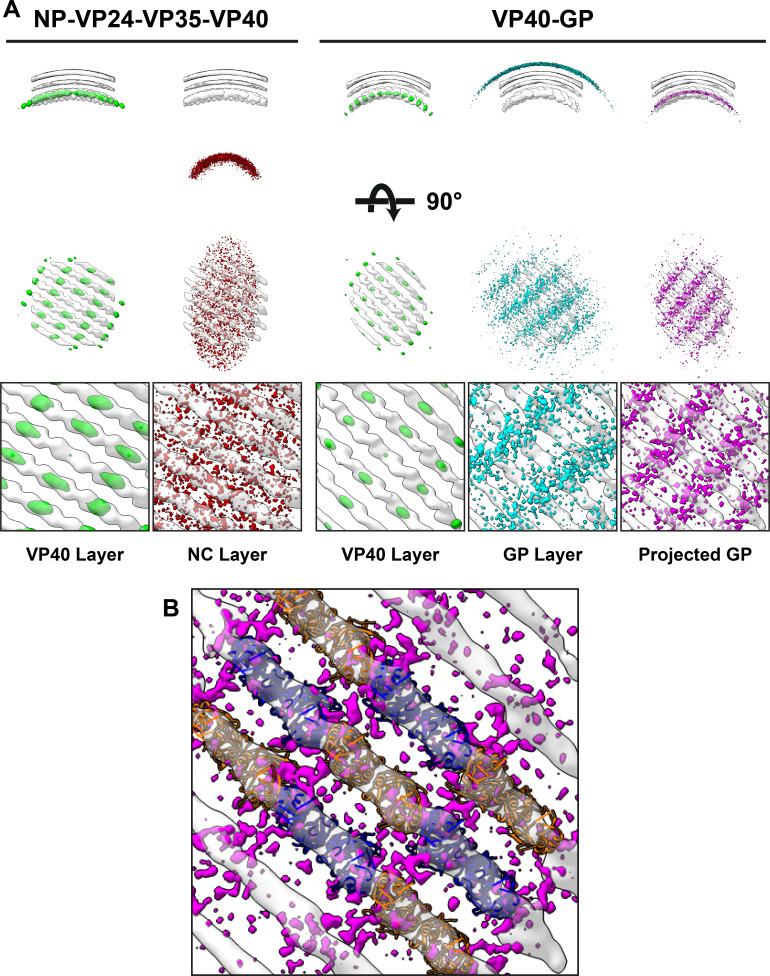
Filoviruses such as Ebola and Marburg virus bud from the host membrane as enveloped virions. This process is achieved by the matrix protein VP40. When expressed alone, VP40 induces budding of filamentous virus-like particles, suggesting that localization to the plasma membrane, oligomerization into a matrix layer, and generation of membrane curvature are intrinsic properties of VP40. There has been no direct information on the structure of VP40 matrix layers within viruses or virus-like particles. We present structures of Ebola and Marburg VP40 matrix layers in intact virus-like particles, and within intact Marburg viruses. VP40 dimers assemble extended chains via C-terminal domain interactions. These chains stack to form 2D matrix lattices below the membrane surface. These lattices form a patchwork assembly across the membrane and suggesting that assembly may begin at multiple points. Our observations define the structure and arrangement of the matrix protein layer that mediates formation of filovirus particles.
丝状病毒科,如埃博拉病毒和马尔堡病毒,通过包膜病毒从宿主膜出芽。这个过程是由基质蛋白 VP40 实现的。当单独表达时,VP40 诱导丝状病毒样颗粒的出芽,这表明定位到质膜、寡聚形成基质层以及产生膜曲率是 VP40 的内在特性。目前还没有关于病毒或病毒样颗粒内 VP40 基质层结构的直接信息。我们展示了完整的病毒样颗粒内以及完整的马尔堡病毒内的埃博拉病毒和马尔堡病毒 VP40 基质层的结构。VP40 二聚体通过 C 末端结构域相互作用组装成伸展链。这些链堆积形成位于膜表面下方的 2D 基质晶格。这些晶格在膜上形成一个拼凑的组装,并表明组装可能从多个点开始。我们的观察结果定义了介导丝状病毒颗粒形成的基质蛋白层的结构和排列。