Department of Urology, School of Medicine, Stanford University, Stanford, California.
Am J Physiol Renal Physiol. 2020 Nov 1;319(5):F876-F884. doi: 10.1152/ajprenal.00318.2020. Epub 2020 Oct 5.
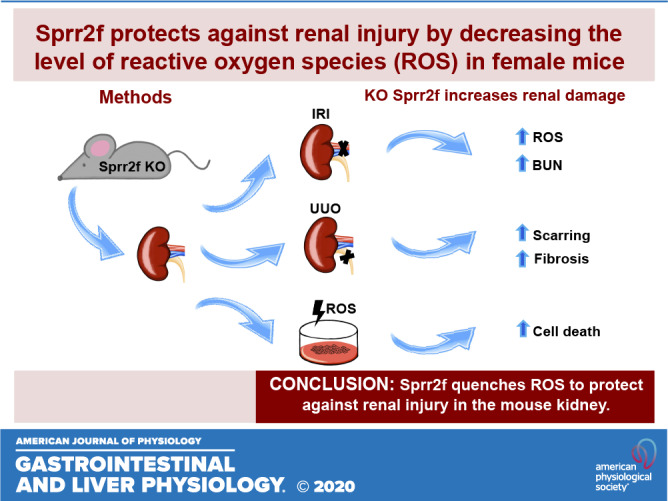
Renal injury leads to chronic kidney disease, with which women are not only more likely to be diagnosed than men but have poorer outcomes as well. We have previously shown that expression of small proline-rich region 2f (), a member of the small proline-rich region () gene family, is increased several hundredfold after renal injury using a unilateral ureteral obstruction (UUO) mouse model. To better understand the role of in renal injury, we generated a knockout (-KO) mouse model using CRISPR-Cas9 technology. -KO female mice showed greater renal damage after UUO compared with wild-type (-WT) animals, as evidenced by higher hydroxyproline levels and denser collagen staining, indicating a protective role of during renal injury. Gene expression profiling by RNA sequencing identified 162 genes whose expression levels were significantly different between and after UUO in -KO mice. Of the 162 genes, 121 genes were upregulated after UUO and enriched with those involved in oxidation-reduction, a phenomenon not observed in -WT animals, suggesting a protective role of in UUO through defense against oxidative damage. Consistently, bilateral ischemia-reperfusion injury resulted in higher serum blood urea nitrogen levels and higher tissue reactive oxygen species in -KO compared with -WT female mice. Moreover, cultured renal epithelial cells from -KO female mice showed lower viability after oxidative damage induced by menadione compared with -WT cells that could be rescued by supplementation with reduced glutathione, suggesting that induction after renal damage acts as a defense against reactive oxygen species.
肾脏损伤会导致慢性肾病,女性不仅比男性更容易被诊断出患有该病,而且预后也更差。我们之前已经证明,在单侧输尿管梗阻 (UUO) 小鼠模型中,小脯氨酸丰富区 2f () 的表达(属于小脯氨酸丰富区 () 基因家族的一员)在肾脏损伤后会增加数百倍。为了更好地了解 在肾脏损伤中的作用,我们使用 CRISPR-Cas9 技术生成了一个 敲除 (-KO) 小鼠模型。-KO 雌性小鼠在 UUO 后肾脏损伤比野生型 (-WT) 动物更严重,这表现在羟脯氨酸水平更高和胶原染色更密集,表明 在肾脏损伤期间具有保护作用。RNA 测序的基因表达谱分析确定了 162 个基因,这些基因在 -KO 小鼠的 UUO 后与 -WT 相比表达水平有显著差异。在这 162 个基因中,有 121 个基因在 UUO 后上调,并富集了与氧化还原相关的基因,这一现象在 -WT 动物中没有观察到,表明 在 UUO 中通过防御氧化损伤来发挥保护作用。一致地,双侧缺血再灌注损伤导致 -KO 雌性小鼠的血清尿素氮水平升高和组织活性氧水平升高,而 -WT 雌性小鼠则没有。此外,与 -WT 细胞相比,来自 -KO 雌性小鼠的肾上皮细胞在 Menadione 诱导的氧化损伤后活力较低,而补充还原型谷胱甘肽可挽救这种情况,这表明 诱导在肾脏损伤后可作为防御活性氧的作用。