
国际共识验证 POPI 工具(儿科:处方遗漏和不适当处方)以识别儿科中的不适当处方。
International consensus validation of the POPI tool (Pediatrics: Omission of Prescriptions and Inappropriate prescriptions) to identify inappropriate prescribing in pediatrics.
机构信息
Pharmacy Department, Robert-Debré Hospital, AP-HP, Paris, France.
Unité d'épidémiologie clinique, Hôpital Universitaire Robert Debré, AP-HP.Nord-Université de Paris, Inserm, CIC 1426, Paris, France.
出版信息
PLoS One. 2020 Oct 5;15(10):e0240105. doi: 10.1371/journal.pone.0240105. eCollection 2020.
INTRODUCTION
While drug prescription should be based on established recommendations stemming from clinical trials but in pediatrics, many drugs are used without marketing authorization. Consequently recommendations are often based on clinical experience and the risk of inappropriate prescription (IP) is high. A tool for detecting IP in pediatrics-called POPI (Pediatrics: Omission of Prescriptions and Inappropriate prescriptions)-has been developed in France. However the relevance of its use at an international level is not known. Our aim has been to adapt POPI for a worldwide use.
MATERIAL AND METHOD
A two-round Delphi online questionnaire was completed and validated by international experts to identify consensual items. They were asked to rate the validity of each items taking into account the recommendations and practices in their countries. Only propositions obtaining a median score in the upper tertile with an agreement of more than 75% of the panel-for the first round-and 85%-for the second round-were retained.
RESULTS
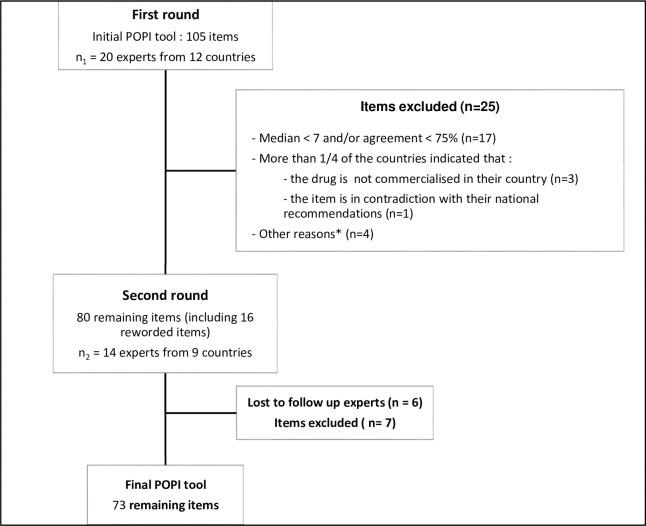
Our panel included 11 pharmacists (55%) and 9 physicians (45%). The panelists came from 12 different countries: England, Belgium, Brazil, Canada, China, Ivory Coast, Ireland, Malaysia, Portugal, Switzerland, Turkey and Vietnam. At the end of the first round, of the 105 items of the original POPI tool, 80 items were retained including 16 items reworded and 25 items were deleted. In the second round, 14 experts participated in the study. This final international POPI tool is composed of 73 IP and omissions of prescriptions in the fields of neuropsychiatry, dermatology, infectiology, pneumology, gastroenterology, pain and fever.
DISCUSSION AND CONCLUSION
This study highlights international consensus on prescription practice in pediatrics. The use of this tool in everyday practice could reduce the risk of inappropriate prescription. The impact of the diffusion of POPI tool will be assessed in a prospective multicentric study.
简介
虽然药物处方应基于临床试验得出的既定建议,但在儿科领域,许多药物在没有获得营销许可的情况下被使用。因此,建议往往基于临床经验,且不适当处方(IP)的风险很高。法国开发了一种用于检测儿科 IP 的工具,称为 POPI(儿科:处方遗漏和不适当处方)。然而,其在国际层面的使用相关性尚不清楚。我们的目标是使 POPI 适应全球使用。
材料与方法
通过两轮在线 Delphi 问卷调查,由国际专家完成并验证了共识项目。他们被要求根据其国家的建议和实践,对每个项目的有效性进行评分。只有在第一轮中获得中位数评分处于上 3 分位,且获得超过 75%专家小组一致性意见的建议,或在第二轮中获得中位数评分处于上 3 分位,且获得超过 85%专家小组一致性意见的建议才被保留。
结果
我们的专家组包括 11 名药剂师(55%)和 9 名医生(45%)。小组成员来自 12 个不同的国家:英国、比利时、巴西、加拿大、中国、科特迪瓦、爱尔兰、马来西亚、葡萄牙、瑞士、土耳其和越南。在第一轮结束时,原始 POPI 工具的 105 个项目中,有 80 个项目被保留,其中包括 16 个重新措辞的项目和 25 个被删除的项目。在第二轮中,有 14 名专家参与了研究。这个最终的国际 POPI 工具由 73 个 IP 和儿科神经精神病学、皮肤病学、传染病学、肺病学、胃肠病学、疼痛和发热领域的处方遗漏组成。
讨论与结论
本研究强调了儿科处方实践的国际共识。在日常实践中使用该工具可以降低不适当处方的风险。POPI 工具的传播效果将在一项前瞻性多中心研究中进行评估。
 Zotero 插件