Prot-Labarthe Sonia, Weil Thomas, Angoulvant François, Boulkedid Rym, Alberti Corinne, Bourdon Olivier
Pharmacie, AP-HP Hôpital Robert-Debré, Paris, France.
Pharmacie, AP-HP Hôpital Robert-Debré, Paris, France; Pharmacie Clinique, Université Paris Descartes, Paris, France.
PLoS One. 2014 Jun 30;9(6):e101171. doi: 10.1371/journal.pone.0101171. eCollection 2014.
Rational prescribing for children is an issue for all countries and has been inadequately studied. Inappropriate prescriptions, including drug omissions, are one of the main causes of medication errors in this population. Our aim is to develop a screening tool to identify omissions and inappropriate prescriptions in pediatrics based on French and international guidelines.
A selection of diseases was included in the tool using data from social security and hospital statistics. A literature review was done to obtain criteria which could be included in the tool called POPI. A 2-round-Delphi consensus technique was used to establish the content validity of POPI; panelists were asked to rate their level of agreement with each proposition on a 9-point Likert scale and add suggestions if necessary.
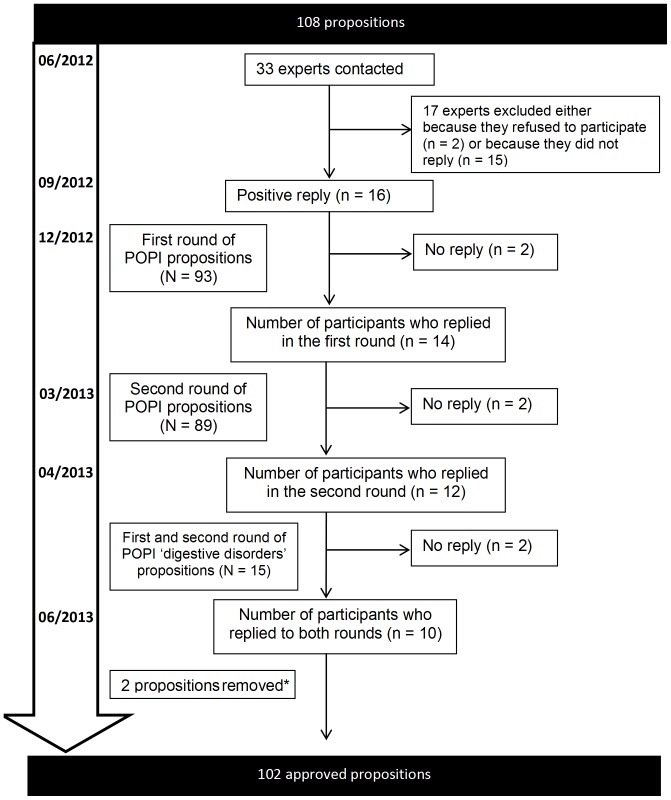
108 explicit criteria (80 inappropriate prescriptions and 28 omissions) were obtained and submitted to a 16-member expert panel (8 pharmacists, 8 pediatricians hospital-based -50%- or working in community -50%-). Criteria were categorized according to the main physiological systems (gastroenterology, respiratory infections, pain, neurology, dermatology and miscellaneous). Each criterion was accompanied by a concise explanation as to why the practice is potentially inappropriate in pediatrics (including references). Two round of Delphi process were completed via an online questionnaire. 104 out of the 108 criteria submitted to experts were selected after 2 Delphi rounds (79 inappropriate prescriptions and 25 omissions).
POPI is the first screening-tool develop to detect inappropriate prescriptions and omissions in pediatrics based on explicit criteria. Inter-user reliability study is necessary before using the tool, and prospective study to assess the effectiveness of POPI is also necessary.
儿童合理用药是所有国家都面临的问题,且相关研究尚不充分。不恰当的处方,包括用药遗漏,是该人群用药错误的主要原因之一。我们的目标是基于法国及国际指南开发一种筛查工具,以识别儿科用药中的遗漏和不恰当处方。
利用社会保障和医院统计数据,在工具中纳入一系列疾病。进行文献综述以获取可纳入名为POPI的工具的标准。采用两轮德尔菲共识技术来确定POPI的内容效度;要求小组成员在9点李克特量表上对每个命题的同意程度进行评分,并在必要时添加建议。
获得了108条明确标准(80条不恰当处方和28条遗漏),并提交给一个由16名专家组成的小组(8名药剂师、8名儿科医生,其中50%为医院儿科医生,50%为社区儿科医生)。标准根据主要生理系统(胃肠病学、呼吸道感染、疼痛、神经病学、皮肤病学及其他)进行分类。每个标准都附有关于该做法在儿科中可能不恰当的简要解释(包括参考文献)。通过在线问卷完成两轮德尔菲过程。两轮德尔菲之后,提交给专家的108条标准中有104条被选中(79条不恰当处方和25条遗漏)。
POPI是首个基于明确标准开发的用于检测儿科不恰当处方和遗漏的筛查工具。在使用该工具之前,有必要进行用户间可靠性研究,并且也有必要进行前瞻性研究以评估POPI的有效性。