Sheridan David C, Dehart Ryan, Lin Amber, Sabbaj Michael, Baker Steven D
Department of Emergency Medicine, Oregon Health & Science University, Portland, USA.
Center of Policy and Research in Emergency Medicine, Oregon Health & Science University, Portland, USA.
Psychiatry Investig. 2020 Sep;17(9):960-965. doi: 10.30773/pi.2020.0168. Epub 2020 Sep 18.
Heart rate variability (HRV) evaluates small beat-to-beat time interval (BBI) differences produced by the heart and suggested as a marker of the autonomic nervous system. Artifact produced by movement with wrist worn devices can significantly impact the validity of HRV analysis. The objective of this study was to determine the impact of small errors in BBI selection on HRV analysis and produce a foundation for future research in mental health wearable technology.
This was a sub-analysis from a prospective observational clinical trial registered with clinicaltrials.gov (NCT03030924). A cohort of 10 subject's HRV tracings from a wearable wrist monitor without any artifact were manipulated by the study team to represent the most common forms of artifact encountered.
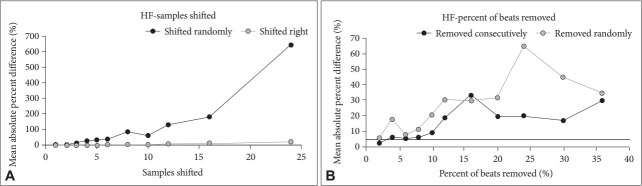
Root mean square of successive differences stayed below a clinically significant change when up to 5 beats were selected at the wrong time interval and up to 36% of BBIs was removed. Standard deviation of next normal intervals stayed below a clinically significant change when up to 3 beats were selected at the wrong time interval and up to 36% of BBIs were removed. High frequency HRV shows significant changes when more than 2 beats were selected at the wrong time interval and any BBIs were removed.
Time domain HRV metrics appear to be more robust to artifact compared to frequency domains. Investigators examining wearable technology for mental health should be aware of these values for future analysis of HRV studies to improve data quality.
心率变异性(HRV)评估心脏产生的逐搏微小时间间隔(BBI)差异,并被视为自主神经系统的一个指标。腕部佩戴设备因运动产生的伪迹会显著影响HRV分析的有效性。本研究的目的是确定BBI选择中的小误差对HRV分析的影响,并为未来心理健康可穿戴技术的研究奠定基础。
这是一项对在clinicaltrials.gov(NCT03030924)注册的前瞻性观察性临床试验的子分析。研究团队对10名受试者来自无任何伪迹的可穿戴腕部监测器的HRV记录进行处理,以呈现最常见的伪迹形式。
当在错误的时间间隔选择多达5个心搏且去除多达36%的BBI时,逐次差值的均方根保持在临床显著变化以下。当下一个正常心搏间期在错误的时间间隔选择多达3个心搏且去除多达36%的BBI时,其标准差保持在临床显著变化以下。当在错误的时间间隔选择超过2个心搏且去除任何BBI时,高频HRV显示出显著变化。
与频域相比,时域HRV指标似乎对伪迹更具鲁棒性。研究心理健康可穿戴技术的研究人员在未来进行HRV研究分析以提高数据质量时应了解这些数值。