Department of Obstetrics and Gynecology, Mount Sinai Hospital (Drs. Zakhari, Paek, Chan, Edwards, Solnik, and Murji); Department of Obstetrics & Gynecology, University of Toronto (Drs. Zakhari, Paek, Chan, Edwards, Solnik, and Murji); Department of XXX, McGill University Health Center, Montreal, Quebec (Dr. Zakhari), Canada.
Department of Obstetrics and Gynecology, Mount Sinai Hospital (Drs. Zakhari, Paek, Chan, Edwards, Solnik, and Murji); Department of Obstetrics & Gynecology, University of Toronto (Drs. Zakhari, Paek, Chan, Edwards, Solnik, and Murji).
J Minim Invasive Gynecol. 2021 May;28(5):1006-1012.e1. doi: 10.1016/j.jmig.2020.09.019. Epub 2020 Oct 3.
To evaluate whether retrofilling the bladder on completion of elective laparoscopic gynecologic surgery for benign indications has an effect on the timing of the first postoperative void and the timing of discharge from the hospital.
Double-blind randomized controlled trial.
Single academic surgical day hospital.
Patients undergoing outpatient laparoscopic gynecologic surgery, excluding hysterectomy or pelvic reconstructive surgery.
On completion of surgery, patients were randomized to either retrograde filling of the bladder with 200 mL of saline before catheter removal or standard care (immediate catheter removal). Patients and postanesthesia care unit nurses (outcome assessors) were both blinded.
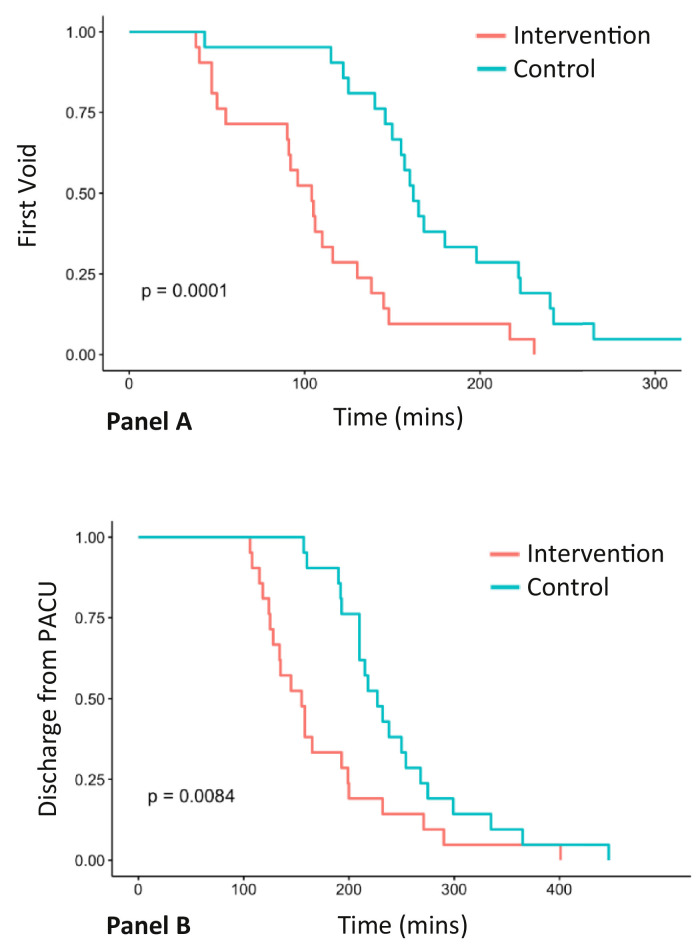
The primary outcome was the time to first void. The secondary outcomes were time to hospital discharge, postoperative urinary tract infection, and patient satisfaction. Over a 3-month period, 47 patients were approached on the day of surgery, 42 consented and were randomized (21 to intervention and 21 to control). There were no significant differences in baseline demographics between the groups. The median time to first void was significantly shorter for patients in the intervention arm than controls (104 ± 75 minutes vs 162 ± 76 minutes, p <.001). Patients who had retrofilled bladders were discharged faster from post-anesthesia care unit compared to controls (155.0 ± 74 minutes vs 227 ± 58 minutes, p = .001). There were no urinary tract infections in either group, and the proportion of satisfied or very satisfied patients was high (93.8% vs 88.2%, p = .512).
Retrograde filling of the bladder after outpatient laparoscopic gynecologic surgery is a safe, effective method that significantly reduces the length of hospital stay.
评估在择期腹腔镜妇科良性手术完成时对膀胱进行逆行填充是否会影响首次术后排尿时间和出院时间。
双盲随机对照试验。
单学术手术日医院。
接受门诊腹腔镜妇科手术的患者,不包括子宫切除术或盆腔重建手术。
手术完成后,患者随机分为在拔除导尿管前用 200 毫升生理盐水逆行填充膀胱或标准护理(立即拔除导尿管)。患者和麻醉后护理单元护士(结果评估者)均被蒙蔽。
主要结果是首次排尿时间。次要结果是出院时间、术后尿路感染和患者满意度。在 3 个月期间,在手术当天有 47 名患者被接触,42 名同意并被随机分组(干预组 21 名,对照组 21 名)。两组患者的基线人口统计学特征无显著差异。干预组患者首次排尿时间明显短于对照组(104 ± 75 分钟比 162 ± 76 分钟,p<0.001)。与对照组相比,膀胱逆行填充的患者从麻醉后护理单元更快出院(155.0 ± 74 分钟比 227 ± 58 分钟,p=0.001)。两组均无尿路感染,满意或非常满意的患者比例较高(93.8%比 88.2%,p=0.512)。
在门诊腹腔镜妇科手术后对膀胱进行逆行填充是一种安全、有效的方法,可以显著缩短住院时间。