Cho Hyun Wook, Jang Donghwan, Jun Hyo Sub
Department of Neurosurgery, Kangwon National University Hospital, Chuncheon, Korea.
Department of Neurosurgery, Kangwon National University College of Medicine, Chuncheon, Korea.
J Cerebrovasc Endovasc Neurosurg. 2021 Jun;23(2):117-122. doi: 10.7461/jcen.2020.E2020.08.004. Epub 2020 Oct 6.
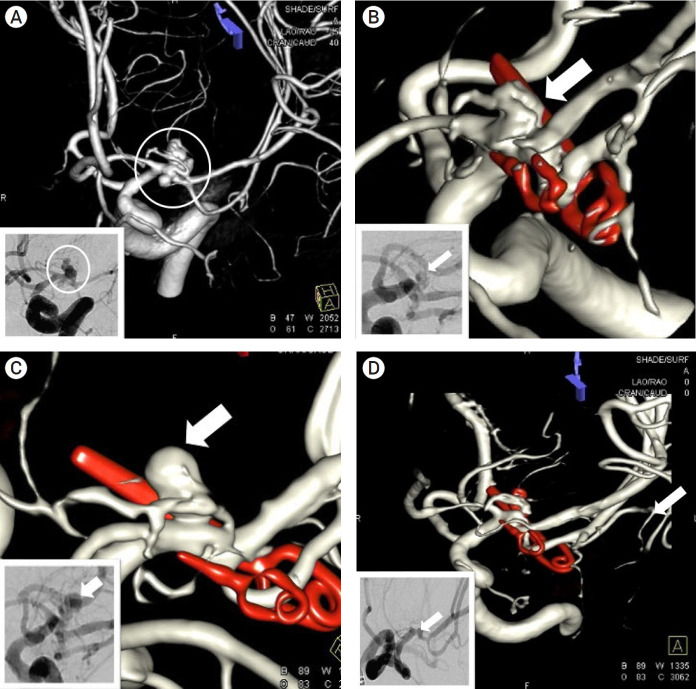
We report two rare cases treated with coiling after rapid regrowth (within a month) of an aneurysm remnant on the middle cerebral artery (MCA) trunk after incomplete surgical clipping. The first case, a 47-year-old man with subarachonoid hemorrhage (SAH) (Hunt-Hess grade II, Fisher grade III) underwent clipping of a ruptured saccular aneurysm with a wide neck on the right early frontal branch arising from the MCA trunk. Incomplete clipping with a 1 mm sized remnant neck was performed to avoid sacrificing the lenticulostriate artery. In a follow-up cerebral angiogram on postoperative day 30, a rapid regrowth of the aneurysm remnant was observed, and on that day, complete obliteration was obtained by rescue endovascular treatment. The second case, a 48-year-old healthy woman with SAH (Hunt-Hess grade II, Fisher grade III) underwent clipping of an anteroposteriorly projecting bilobulated aneurysm on the left M1. Incomplete clipping with a minimal remnant neck was performed. In follow-up digital subtraction angiogram on postoperative day 30, a rapid regrowth of an aneurysm remnant involving only a part of the initial aneurysm near the neck was observed, and on that day, complete obliteration was obtained by rescue coiling. These patients were both discharged without any neurological deficits.
我们报告了两例罕见病例,这两例患者均在大脑中动脉(MCA)主干动脉瘤残端在手术夹闭不完全后快速再生长(1个月内)后接受了弹簧圈栓塞治疗。第一例,一名47岁男性,患有蛛网膜下腔出血(SAH)(Hunt-Hess分级II级,Fisher分级III级),接受了对起源于MCA主干的右侧早期额叶分支处一个宽颈破裂囊状动脉瘤的夹闭手术。为避免牺牲豆纹动脉,进行了不完全夹闭,残留一个1毫米大小的瘤颈。在术后第30天的随访脑血管造影中,观察到动脉瘤残端快速再生长,就在当天,通过挽救性血管内治疗实现了完全闭塞。第二例,一名48岁健康女性,患有SAH(Hunt-Hess分级II级,Fisher分级III级),接受了对左侧M1段一个前后突出的双叶状动脉瘤的夹闭手术。进行了不完全夹闭,残留极小的瘤颈。在术后第30天的随访数字减影血管造影中,观察到动脉瘤残端快速再生长,仅累及靠近瘤颈的初始动脉瘤的一部分,就在当天,通过挽救性弹簧圈栓塞实现了完全闭塞。这两名患者均无任何神经功能缺损出院。