Food Security and Safety Niche Area, Faculty of Natural and Agricultural Sciences, North-West University, Private Bag X2046, Mmabatho 2745, South Africa.
Oyo State College of Agriculture and Technology, P.M.B. 10, Igboora, Oyo State, Nigeria.
Int J Environ Res Public Health. 2020 Oct 1;17(19):7188. doi: 10.3390/ijerph17197188.
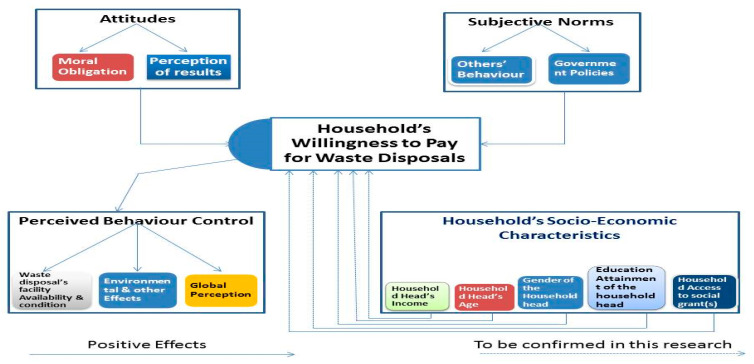
Safeguarding the environment and its citizens' health remains one of the key policy priorities of the governments of many developing and emerging countries. Using the 2017 General Household Survey (GHS) dataset, this study examines the driving factors affecting households' recycling behaviour and payment for waste disposal in South Africa. The methods of data analysis were based on descriptive statistics and a Bivariate Probit regression model. The descriptive statistics results indicate that there are 56.29% male-headed and 43.71% female headed households, with an average age of 49 years. In addition, the study shows that 89.97% of household heads had formal education with a mean monthly income of 11,099.07 ZAR/650.504 USD. The study also revealed that 22% of the households sampled had access to social grants. The results from the Bivariate Probit regression model show that household's income, access to social grants, formal educational attainment and the age of the household were significant ( < 0.01) driving factors affecting households' recycling behaviour and payment for waste disposal. The study concludes that the households' socio-economic factors affect their recycling behaviour and willingness to pay for waste management in South Africa. Actions targeted at poverty alleviation and environmental sensitization programmes are key for facilitating environmental conservation behaviours of households in South Africa in order to achieve the environmental sustainability Sustainable Development Goal (SDG) target of the United Nations.
保护环境和公民健康仍然是许多发展中国家和新兴国家政府的主要政策重点之一。本研究利用 2017 年全国家庭调查(GHS)数据集,考察了影响南非家庭回收行为和支付垃圾处理费用的驱动因素。数据分析方法基于描述性统计和双变量 Probit 回归模型。描述性统计结果表明,有 56.29%的家庭由男性户主领导,43.71%的家庭由女性户主领导,平均年龄为 49 岁。此外,研究表明,89.97%的家庭户主接受过正规教育,平均月收入为 11099.07 南非兰特/650.504 美元。研究还显示,22%的抽样家庭可以获得社会补助金。双变量 Probit 回归模型的结果表明,家庭收入、获得社会补助金、正规教育程度和家庭年龄是影响家庭回收行为和支付垃圾处理费用的重要(<0.01)驱动因素。研究得出结论,家庭的社会经济因素影响他们在南非的回收行为和支付垃圾管理费用的意愿。针对减贫和环境敏感化计划的行动是促进南非家庭环保行为的关键,以实现联合国环境可持续性可持续发展目标(SDG)的目标。