Division of Gastroenterology and Hepatology, Department of Medicine, Indiana University School of Medicine, Indianapolis, IN, USA.
Department of Science and Mathematics, Texas A&M University - Central Texas, Killeen, TX, USA.
J Pineal Res. 2021 Mar;70(2):e12699. doi: 10.1111/jpi.12699. Epub 2020 Nov 29.
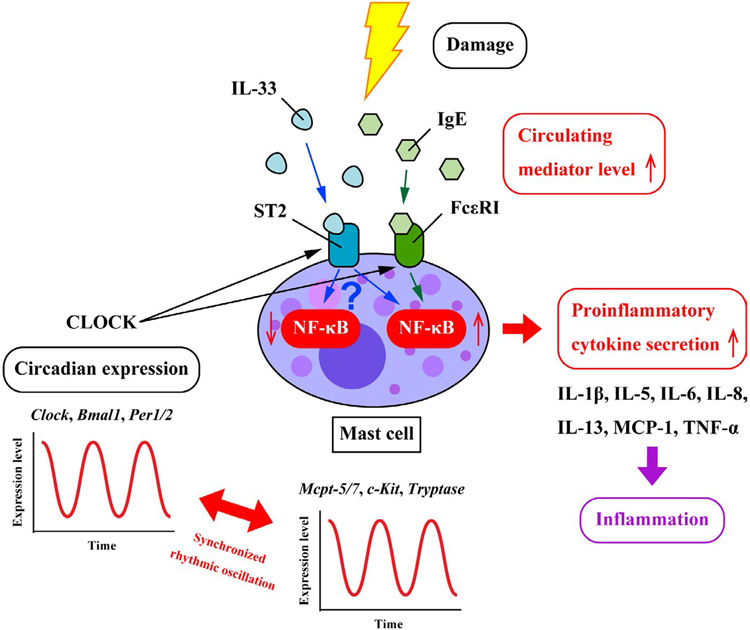
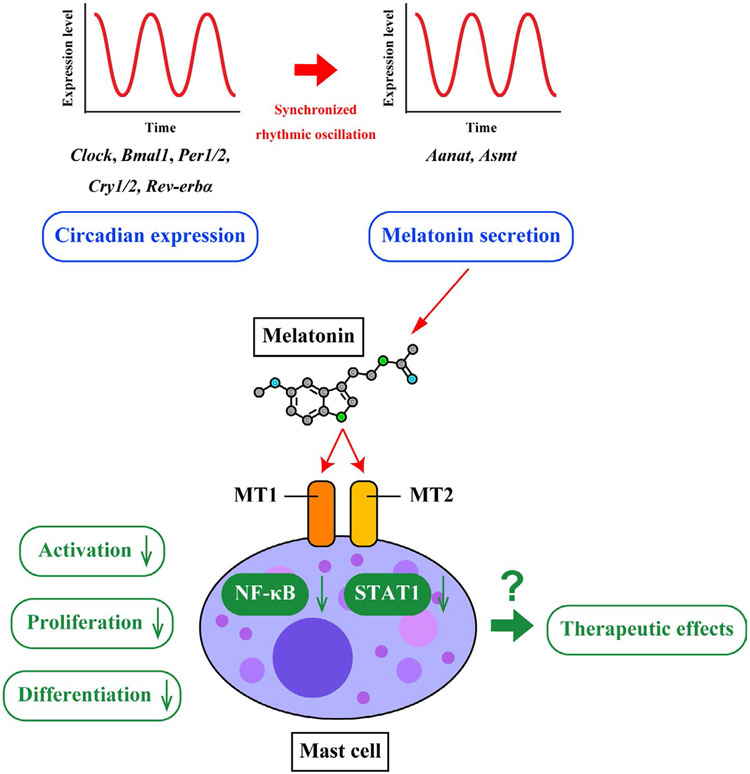
Our daily rhythmicity is controlled by a circadian clock with a specific set of genes located in the suprachiasmatic nucleus in the hypothalamus. Mast cells (MCs) are major effector cells that play a protective role against pathogens and inflammation. MC distribution and activation are associated with the circadian rhythm via two major pathways, IgE/FcεRI- and IL-33/ST2-mediated signaling. Furthermore, there is a robust oscillation between clock genes and MC-specific genes. Melatonin is a hormone derived from the amino acid tryptophan and is produced primarily in the pineal gland near the center of the brain, and histamine is a biologically active amine synthesized from the decarboxylation of the amino acid histidine by the L-histidine decarboxylase enzyme. Melatonin and histamine are previously reported to modulate circadian rhythms by pathways incorporating various modulators in which the nuclear factor-binding near the κ light-chain gene in B cells, NF-κB, is the common key factor. NF-κB interacts with the core clock genes and disrupts the production of pro-inflammatory cytokine mediators such as IL-6, IL-13, and TNF-α. Currently, there has been no study evaluating the interdependence between melatonin and histamine with respect to circadian oscillations in MCs. Accumulating evidence suggests that restoring circadian rhythms in MCs by targeting melatonin and histamine via NF-κB may be promising therapeutic strategy for MC-mediated inflammatory diseases. This review summarizes recent findings for circadian-mediated MC functional roles and activation paradigms, as well as the therapeutic potentials of targeting circadian-mediated melatonin and histamine signaling in MC-dependent inflammatory diseases.
我们的日常节律受生物钟控制,生物钟的特定基因位于下丘脑的视交叉上核。肥大细胞 (MCs) 是主要的效应细胞,在对抗病原体和炎症方面发挥着保护作用。MC 的分布和激活与昼夜节律通过两条主要途径相关,即 IgE/FcεRI- 和 IL-33/ST2 介导的信号转导。此外,时钟基因和 MC 特异性基因之间存在强大的振荡。褪黑素是一种源自色氨酸的激素,主要由脑中心附近的松果体产生,组胺是一种由氨基酸组氨酸脱羧酶酶催化脱羧生成的生物活性胺。褪黑素和组胺先前被报道通过包含各种调节剂的途径来调节昼夜节律,其中核因子结合在 B 细胞 κ 轻链基因附近,NF-κB 是共同的关键因素。NF-κB 与核心时钟基因相互作用,破坏促炎细胞因子介质的产生,如 IL-6、IL-13 和 TNF-α。目前,尚无研究评估褪黑素和组胺之间在 MC 昼夜波动方面的相互依存关系。越来越多的证据表明,通过 NF-κB 靶向褪黑素和组胺来恢复 MC 中的昼夜节律可能是一种有前途的 MC 介导炎症性疾病的治疗策略。这篇综述总结了最近关于昼夜节律调节 MC 功能作用和激活模式的发现,以及靶向昼夜节律调节的褪黑素和组胺信号在 MC 依赖性炎症性疾病中的治疗潜力。