Division of Cardiology, Department of Internal Medicine II, Medical University of Vienna, Vienna, Austria.
Ludwig Boltzmann Cluster for Cardiovascular Research, Vienna, Austria.
J Leukoc Biol. 2021 Jun;109(6):1139-1146. doi: 10.1002/JLB.5A0420-231RR. Epub 2020 Oct 5.
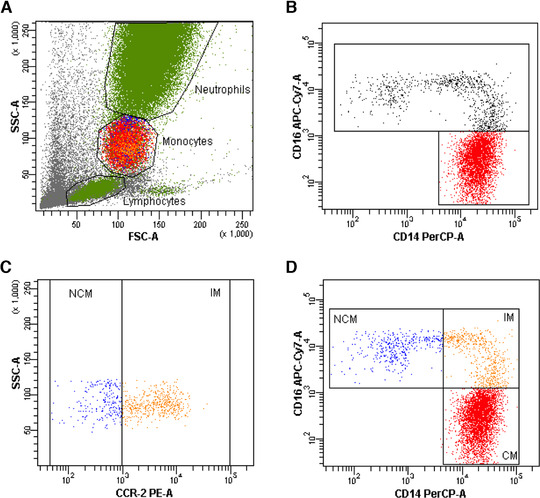
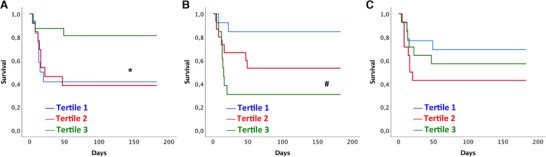
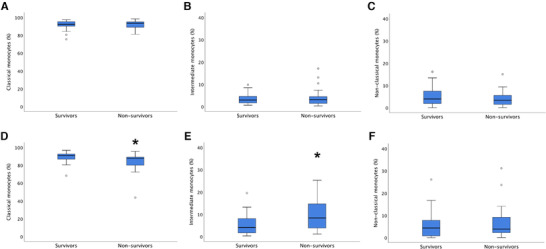
After successful cardiopulmonary resuscitation (CPR), many patients show signs of an overactive immune activation. Monocytes are a heterogeneous cell population that can be distinguished into 3 subsets by flow cytometry (classical monocytes [CM: CD14 CD16 ], intermediate monocytes [IM: CD14 CD16 CCR2 ] and non-classical monocytes [NCM: CD14 CD16 CCR2 ]). Fifty-three patients admitted to the medical intensive care unit (ICU) after cardiac arrest were included. Blood was taken on admission and after 72 h. The primary endpoint of this study was survival at 6 months and the secondary endpoint was neurological outcome as determined by cerebral performance category (CPC)-score at 6 months. Median age was 64.5 (49.8-74.3) years and 75.5% were male. Six-month mortality was 50.9% and survival with good neurological outcome was 37.7%. Monocyte subset distribution upon admission to the ICU did not differ according to survival. Seventy-two hours after admission, patients who died within 6 months showed a higher percentage of the pro-inflammatory subset of IM (8.3% [3.8-14.6]% vs. 4.1% [1.5-8.2]%; P = 0.025), and a lower percentage of CM (87.5% [79.9-89.0]% vs. 90.8% [85.9-92.7]%; P = 0.036) as compared to survivors. In addition, IM were predictive of outcome independent of time to ROSC and witnessed cardiac arrest, and correlated with CPC-score at 6 months (R = 0.32; P = 0.043). These findings suggest a possible role of the innate immune system in the pathophysiology of post cardiac arrest syndrome.
心肺复苏(CPR)成功后,许多患者表现出过度活跃的免疫激活迹象。单核细胞是一种异质性细胞群,可以通过流式细胞术(经典单核细胞[CM:CD14 CD16]、中间单核细胞[IM:CD14 CD16 CCR2]和非经典单核细胞[NCM:CD14 CD16 CCR2])分为 3 个亚群。本研究纳入了 53 例心脏骤停后入住重症监护病房(ICU)的患者。在入院时和 72 小时时采集血液。本研究的主要终点是 6 个月时的存活率,次要终点是 6 个月时通过脑功能分类(CPC)评分确定的神经功能结局。中位年龄为 64.5(49.8-74.3)岁,75.5%为男性。6 个月死亡率为 50.9%,生存且神经功能良好的比例为 37.7%。入住 ICU 时单核细胞亚群分布与存活率无差异。入院后 72 小时,6 个月内死亡的患者表现出更高比例的促炎型中间单核细胞亚群(8.3%[3.8-14.6]%比 4.1%[1.5-8.2]%;P=0.025),以及更低比例的经典单核细胞亚群(87.5%[79.9-89.0]%比 90.8%[85.9-92.7]%;P=0.036)。此外,中间单核细胞是除了 ROSC 时间和目击性心脏骤停以外,预测结局的独立因素,与 6 个月时的 CPC 评分相关(R=0.32;P=0.043)。这些发现提示固有免疫系统可能在心脏骤停后综合征的病理生理学中发挥作用。