Juul Rasmussen Ida, Rasmussen Katrine Laura, Nordestgaard Børge G, Tybjærg-Hansen Anne, Frikke-Schmidt Ruth
Department of Clinical Biochemistry, Rigshospitalet, Copenhagen University Hospital, Blegdamsvej 9, DK-2100 Copenhagen, Denmark.
The Copenhagen General Population Study, Herlev and Gentofte Hospital, Copenhagen University Hospital, Borgmester Ib Juuls Vej 1, DK-2730 Herlev, Denmark.
Eur Heart J. 2020 Nov 1;41(41):4024-4033. doi: 10.1093/eurheartj/ehaa695.
Dementia is a major global challenge for health and social care in aging populations. A third of all dementia may be preventable due to cardiovascular risk factors. Intensive multi-domain intervention trials targeting primarily cardiovascular risk factors show improved cognitive function in people at risk. Such interventions will, however, be expensive to implement in all individuals at risk and will represent unrealistic economic tasks for most societies. Therefore, a risk score identifying high-risk individuals is warranted.
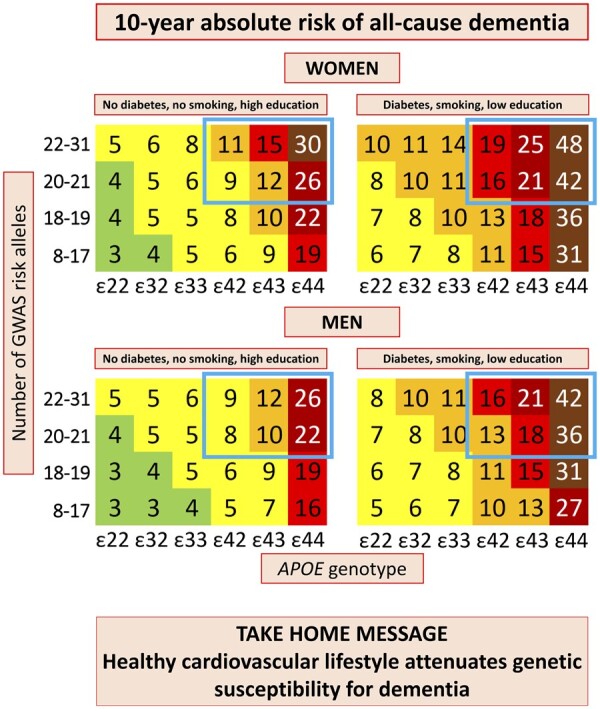
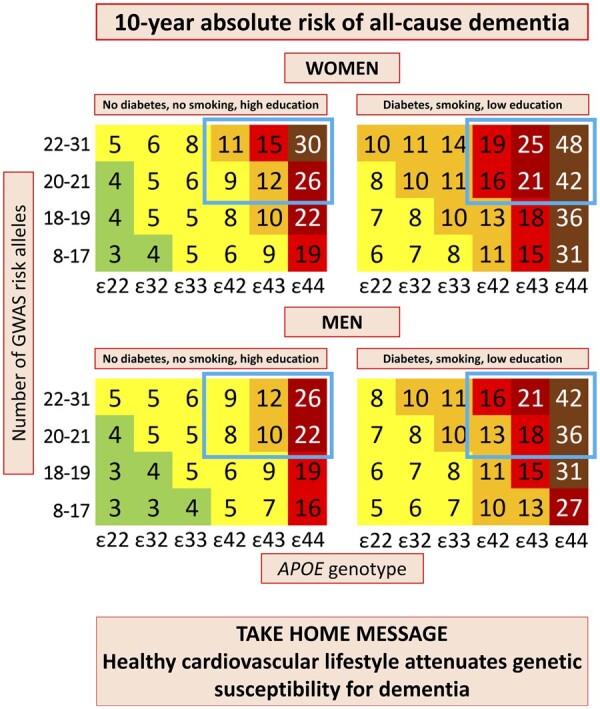
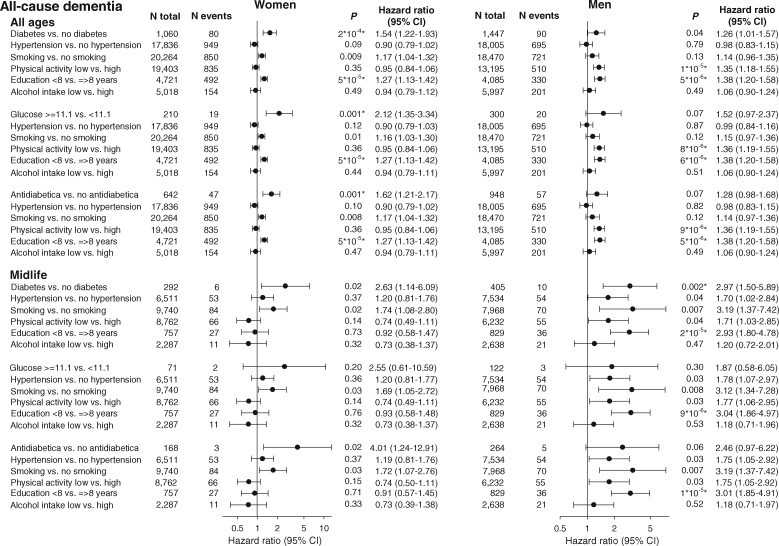
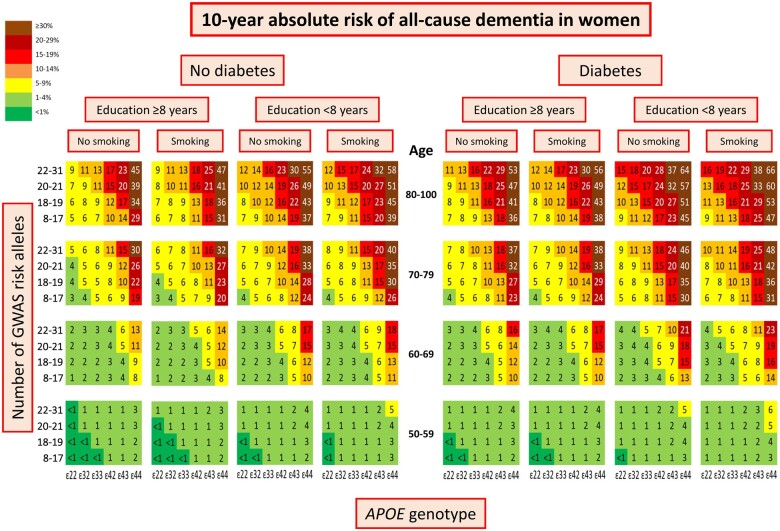
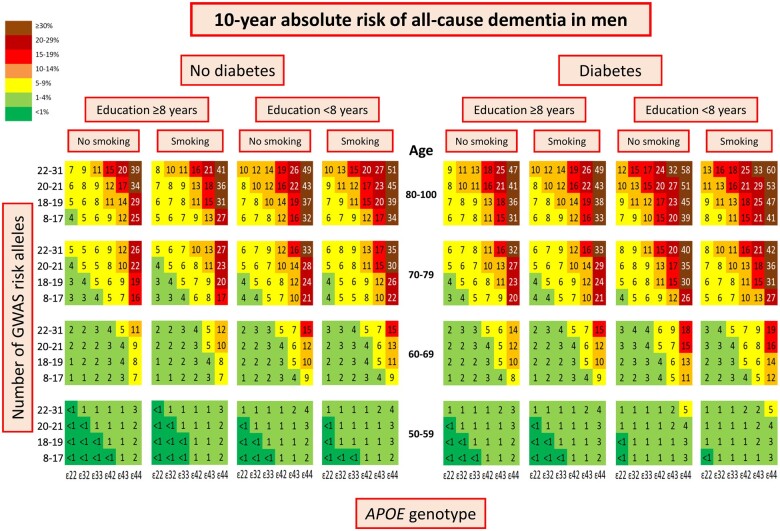
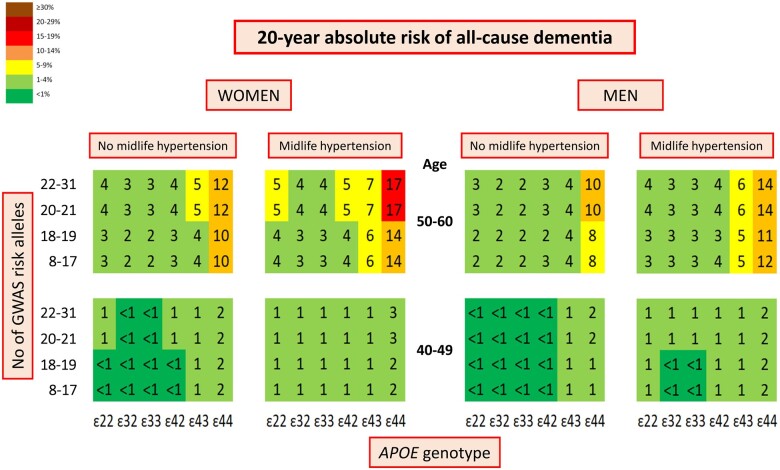
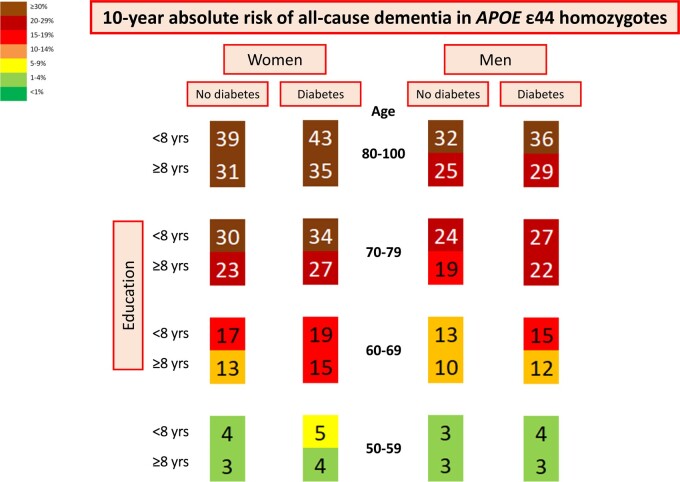
In 61 664 individuals from two prospective cohorts of the Danish general population, we generated 10-year absolute risk scores for all-cause dementia from cardiovascular risk factors and genetics. In both sexes, 10-year absolute risk of all-cause dementia increased with increasing age, number of apolipoprotein E (APOE) ɛ4 alleles, number of genome-wide association studies (GWAS) risk alleles, and cardiovascular risk factors. The highest 10-year absolute risks of all-cause dementia seen in smoking women with diabetes, low education, APOE ɛ44 genotype, and 22-31 GWAS risk alleles were 6%, 23%, 48%, and 66% in those aged 50-59, 60-69, 70-79, and 80-100, respectively. Corresponding values for men were 5%, 19%, 42%, and 60%, respectively.
Ten-year absolute risk of all-cause dementia increased with age, APOE ɛ4 alleles, GWAS risk alleles, diabetes, low education, and smoking in both women and men. Ten-year absolute risk charts for dementia will facilitate identification of high-risk individuals, those who likely will benefit the most from an early intervention against cardiovascular risk factors.
痴呆是老龄化人口健康和社会护理面临的一项重大全球性挑战。由于心血管危险因素,三分之一的痴呆可能是可预防的。主要针对心血管危险因素的强化多领域干预试验表明,有风险人群的认知功能得到改善。然而,在所有有风险的个体中实施此类干预措施成本高昂,对大多数社会来说将是不切实际的经济任务。因此,有必要制定一个识别高危个体的风险评分。
在来自丹麦普通人群两个前瞻性队列的61664名个体中,我们根据心血管危险因素和基因生成了全因痴呆的10年绝对风险评分。在男性和女性中,全因痴呆的10年绝对风险均随着年龄增长、载脂蛋白E(APOE)ε4等位基因数量、全基因组关联研究(GWAS)风险等位基因数量以及心血管危险因素的增加而升高。在患有糖尿病、低教育水平、APOE ε44基因型且有22 - 31个GWAS风险等位基因的吸烟女性中,50 - 59岁、60 - 69岁、70 - 79岁和80 - 100岁人群的全因痴呆10年绝对风险最高分别为6%、23%、48%和66%。男性的相应数值分别为5%、19%、42%和60%。
男性和女性全因痴呆的10年绝对风险均随着年龄、APOE ε4等位基因、GWAS风险等位基因、糖尿病、低教育水平和吸烟而增加。痴呆的10年绝对风险图表将有助于识别高危个体,即那些可能从针对心血管危险因素的早期干预中获益最大的人。