Danish Dementia Research Centre, Department of Neurology, Copenhagen University Hospital- Rigshospitalet, Copenhagen, Denmark.
Section of General Practice, Department of Public Health, University of Copenhagen, Copenhagen, Denmark.
BMC Geriatr. 2024 Jan 11;24(1):53. doi: 10.1186/s12877-024-04675-1.
This study aims to evaluate the diagnostic accuracy and reliability of a new, brief questionnaire, 'Brief Assessment of Impaired Cognition- Questionnaire' (BASIC-Q) for detection of cognitive impairment, primarily developed for use in primary care. BASIC-Q has three components: Self-report, Informant report, and Orientation. Self-report and Orientation are completed by the individual and Informant report is answered by a close relative.
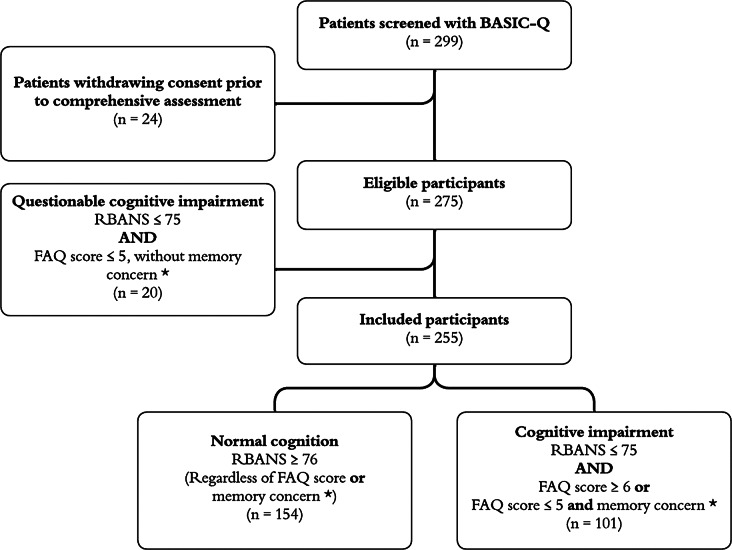
We included 275 participants ≥ 70 years, without a prior diagnosis of dementia, and with a close relative who agreed to participate as an informant. Participants were included prospectively in 14 general practices in urban and rural Denmark using a convenience sampling method. The Repeatable Battery for the Assessment of Neuropsychological Status (RBANS), the informant-completed Functional Activities Questionnaire (FAQ) and reported memory concern were used as a reference standard for the classification of the participants' cognitive function.
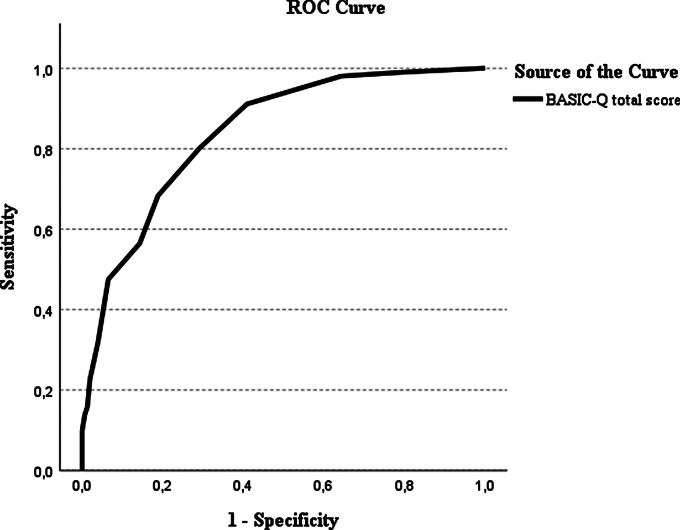
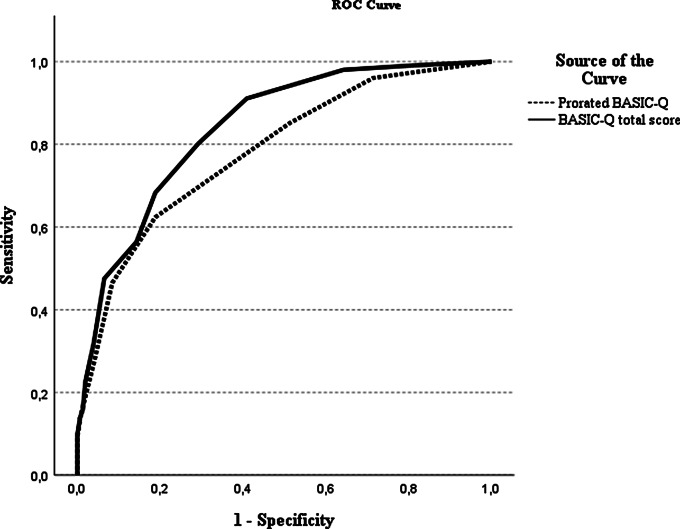
BASIC-Q demonstrated a fair to good diagnostic accuracy to differentiate between people with cognitive impairment and normal cognition with an area under the ROC curve (AUC) of 0.84 (95% CI 0.79-0.89) and a sensitivity and specificity of 0.80 (95% CI 0.72-0.87) and 0.71 (95% CI 0.63-0.78). A prorated BASIC-Q score derived from BASIC-Q without Informant report had significantly lower classification accuracy than the full BASIC-Q. The test-retest reliability of BASIC-Q was good with an intraclass correlation coefficient of 0.84.
BASIC-Q is a brief, easy-to-use questionnaire for identification of cognitive impairment in older adults. It demonstrated fair to good classification accuracy in a general practice setting and can be a useful case-finding tool when suspecting dementia in primary health care.
本研究旨在评估一种新的简短问卷——“认知障碍简易评估问卷”(BASIC-Q)的诊断准确性和可靠性,该问卷主要用于初级保健,用于检测认知障碍。BASIC-Q 有三个组成部分:自我报告、知情者报告和定向力。自我报告和定向力由个人完成,知情者报告由近亲回答。
我们纳入了 275 名年龄≥70 岁、无痴呆既往诊断且有近亲同意作为知情者参与的参与者。参与者前瞻性地纳入丹麦城乡的 14 家普通诊所,采用便利抽样法。重复认知评估成套测验(RBANS)、知情者完成的功能活动问卷(FAQ)和报告的记忆问题被用作参与者认知功能分类的参考标准。
BASIC-Q 区分认知障碍和正常认知的诊断准确性为中等至良好,ROC 曲线下面积(AUC)为 0.84(95%CI 0.79-0.89),灵敏度和特异度分别为 0.80(95%CI 0.72-0.87)和 0.71(95%CI 0.63-0.78)。没有知情者报告的简化 BASIC-Q 评分的区分准确性显著低于完整 BASIC-Q。BASIC-Q 的测试-重测信度良好,组内相关系数为 0.84。
BASIC-Q 是一种用于识别老年人认知障碍的简短、易用的问卷。它在普通诊所环境中具有中等至良好的分类准确性,可以成为初级保健中怀疑痴呆时的有用病例发现工具。