
脂质体递送阿奇霉素增强其免疫治疗效果并降低心肌梗死的毒性。
Liposomal delivery of azithromycin enhances its immunotherapeutic efficacy and reduces toxicity in myocardial infarction.
机构信息
Gill Heart and Vascular Institute and Division of Cardiovascular Medicine, University of Kentucky, Lexington, KY, USA.
College of Pharmacy, University of Kentucky, Lexington, KY, USA.
出版信息
Sci Rep. 2020 Oct 6;10(1):16596. doi: 10.1038/s41598-020-73593-0.
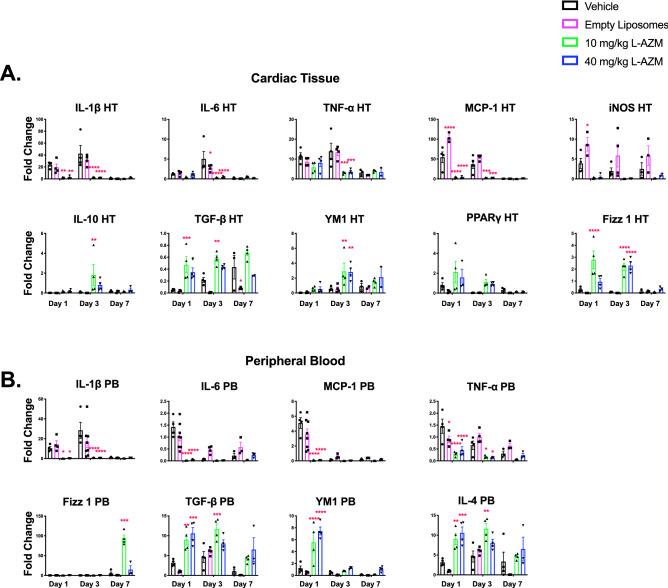
A growing body of evidence shows that altering the inflammatory response by alternative macrophage polarization is protective against complications related to acute myocardial infarction (MI). We have previously shown that oral azithromycin (AZM), initiated prior to MI, reduces inflammation and its negative sequelae on the myocardium. Here, we investigated the immunomodulatory role of a liposomal AZM formulation (L-AZM) in a clinically relevant model to enhance its therapeutic potency and avoid off-target effects. L-AZM (40 or 10 mg/kg, IV) was administered immediately post-MI and compared to free AZM (F-AZM). L-AZM reduced cardiac toxicity and associated mortality by 50% in mice. We observed a significant shift favoring reparatory/anti-inflammatory macrophages with L-AZM formulation. L-AZM use resulted in a remarkable decrease in cardiac inflammatory neutrophils and the infiltration of inflammatory monocytes. Immune cell modulation was associated with the downregulation of pro-inflammatory genes and the upregulation of anti-inflammatory genes. The immunomodulatory effects of L-AZM were associated with a reduction in cardiac cell death and scar size as well as enhanced angiogenesis. Overall, L-AZM use enhanced cardiac recovery and survival after MI. Importantly, L-AZM was protective from F-AZM cardiac off-target effects. We demonstrate that the liposomal formulation of AZM enhances the drug's efficacy and safety in an animal model of acute myocardial injury. This is the first study to establish the immunomodulatory properties of liposomal AZM formulations. Our findings strongly support clinical trials using L-AZM as a novel and clinically relevant therapeutic target to improve cardiac recovery and reduce heart failure post-MI in humans.
越来越多的证据表明,通过改变巨噬细胞的极化来改变炎症反应,可以预防与急性心肌梗死(MI)相关的并发症。我们之前已经表明,在 MI 之前口服阿奇霉素(AZM)可以减少炎症及其对心肌的负面影响。在这里,我们研究了脂质体 AZM 制剂(L-AZM)在临床相关模型中的免疫调节作用,以增强其治疗效力并避免脱靶效应。L-AZM(40 或 10mg/kg,IV)在 MI 后立即给药,并与游离 AZM(F-AZM)进行比较。L-AZM 使小鼠的心脏毒性和相关死亡率降低了 50%。我们观察到 L-AZM 制剂明显偏向于修复/抗炎巨噬细胞。L-AZM 的使用导致心脏炎症中性粒细胞和炎症单核细胞浸润显著减少。免疫细胞调节与促炎基因下调和抗炎基因上调相关。L-AZM 的免疫调节作用与心脏细胞死亡和疤痕面积减少以及血管生成增强有关。总的来说,L-AZM 的使用增强了 MI 后心脏的恢复和存活。重要的是,L-AZM 可预防 F-AZM 的心脏脱靶效应。我们证明,AZM 的脂质体制剂在急性心肌损伤的动物模型中增强了药物的疗效和安全性。这是第一项研究脂质体 AZM 制剂的免疫调节特性的研究。我们的研究结果强烈支持使用 L-AZM 作为一种新的、临床相关的治疗靶点,以改善人类 MI 后心脏恢复和减少心力衰竭的临床试验。


 Zotero 插件